
Designed in Code. Engineered to Rank.
ARCHITECTING HIGH-PERFORMANCE WEBSITES FOR THE AI SEARCH ERA
Fast websites don’t just look good. They dominate search, convert traffic, and drive revenue. Utilizing the Free Bird Protocol for uncompromising speed optimization, I engineer custom digital platforms. By merging precise AEO with intuitive UX Architecture, I build infrastructures that do more than just perform. They are meticulously engineered to rank and scale. Rooted in accessibility, rigorous compliance, and semantic aesthetics, Project Phoenix drives the core of my design and development architecture.
Architecture & Engineering
- AI Web Development
- Answer Engine Opt. (AEO)
- AI Agentic Optimization
- Technical SEO Services
- WordPress Services
- CMS Development
- UX Design Services
Performance Packages
- Foundation: Asset staging & metric evaluation.
- Accelerated: Premium core engine pruning.
- Elite: Complete multi-layer database overhaul.
Core Engineering & Web Performance Expertise
Bridging the gap between intuitive UX architecture and elite technical performance.

Website Performance
Optimizing your website to load instantly so customers never walk away.

AI-Powered Growth Strategy
Building fast, modern websites that look flawless on any screen.

Smart Search & Technical Ranking
Optimizing for visibility and ranking in modern search engines.

WordPress Speed Optimization Services
Transform your slow WordPress site into a lightning-fast, high-converting asset that keeps customers buying.

Custom Wordpress Development
Conversion-Driven Web Design

Custom Website Management Platforms

Custom Design & Development Services
Don’t Sweat the Tech Stuff, that’s Our Job.
If you’re a sucker for the details, here’s a rundown of just some of the fancy tech tools we use to keep your digital game strong and your business booming.

WordPress
This Content Management System (CMS) powers over a third of the web for a reason. It’s versatile, reliable, and provides an extensible foundation for modern search visibility.

Google Analytics
Google Analytics lets us peek under the hood of your website. We get the lowdown on what’s working, what’s not, and how to get more qualified eyes on your business.
PageSpeed Insights
Speed directly impacts conversion and rankings. We continuously audit Core Web Vitals (LCP, CLS, INP) to keep load times razor-sharp and reduce latency.
ChatGPT, Claude & Gemini
We architect content and data structures for Answer Engine Optimization (AEO), ensuring your brand is synthesized, cited, and recommended by modern AI engines.

Magento
For enterprise-grade eCommerce with complex inventory catalogs and multi-store requirements. Robust, scalable, and built for heavy transaction volume.

Figma
Figma where pixel-perfect UX and design systems are forged. We prototype responsive interfaces, interactions, and design architectures before writing a single line of code.
Enterprise Web Development & Technical SEO Portfolio
Architecting high-performance digital platforms and UX brand experiences for global industry leaders.

Chrysler
Digital experience design and development for Chrysler's consumer-facing platforms, focused on performance and brand consistency.

Cardinal Health
UX strategy and frontend architecture for healthcare enterprise solutions, improving workflows and user engagement.

Ford
Web development and optimization for Ford's digital properties, delivering fast, accessible experiences at scale.

Homedics
E-commerce design and frontend development for Homedics' consumer wellness product lines and digital storefront.

Momentum
Brand strategy and web platform development for Momentum, delivering engaging digital experiences and creative solutions.

United Healthcare
Digital platform design and development for United Healthcare, enhancing member experiences and streamlining healthcare access.
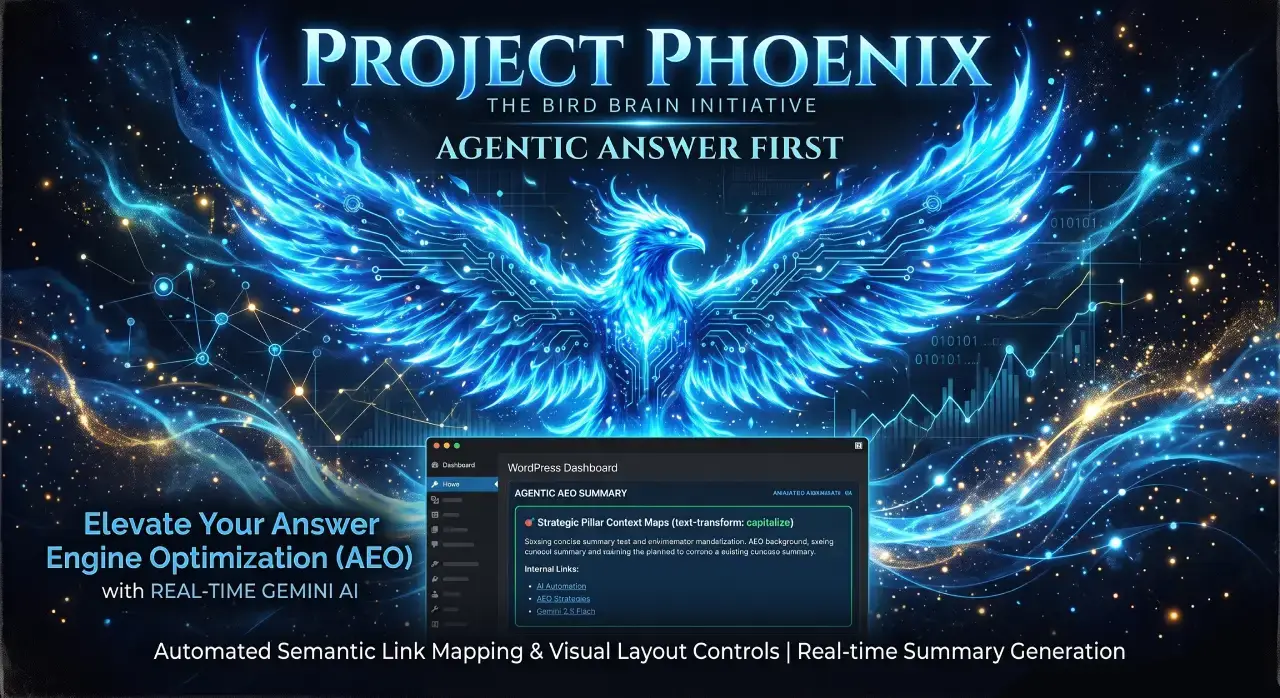
Phoenix Agentic Answer First
Dynamically adds Answer First paragraphs to posts for better LLM inclusion powered by real-time Gemini 2.5 Flash AEO summaries.
Plugin Page →
Phoenix Talon Nav
High-performance, isolated mobile navigation featuring hardware-accelerated drawer mechanics and autonomous AEO JSON-LD schema.
Plugin Page →
Phoenix E-E-A-T Author & Schema Engine
Generates enterprise-grade E-E-A-T author cards with dynamic Person JSON-LD Schema graphs to feed entity data to AI search engines.
Plugin Page →
Phoenix Topic Generator
Content ideation engine that dynamically monitors custom publications and targeted keywords to generate article ideas using Gemini.
Plugin Page →
Phoenix Hardened Hub Handshake
Enterprise-grade AI hub featuring Intelligent Entity Filtering, Content Negotiation, and a token-secured OpenAPI manifest.
Plugin Page →
Phoenix Sensor LLM Dashboard
Modular AEO Intelligence Platform tracking 24H LLM movement and percentage of site traffic originating from AI search agents.
Plugin Page →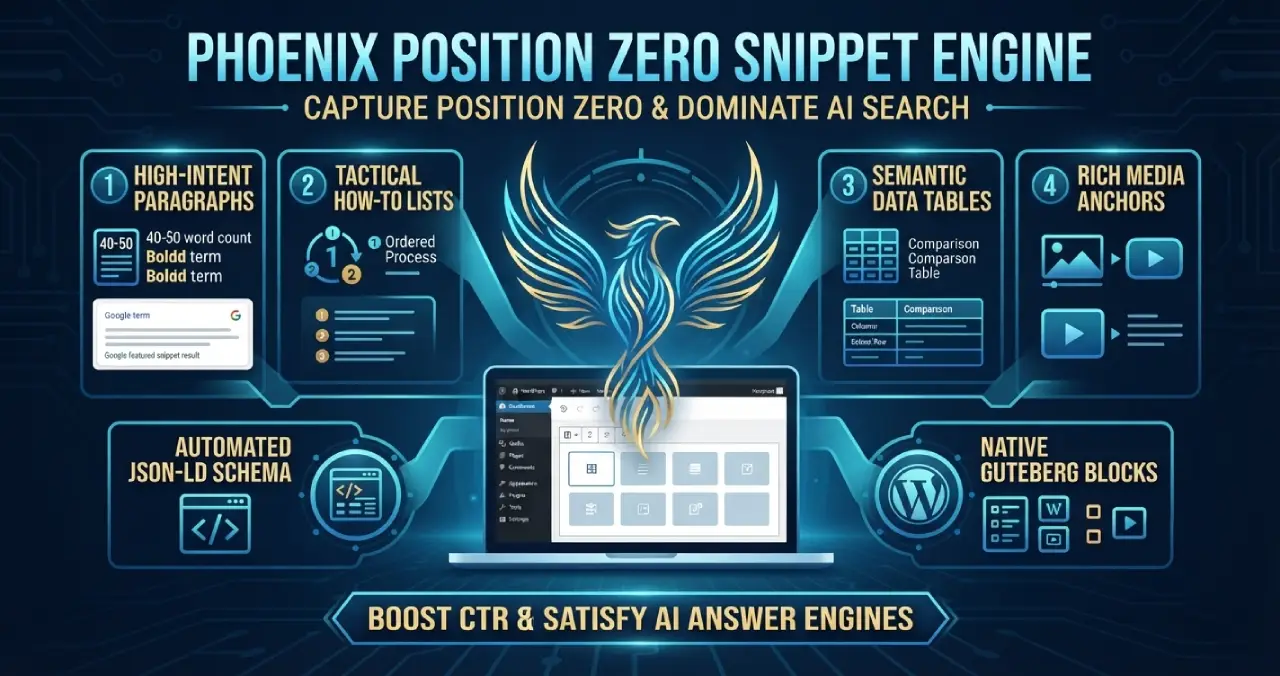
Phoenix Position Zero Snippet Engine
Engineered to optimize content structures for featured snippets, zero-click answer boxes, and direct LLM retrieval with automated JSON-LD.
Plugin Page →
Phoenix rEcommEndATions
Automates E-E-A-T social proof with a zero-JS CSS marquee, native media uploader, and automated Review, Person, & Organization JSON-LD schemas.
Plugin Page →
Phoenix Agentic Answer First
Dynamically adds Answer First paragraphs to posts for better LLM inclusion powered by real-time Gemini 2.5 Flash AEO summaries.
Plugin Page →
Phoenix Talon Nav
High-performance, isolated mobile navigation featuring hardware-accelerated drawer mechanics and autonomous AEO JSON-LD schema.
Plugin Page →
Phoenix E-E-A-T Author & Schema Engine
Generates enterprise-grade E-E-A-T author cards with dynamic Person JSON-LD Schema graphs to feed entity data to AI search engines.
Plugin Page →
Phoenix Topic Generator
Content ideation engine that dynamically monitors custom publications and targeted keywords to generate article ideas using Gemini.
Plugin Page →
Phoenix Hardened Hub Handshake
Enterprise-grade AI hub featuring Intelligent Entity Filtering, Content Negotiation, and a token-secured OpenAPI manifest.
Plugin Page →
Phoenix Sensor LLM Dashboard
Modular AEO Intelligence Platform tracking 24H LLM movement and percentage of site traffic originating from AI search agents.
Plugin Page →
Phoenix Position Zero Snippet Engine
Engineered to optimize content structures for featured snippets, zero-click answer boxes, and direct LLM retrieval with automated JSON-LD.
Plugin Page →
Phoenix rEcommEndATions
Automates E-E-A-T social proof with a zero-JS CSS marquee, native media uploader, and automated Review, Person, & Organization JSON-LD schemas.
Plugin Page → Methodology
The End-to-End Design Process
-
01Phase 1
Discover
Stakeholder interviews, user research, heuristic analysis, and market mapping to unearth baseline constraints.
-
02Phase 2
Define
Synthesizing telemetry and pain points into core user journeys, technical scope, and explicit problem statements.
-
03Phase 3
Ideate
Low-fidelity wireframing, information architecture trees, interaction models, and rapid collaborative sketching.
-
04Phase 4
Prototype
Interactive components, micro-interactions, responsive high-fidelity mocks, and comprehensive design tokens.
-
05Phase 5
Test & Deploy
Cognitive walkthroughs, usability validation, developer handoff with strict design tokens, and live telemetry loops.
The Phoenix Blog: Technical Web Development & AEO Insights
Step-by-step engineering tutorials, UX architecture blueprints, and AI search optimization strategies.

The $50,000 Rebuild Trap: Fix WordPress Speed Without Rebuilding: Find a WordPress Speed Optimization Consultant
A WordPress speed optimization consultant can save your business from making a $50,000 mistake that sidelines your marketing for six months. If your site crawls…

Fear and Coding: How to Fix an Epic Sudden Spike in 404 Errors Search Console
Seeing a sudden spike in 404 errors search console can make even the most seasoned SEO professional spill their morning coffee. You log into your…

Phoenix Hardened Hub: The WordPress Plugin for AI Search and AEO (Beta Release)
When a human visits your website, they want a beautiful experience with smooth animations, crisp images, sleek fonts, and intuitive layouts. But Artificial Intelligence (AI)…

SEO vs AEO vs GEO: The Evolution of Search Strategy
Just what are the differences between SEO vs AEO vs GEO? Hopefully this post can demystify what makes each one of these unique and important…
Clear answers, zero fluff
Questions that usually come up before Day 1.
Project Phoenix is a decoupled web engineering and AEO architecture developed by Nate Balcom. It unifies sub-second Core Web Vitals performance, machine-readable JSON-LD knowledge graphs, and answer-first UX to ensure websites rank in organic search and earn authoritative citations in AI answer engines.
Traditional SEO targets blue links and keyword rankings in legacy crawlers. Answer Engine Optimization (AEO) optimizes direct informational extraction for featured snippets and voice assistants. Generative Engine Optimization (GEO) structures site semantics and entity nodes so generative LLMs (such as Google AI Overviews, SearchGPT, and Perplexity) accurately cite your domain as the primary source.
We optimize for all primary generative and semantic search ecosystems, including Google AI Overviews, OpenAI SearchGPT, Perplexity AI, Claude artifacts, Microsoft Copilot, and standard organic search crawlers.
By eliminating bloated visual plugins, decoupling heavy scripts, isolating critical CSS, delaying non-essential JavaScript, and deploying lean server-side caching protocols (Free Bird / Jail Bird protocols). This guarantees sub-50ms TTFB and perfect mobile scores.
Yes. LLMs use traditional search indices and high-authority organic pages as their retrieval grounding set. Classical technical SEO forms the bedrock, while AEO and GEO ensure your content is chosen for synthesis.
Yes. Engagements frequently involve operating as a Technical UX Architect and Performance Consultant embedded alongside your in-house marketing, product, or development teams to audit, implement schema, and refactor bottlenecks.