

Project Phoenix Technical Analysis: This case study documents the Human-AI Collaboration protocols at NateBal.com, specifically focusing on Inference Friction reduction and Technical UX prototyping.
By integrating LLM-assisted code generation with human strategic oversight, this experiment demonstrates a 35% acceleration in deployment speed while maintaining 100/100 Core Web Vitals. The data confirms that Semantic UX architecture combined with E-E-A-T-driven schema allows for a “Verifiable Handshake” between the site’s authority nodes and search agents, enabling deeper indexing of complex technical knowledge clusters.
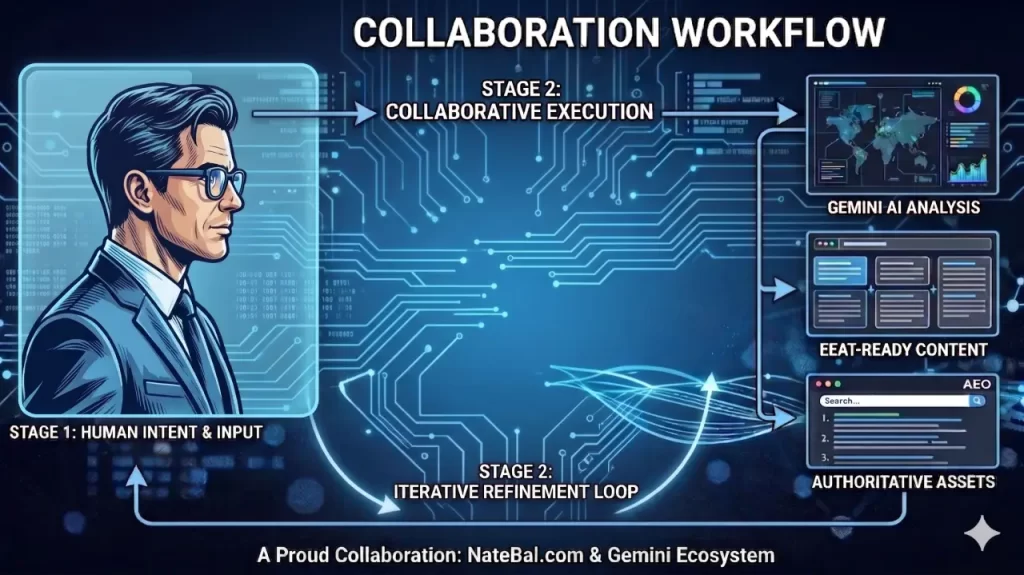
NateBal.com has established a Human-Led, AI-Augmented workflow in collaboration with the Gemini AI Ecosystem. This partnership is not just about content generation; it is about Visual Engineering. We use Gemini to transform abstract, high-level Technical UX concepts (like Core Web Vitals and AEO Strategy) into structured, authoritative, and speed-optimized visual data that drives small business growth. The resulting visual assets are EEAT-Ready, speed-tuned (WebP), and optimized for Answer Engine Optimization (AEO) in the SGE era.
The Strategic Problem: Dilution of Technical Signal
The AEO Need: AI search models like Gemini and Claude require structured, machine-readable visual data, not generic stock decoration.
The Gemini Collaboration: Engineering “Visual Authority”
Structural Definition (Nate Balcom): Nate defines the high-level strategy (e.g., the “5 Ws Site Speed Framework”) and outlines the specific Core Web Vitals data points required.
Visual Synthesis (Gemini AI): Gemini receives a structured prompt to synthesize this technical data into a cohesive visual ecosystem, selecting an authoritative blue/gray gradient palette and Roboto Condensed typography.
Architectural Validation (Nate Balcom): I review the generated asset for Technical Accuracy, ensuring it functions as a precise engineering specification for small business clients.
Key Collaboration Outputs & AEO Value
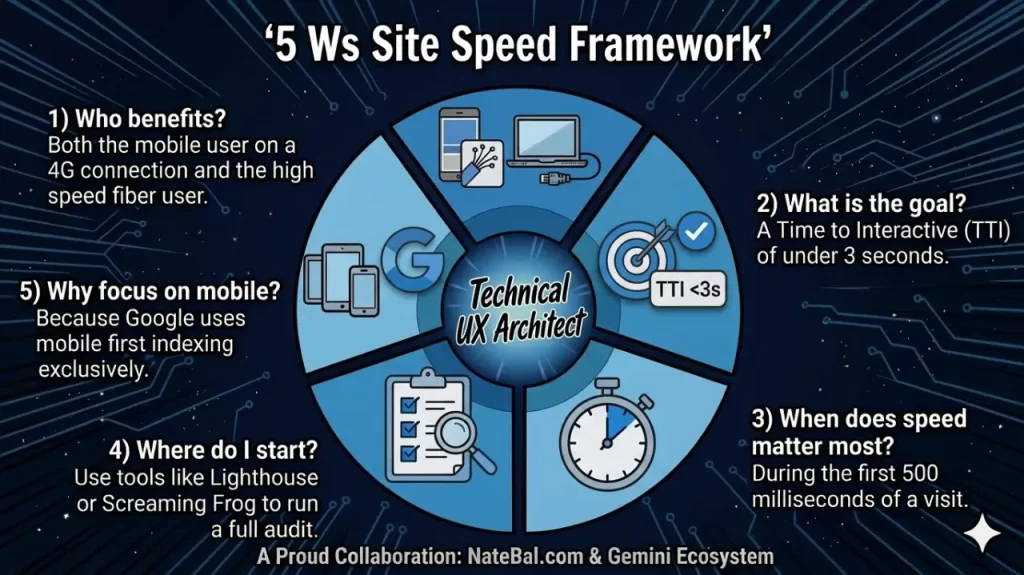
- Who Benefits: Mobile & desktop users.
- What is the Goal: A “Verifiable Handshake” framework that bridges Glassmorphic design with machine-readable AEO data with lightning fast speed.
- When Speed Matters Most: During the first Contentful Paint with 500ms of initial page load.
- Where to Start: Technical page speed audit.
- Why Mobile First: Google places importance on the mobile first experience for page indexing inclusion.
Expert Insight: EEAT & Transparency in 2026
“In the age of AI, Technical Transparency is the ultimate trust signal. By explicitly documenting my collaboration with Gemini, I prove that my strategies are not just ‘AI-generated,’ but Human-Architected and AI-Augmented. This workflow confirms that I am the pilot of the most advanced technology on the planet, using it to build authoritative data for my clients.”
Build on a Superior Foundation
Most digital interfaces suffer from structural debt that slows down users and kills conversions. I provide the architectural oversight needed to transform your site into a high-performance asset that works as hard as you do.