

Hi, I’m Nate Balcom and this is my website NateBal.com. Clever huh? Well I thought so, so I registered it. I build websites, design software, and digital experiences that do more than look good. They perform, rank, convert, and solve real problems. If you’re looking for someone who blends UX, development, AI, and search strategy into one cohesive system, you’re in the right place.
That multidisciplinary approach wasn't learned in a textbook; it was forged through two decades of surviving dot-com collapses, major search disruptions, and creative reinvention. Dive into my raw web development journey and career pivot story to see where the chaos meets the code.
My Mission
My goal is simple: create digital products that actually move the needle. Not vanity metrics. Not empty traffic. Real outcomes for real users and real businesses. I believe that resilient digital products are built on a foundation of technical authority and shared strategy. My work is governed by a structured Collaboration Model designed to integrate seamlessly with engineering and design teams.
What Makes My Approach Different
I treat user experience design and backend development as two sides of the same coin, prioritizing clean code and digital accessibility equally. This means going beyond simple CSS overrides to enforce technical accessibility standards for dark mode that protect long-term readability and fulfill strict WCAG contrast guidelines.
I integrate elements that are often handled separately:

By integrating elements that are typically handled in isolation, I bridge domains where each brings its own unique requirements and constraints. This holistic approach delivers stronger, more durable solutions while ensuring your project stays ahead and is built for what comes next.
- Code and Design
- Search & Answer Engine Optimization
- Content Management
- User Experience and Engineering
- Human Centered Design and Machine Readability
- Strategy and Execution
- Performance and Aesthetics
Philosophy on Technology and Design
Technology should feel intuitive. Users should not have to think about the interface to accomplish their goals.
Great design removes friction, builds trust, and enables progress.
Performance, Security, and Reliability
Speed and stability influence both user satisfaction and search performance.
I build systems that are:
- Fast loading
- Scalable
- Secure
- Maintainable
- Resilient
I engineer high-performance digital systems focused on speed, stability, and security to directly maximize user satisfaction and search visibility. By building scalable, resilient, and maintainable architectures, I ensure your platform is structurally optimized to grow with your business.
Collaboration With Global Technology Brands
These collaborations required aligning hardware capabilities, software ecosystems, and user expectations across different markets.
Collaborated on initiatives involving major international companies such as:
No matter the organizational footprint, success hinges on three pillars: messaging, reliability, and performance. My experience spans from agile teams to global brands, ensuring enterprise-grade execution at every level.
Medical Industry Software Design
Healthcare technology demands precision, compliance, and empathy.
I contributed to software design work associated with organizations such as Cardinal Health and United Healthcare, focusing on tools used by professionals in the medical field.
Key priorities include:
- Clarity under pressure
- Error prevention
- Accessibility (ARIA)
- Workflow efficiency
- Regulatory awareness
- Data sensitivity
In medical environments, usability is not just a convenience. It can directly affect outcomes.
Conversion Focused Design
A website should function as a business engine.
Every interface element should support meaningful action:
- Contact
- Purchase
- Booking
- Subscription
- Engagement
Design without purpose does not produce results.
Deep Roots in User Experience Design
User Experience has been at the core of my work for many years. Long before AI optimization and modern SEO became mainstream, I was focused on understanding how people interact with technology and how design decisions affect behavior, efficiency, and trust.
My UX Background Spans:
- Consumer Web Products
- Enterprise Software
- In-Vehicleehicle Interfaces
- Medical Systems
- Fleet Management Tools
- Hardware Integrated Software Experiences
- Vehcile Interior Prototypes
Good UX is invisible when done right. It simply feels natural.
| Specialization | Industries | Continous Learning |
|
|
|
WordPress Development Since 2003
I began working with WordPress when it launched in 2003 and have continued to build on the platform ever since.
Over the years I’ve:
- Developed custom themes
- Built custom WordPress Plugins
- Migrated complex legacy systems
- Hardened security
- Managed performance tuning
- Built scalable content architectures
- Specialized WordPress Database Bridge Development
- The Phoenix Apex AEO software suite
Few platforms have evolved as dramatically, and growing alongside it has given me deep technical fluency.
Blogging, Writing, and Research Since 2003
I’ve been writing, developing, and researching online since 2003, back when blogging platforms were just beginning to reshape how information is shared on the web. Over the years, blogging has been both a creative outlet and a professional tool for exploring technology, user experience, search strategy, and digital innovation.
My approach to blogging goes beyond publishing articles. It involves deep research, technical experimentation, and practical insights drawn from real world projects. This long term perspective has allowed me to document industry shifts from early web standards and the rise of content management systems to modern AI driven search and Answer Engine Optimization.
Consistent writing over two decades has sharpened my ability to explain complex topics clearly, produce authoritative content, and create resources that are genuinely useful to readers. It also reinforces my belief that high quality content is one of the most powerful tools for building trust, visibility, and lasting impact online.
Extensive CMS Architecture Experience
Beyond WordPress, I’ve designed and maintained numerous content management systems across industries.
This includes:
- Enterprise CMS deployments
- E commerce back ends
- Custom publishing workflows
- Database driven applications
- Content governance frameworks
- Long term maintenance planning
AI Web Development Expertise
I build websites and applications designed for this new landscape.
AI Ready Development Includes
- Structured content architecture
- Schema implementation
- Machine readable design patterns
- Fast, clean code
- Integration with AI driven tools
- Future proof frameworks
AEO and Modern SEO Specialization
Search has shifted from keyword matching to answer delivery. AEO focuses on making your content the source that AI systems trust and surface
Core techniques include:
- Clear question and answer structure
- Concise explanations
- Featured snippet targeting
- Semantic clarity
- Authority signals
Sustainable SEO
The objective is not just visibility but authority
- Intent based keyword strategy
- Technical optimization
- Content depth
- Internal linking systems
- Performance metrics
- EEAT alignment
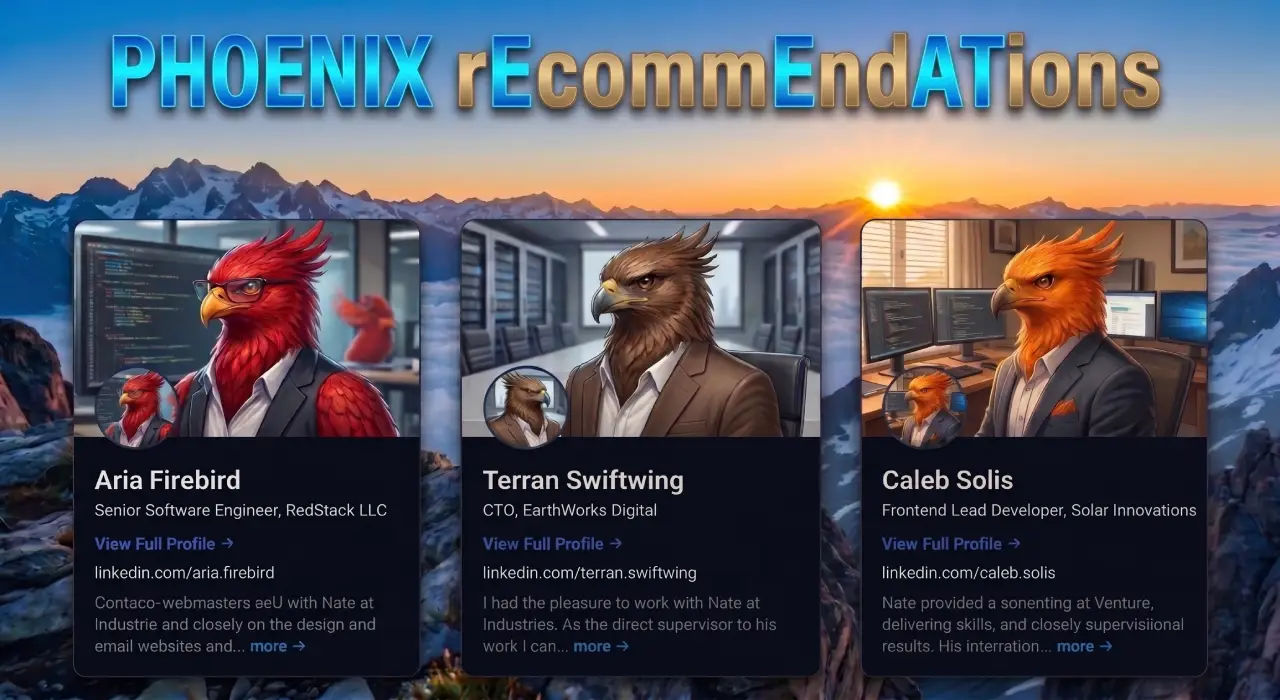
Phoenix rEcommEndATions
Automates E-E-A-T social proof with a zero-JS CSS marquee, native media uploader, and automated Review, Person, & Organization JSON-LD schemas.
Plugin Page →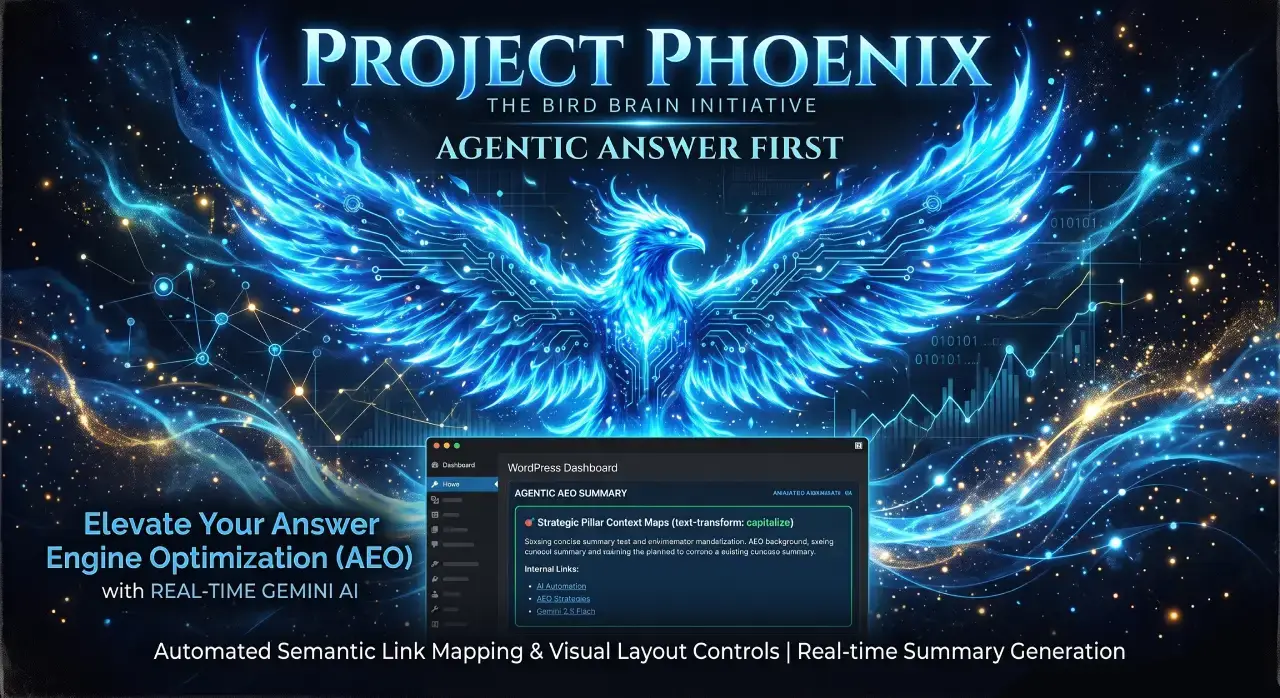
Phoenix Agentic Answer First
Dynamically adds Answer First paragraphs to posts for better LLM inclusion powered by real-time Gemini 2.5 Flash AEO summaries.
Plugin Page →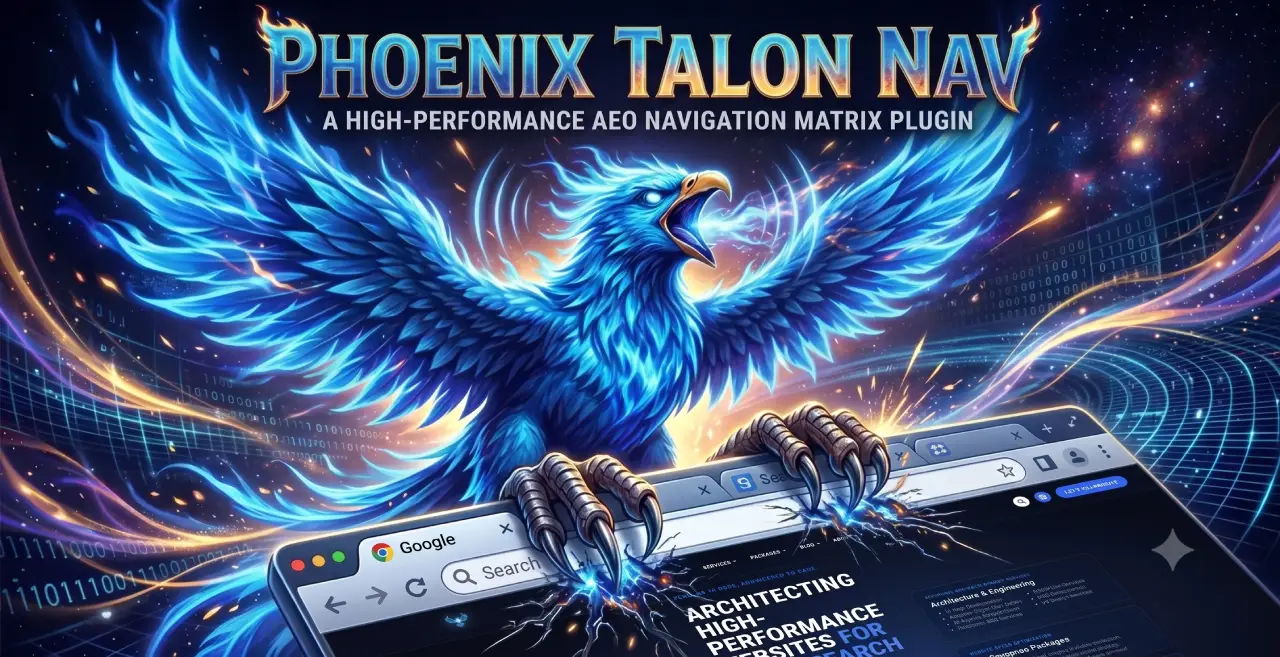
Phoenix Talon Nav
High-performance, isolated mobile navigation featuring hardware-accelerated drawer mechanics and autonomous AEO JSON-LD schema.
Plugin Page →
Phoenix E-E-A-T Author & Schema Engine
Generates enterprise-grade E-E-A-T author cards with dynamic Person JSON-LD Schema graphs to feed entity data to AI search engines.
Plugin Page →
Phoenix Topic Generator
Content ideation engine that dynamically monitors custom publications and targeted keywords to generate article ideas using Gemini.
Plugin Page →
Phoenix Hardened Hub Handshake
Enterprise-grade AI hub featuring Intelligent Entity Filtering, Content Negotiation, and a token-secured OpenAPI manifest.
Plugin Page →
Phoenix Sensor LLM Dashboard
Modular AEO Intelligence Platform tracking 24H LLM movement and percentage of site traffic originating from AI search agents.
Plugin Page →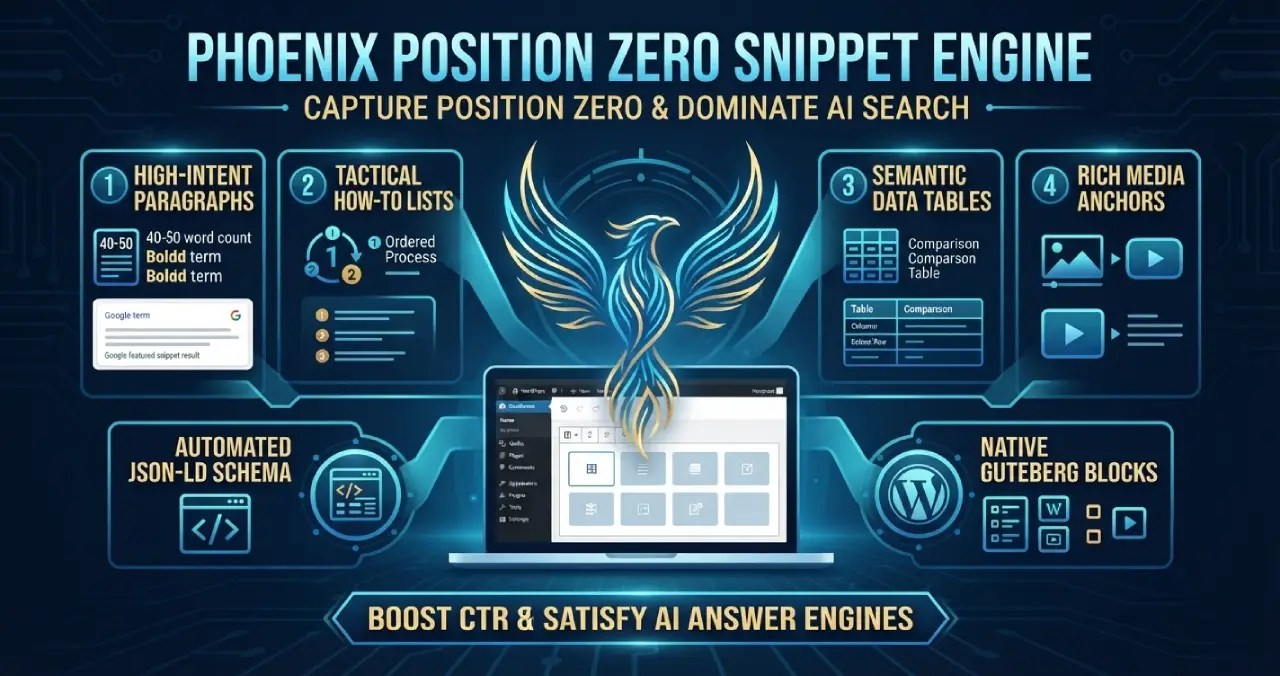
Phoenix Position Zero Snippet Engine
Engineered to optimize content structures for featured snippets, zero-click answer boxes, and direct LLM retrieval with automated JSON-LD.
Plugin Page →
Phoenix rEcommEndATions
Automates E-E-A-T social proof with a zero-JS CSS marquee, native media uploader, and automated Review, Person, & Organization JSON-LD schemas.
Plugin Page →
Phoenix Agentic Answer First
Dynamically adds Answer First paragraphs to posts for better LLM inclusion powered by real-time Gemini 2.5 Flash AEO summaries.
Plugin Page →
Phoenix Talon Nav
High-performance, isolated mobile navigation featuring hardware-accelerated drawer mechanics and autonomous AEO JSON-LD schema.
Plugin Page →
Phoenix E-E-A-T Author & Schema Engine
Generates enterprise-grade E-E-A-T author cards with dynamic Person JSON-LD Schema graphs to feed entity data to AI search engines.
Plugin Page →
Phoenix Topic Generator
Content ideation engine that dynamically monitors custom publications and targeted keywords to generate article ideas using Gemini.
Plugin Page →
Phoenix Hardened Hub Handshake
Enterprise-grade AI hub featuring Intelligent Entity Filtering, Content Negotiation, and a token-secured OpenAPI manifest.
Plugin Page →
Phoenix Sensor LLM Dashboard
Modular AEO Intelligence Platform tracking 24H LLM movement and percentage of site traffic originating from AI search agents.
Plugin Page →
Phoenix Position Zero Snippet Engine
Engineered to optimize content structures for featured snippets, zero-click answer boxes, and direct LLM retrieval with automated JSON-LD.
Plugin Page →UX Highlights
Design Sprints With Google and FCA

I have participated in numerous design sprints both at Google facilities and at FCA World Headquarters.
Design sprints compress months of product development into focused sessions that combine:
- Research
- Ideation
- Rapid prototyping
- User testing
- Decision making
These experiences reinforced a user first mindset and a bias toward action.

Googleplex Office

ID's from Visit to Google, HQ in Mountain View, CA

Inspiration Board Brainstorm

Google Design Sprint Signed by FCA & Google

Google Sprint Book

Iteration Board

More Google Bikes

Google Designated Parking

Me @ the Googleplex

Bikes at Googleplex

Android Oreo

Google TV Demo

Google I/O Conferences

I’ve also attended multiple Google I/O conferences—Google's premier annual developer event where the company reveals its latest hardware breakthroughs, software advancements, and overarching product directions firsthand. Witnessing these global innovations unveiled in real time provided me with a direct look at the bleeding edge of technology, giving me deep insight into exactly how the web, mobile platforms, and AI ecosystems are evolving next.
Seeing innovations unveiled in real time provided insight into how the web, mobile platforms, and AI ecosystems evolve. These events influenced how I approach future ready development.
Google I/O - Panel

Google Disco Blocks

Google IOT

Google I/O 2017 - Google Images Unveiled

Google I/O 2017 - Me

PANO Shot Shoreline Amphitheater

Google CEO Sundar Pichai’s Keynote at 2017 I/O Conference

Google I/O 2017 - Machine Learning

Google I/O - IOT Exhibit

Google I/O 2017

Google I/O 2017 Main Stage Shoreline Amphitheater

Google I/O 2017 - Sundar Pichai Keynote Speech

Google I/O 2017 - Kotlin Panel

Google Bush Google I/O

Shoreline Amphitheater Google I/O Kotlin Keymote

Google I/O 2017 Video Highlights



Let’s Build Something Meaningful
Whether you need a high performance website, AI ready platform, complex software interface, or strategic guidance, I bring experience across industries and technologies to help you succeed.
Your digital presence should reflect the quality of your work and support long term growth.
If that sounds like what you need, let’s start the conversation. 💬