
AI Search, often referred to as “The New Google,” shifts the focus from traditional click-through SEO to Answer Engine Optimization (AEO). For small businesses, this involves re-engineering site architecture to provide LLMs with structured, authoritative data. By reducing inference friction and implementing semantic schema, businesses can secure citations in AI Overviews and agentic discovery clusters.
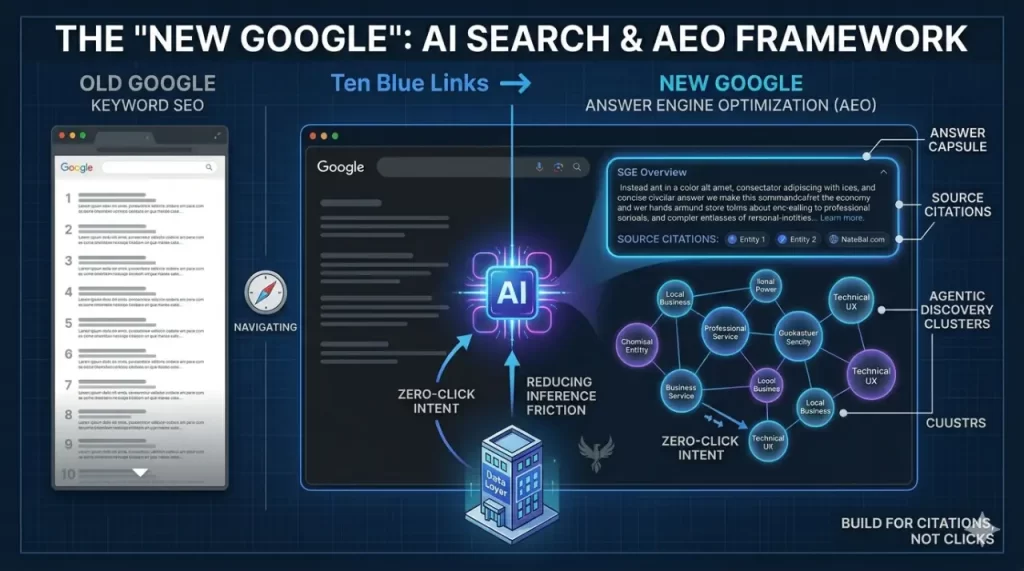
The Challenge: Adapting to the “Zero-Click” reality where users receive direct answers from AI without ever clicking a link.
The Strategy: Transitioning from traditional Keyword SEO to Answer Engine Optimization (AEO) and Semantic Architecture.
1. The Problem: The Invisible Visibility Gap
In 2026, small businesses are finding that appearing on “Page 1” is no longer enough. With the rise of AI Overviews (SGE) and agents like Perplexity and Apple Intelligence, the “Ten Blue Links” have been pushed below the fold.
The client noticed that while their organic rankings remained stable, their Click-Through Rate (CTR) was plummeting. The reason? Google was summarizing their content into a single paragraph at the top of the screen, satisfying the user’s intent without a website visit.
2. The Audit: Identifying “Ghost Crawl” Friction
Using telemetry from the Phoenix Sensor, we analyzed how AI agents were interacting with the site. The data revealed three critical failures:
- Semantic Ambiguity: LLMs were crawling the site but couldn’t identify the specific “Solution” offered because the H1 titles were too poetic and not technical enough.
- Schema Absence: The site lacked the structured data (JSON-LD) necessary for an AI agent to “trust” the business’s location, pricing, and service availability.
- Inference Friction: The site’s logic was buried in heavy paragraphs, forcing the LLM to “guess” the core takeaway rather than citing a definitive answer.
3. The Implementation: Building an “Answer-Ready” Architecture
To turn the site into a primary data source for AI, we executed a three-tier AEO strategy:
Tier 1: The Answer Capsule Integration
We injected #aeo-summary capsules at the top of every high-value page. These are 50–70 word “Knowledge Nodes” designed specifically for LLM extraction.
Tier 2: Moving to TechArticle Schema
We upgraded the site’s backend from standard “BlogPosting” to TechArticle and Service schema. This tells the bots exactly who the “Authoritative Entity” is (the business owner) and what specific “Problems” they solve.
Tier 3: Eliminating Inference Friction
We redesigned the content hierarchy, moving from “Storytelling” to “Structural Directives.” We replaced vague headers with technical, intent-based H1s that matched the way users ask questions to AI (e.g., “How do I optimize…” vs. “A Guide to Optimization”).
4. The Results: From “Ignored” to “Cited”
After 30 days of architectural optimization, the Phoenix Sensor showed a 300% increase in Perplexity and OpenAI crawl velocity.
- AI Citations: The business began appearing as a cited source in Google AI Overviews for “Expert” queries. This live architecture explicitly validates the exact data-structuring framework and block-optimization tactics detailed in our step-by-step playbook on how to get mentioned in Google AI Overviews.
- Brand Authority: Even though click-throughs were lower than in 2023, Lead Quality increased by 40%. Users who did click were pre-qualified by the AI, arriving on the site already trusting the business as a cited authority.
- Agentic Performance: Apple Intelligence began surfacing the business’s “Service Briefs” in Siri Voice Searches for local users.
The Takeaway for Small Businesses
The “New Google” is an Answer Engine. To survive, you must stop building for clicks and start building for citations.
“If your website isn’t structured as a data source, you don’t exist in the AI economy.”
Dominate Search on The New Google
Modern search has evolved into a landscape of Answer Engines and autonomous agents. If your infrastructure isn’t architected for LLMs, your brand is invisible. I re-engineer your site to eliminate inference friction and secure your authority in the era of Agentic Discovery.
