
There is a massive point of friction happening right now between business owners and modern search technology. You log into your search dashboards, witness your traditional website referral traffic slowing down, and assume your digital footprint is losing value.
The truth? You are likely optimizing for an obsolete model of user behavior. AI search engines, large language models (LLMs), and automated chat interfaces like Microsoft Copilot or ChatGPT are consuming web information faster than ever before. But instead of sending users directly to your landing pages, they are using your source code to answer prompts inside their own chat interfaces.
To strip away the guesswork, we ran an extensive 90-day technical telemetry audit on NateBal.com. By diving deep into our raw AI Performance logs, we captured exactly how large language models interact with a high-performance web platform.
The Telemetry: The 90-Day AI Search Footprint
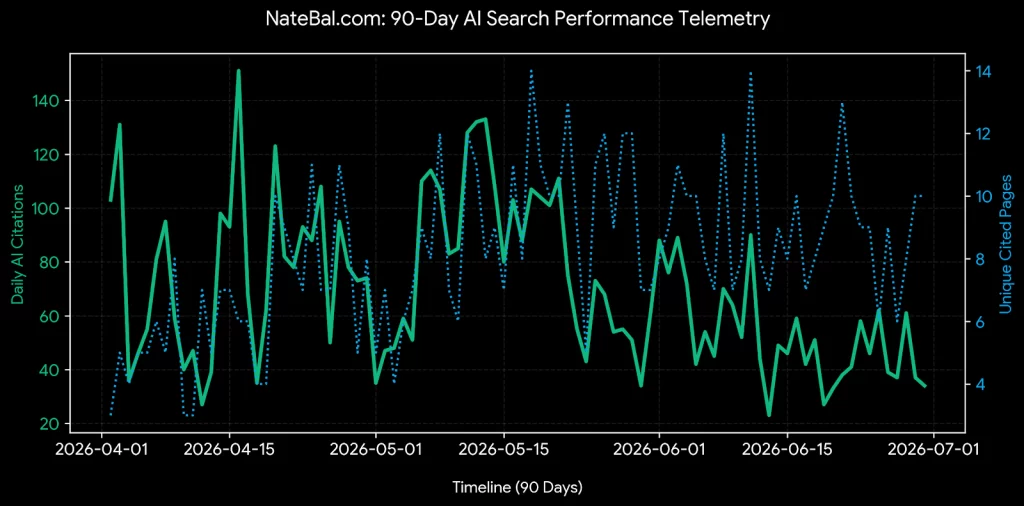
Rather than relying on generic industry predictions, we pulled the concrete, raw server and search index metrics directly from our active optimization reports. Over a rolling 90-day window, the data revealed an entirely new pattern of digital discovery:
- Total Logged AI Citations: 6,279 verification points
- Average Daily Citations: 69.77 citations per day
- Peak Daily Citations Volume: 151 citations in a single 24-hour window
- Average Unique Pages Cited Daily: 8.16 pages
- Maximum Concurrent Pages Cited: 14 unique pages
The operational reality of these data points is visualized clearly in the performance tracking telemetry log below:
Core Finding 1: The Zero-Click Reality and The Citation-to-Click Ratio
The most striking revelation from this dataset is the extreme disconnect between high AI visibility and traditional web traffic. During our peak performance window, where an AI model accessed, parsed, and cited our content 151 times in a single day, Google Analytics 4 showed zero matching referral clicks from those exact search interactions.
This is the reality of modern Answer Engine Optimization (AEO). When a model hits your platform 151 times a day to borrow your expertise, it is not doing so to act as a friendly directory service for your website. It is actively grabbing your factual arrays, processing them through a Retrieval-Augmented Generation (RAG) loop, and displaying the synthesis straight to the human user.
Does this mean your on-page optimization efforts are a waste of time? Absolutely not. It means citations have become the new currency of brand authority. If the AI models consistently trust your technical data blocks enough to ground their answers, your business becomes the invisible framework anchoring that entire industry niche.
Core Finding 2: High Volume, Extreme Page Concentration
Traditional SEO wisdom tells business owners to scale up aggressively by writing hundreds of shallow, 500-word blog articles to capture every keyword variation under the sun. Our 90-day case study completely shatters that strategy.
While NateBal.com secured over 6,200 individual citations, those queries were driven by a highly concentrated daily average of just 8 core web pages. Even at our absolute highest level of market penetration, only 14 unique pages were utilized concurrently by the retrieval crawlers.
AI models are inherently built to minimize computational processing costs. They do not want to crawl through an endless sea of thin boilerplate text. They look for single, ultra-optimized, error-free “source pillars” that contain high concentrations of factual data, clean layout structures, and explicit coding relationships.
The Actionable Playbook for Business Owners
If you want to transition your website from an invisible digital brochure into a highly cited AI resource node, you must adjust your architecture to match how these models extract data:
- Stop Content Stuffing; Build Value Pillars: Shift your focus away from maintaining a massive, low-quality blog network. Instead, invest your resources into developing 10 to 15 incredibly deep, high-gain, authoritative resource pages that answer complex industry questions seamlessly.
- Optimize for Zero Cognitive Load: AI models scan your underlying layout files for facts. Use crisp, question-based headings and place a 2 to 3 sentence direct answer summary block right at the top of your pages so the bots can scrape and cite your text instantly without timing out.
- Validate Your Technical Infrastructure: A slow website is invisible to an AI crawler. If your site code blocks a bot or takes too long to load, the retrieval agent will instantly move to a faster competitor. Your underlying technical platform must be engineered for high-velocity delivery.
Dominate the Future of Discovery
The search landscape has permanently shifted, and winning in this new environment requires a completely different approach to digital delivery. You cannot achieve position zero using outdated marketing checklists. It requires an integrated understanding of high-velocity code development, structural layout design, and semantic authority.
At NateBal.com, I design, engineer, and optimize advanced web platforms specifically tailored to establish authority in modern search environments. Stop letting unoptimized code hide your brand from the automated agents. Sign up for my services to be found in AI search today, and let us build a technical framework that turns your expertise into the primary source of truth for your entire market.
Dominate Search on The New Google
Modern search has evolved into a landscape of Answer Engines and autonomous agents. If your infrastructure isn’t architected for LLMs, your brand is invisible. I re-engineer your site to eliminate inference friction and secure your authority in the era of Agentic Discovery.