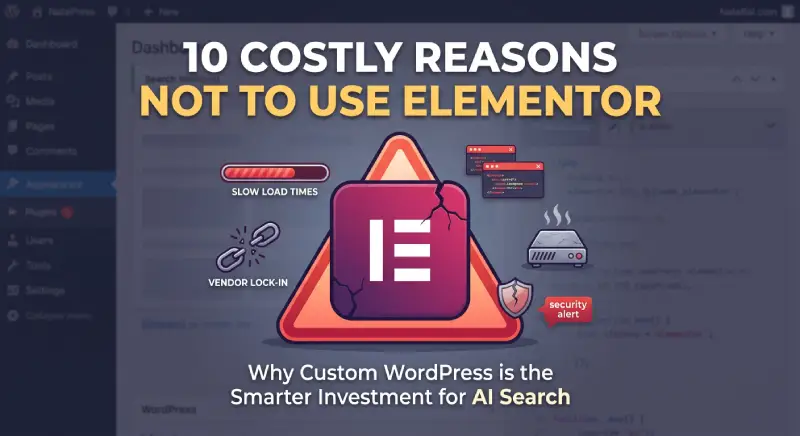

Understanding the reasons to not use Elementor is crucial for modern businesses. While drag-and-drop builders promised ease, they now hinder speed, generate bloated code, and create security risks. This impacts visibility in the era of Answer Engine Optimization (AEO) and LLM SEO, where AI search bots demand clean, semantic architecture. Opting for native WordPress blocks ensures faster, more secure, and AI-friendly web platforms.
Strategic Pillar Context Maps
Understanding the valid reasons to not use Elementor is one of the most critical decisions you will make when planning or redesigning your business website. While drag-and-drop builders promised an easy path to website creation years ago, the modern web has completely outgrown them.

Today, speed, clean code, accessibility, and machine-readable data dictate whether your brand actually gets discovered. The modern battleground is no longer just ranking for blue links on Google; it is winning the visibility fight between LLM SEO vs traditional SEO. When an artificial intelligence agent or an automated search crawler evaluates your web pages, every wasted line of bloated code becomes a direct liability to your business.
If you are a business owner watching your website load slowly, dealing with broken updates, or wondering why your content never gets cited by generative engines, these performance headaches represent practical reasons to not use Elementor for a growth-focused brand. In this guide, we examine the technical, financial, and strategic drawbacks of visual builders, explore the structural reality of LLM SEO vs traditional SEO, and outline a cleaner path forward for modern web design.
Reasons to Not Use Elementor
The Evolution of Search: AEO, GEO, and Why Page Builders Fail
Search is no longer a simple game of inserting keywords into a metadata plugin and hoping for organic clicks. We have entered the era of Answer Engine Optimization (AEO) and Generative Engine Optimization (GEO), where AI assistants like ChatGPT, Claude, Perplexity, and Google Gemini deliver instant answers directly to prospective customers.
This transformation highlights the fundamental difference between LLM SEO vs traditional SEO. In traditional search, a crawler downloaded your page and indexed text strings. In the generative search era, artificial intelligence agents parse your document structure, verify your entity relationships, and calculate whether your data is clean enough to synthesize into a direct answer. Bloated page builders introduce massive inference friction, wasting crawler token budgets and causing AI scrapers to bypass your content entirely. For forward-thinking founders, this technological shift ranks among the most overlooked reasons to not use Elementor on revenue-generating platforms.
Review how search visibility and answer engine extraction operate side by side:
Understanding Search Visibility: AEO and SEO Benefits Compared
| Optimization Dimension | Traditional Search Engine Optimization (SEO) | Answer Engine Optimization (AEO & GEO) |
| Primary Target | Traditional search algorithms and indexing bots (Google, Bing) | Large Language Models and AI search bots (ChatGPT, Perplexity, Gemini) |
| User Search Intent | Clicks, visits, and page exploration | Instant answers, direct citations, and autonomous task execution |
| Content Structure | Long-form articles with standard keyword optimization | Semantic chunks, answer-first paragraphs, and verified schema data |
| Technical Requirement | Responsive design and passable Core Web Vitals | Zero layout shift, ultra-fast TTFB, and minimal DOM depth |
| Code Cleanliness | Tolerates moderate template code overhead | Requires lean, machine-readable HTML with zero nested bloat |
| Primary Outcome | Referral traffic to your website | Direct brand recommendation and source citation inside AI answers |
Navigating the transition from LLM SEO vs traditional SEO requires clean semantic architecture. Drag-and-drop builders simply were not engineered for this reality.
Core Reasons to Not Use Elementor for Your Business Website
When evaluating your web architecture, looking at the code beneath the canvas reveals the genuine reasons to not use Elementor on a commercial website. Below are the primary technical and operational factors to consider before committing your business to a visual builder.
1. Does Elementor Ruin Website Speed and Core Web Vitals?
Yes, Elementor degrades speed and makes passing Google Core Web Vitals difficult. To render basic headings and buttons, Elementor loads global CSS stylesheets, polyfills, icon libraries, and render-blocking scripts.
Google scores your site on Largest Contentful Paint (LCP) and Interaction to Next Paint (INP). When a browser downloads bloated asset payloads to render the top fold, LCP suffers. Heavy script execution also delays user clicks, harming INP. In the modern comparison of LLM SEO vs traditional SEO, performance latency directly reduces how often autonomous crawlers index your pages. Sluggish mobile delivery is consistently one of the top performance-driven reasons to not use Elementor.
2. Does Elementor Increase Server CPU and Memory Usage?
Elementor places heavy computational strain on hosting environments. Because it processes dynamic styling, conditional display logic, and theme overrides on every request, your server executes far more PHP cycles than a native WordPress build.
This overhead frequently causes shared hosting to exhaust PHP memory limits, triggering 504 gateway timeouts. Furthermore, Elementor stores layout data in post meta tables as serialized JSON arrays. Every time an editor opens a page or a visitor requests an uncached URL, MySQL parses bloated metadata queries. This overhead drives up hosting expenses because you must purchase oversized cloud instances simply to handle baseline traffic, illustrating another set of financial reasons to not use Elementor.
3. Does Elementor Output Clean, Semantic HTML?
Elementor does not generate clean or semantic code. Instead, it produces an architectural defect known as div soup. To create a straightforward two-column block, Elementor nests five to eight layers of divider tags inside one another before reaching your actual text.
This excessive DOM depth causes visible rendering lag on mobile devices. More importantly, it destroys the semantic hierarchy that screen readers and search crawlers rely on to interpret your content. When evaluating LLM SEO vs traditional SEO, structural clarity is non-negotiable. Modern language models require concise, direct markup; burying key offerings beneath styling wrappers prevents machines from recognizing your authority. These accessibility and structure hurdles are compelling technical reasons to not use Elementor.
4. Is Elementor Prone to Security Vulnerabilities?
Elementor and its commercial plugin ecosystem have an extensive history of security vulnerabilities. Multiple Common Vulnerabilities and Exposures (CVEs) have surfaced in Elementor Core and Pro, ranging from stored cross-site scripting exploits to authenticated file uploads and remote code execution exploits.
Because Elementor runs on millions of sites, it represents an attractive target for automated botnets. When an exploit is discovered, attackers scan the web to compromise vulnerable installations within hours. Relying on an enterprise custom build constructed with native WordPress standards dramatically reduces your attack surface by stripping away millions of lines of third-party code.
5. Why Does My Site Break Every Time Elementor Updates?
A persistent frustration for business owners is that layouts break whenever Elementor releases a major update. This happens because page builders operate as visual abstraction layers on top of WordPress core software.
When WordPress updates script libraries, Gutenberg blocks, or PHP compatibility, Elementor deploys patch updates to keep pace. If your site relies on custom CSS, third-party template kits, or version-specific layout engines, these updates trigger visual regressions. Buttons shift, menus fail to open, and fonts fail to load, forcing you to spend billable hours fixing visual glitches rather than growing your business.
6. Are Third-Party Elementor Addon Packs Safe to Use?
Third-party Elementor addon packs introduce severe security, stability, and speed liabilities into your digital infrastructure. Because the base builder lacks essential UI components, site creators often install auxiliary widget plugins to add pricing tables, review sliders, and animated headlines.
Each auxiliary addon pack introduces standalone CSS files, custom scripts, external font assets, and potential security gaps. Worse, these plugins frequently conflict during updates, creating software gridlocks where updating one plugin breaks another. Over time, your digital ecosystem degenerates into dependency conflicts that make routine maintenance an expensive headache.
7. What Happens to My Site If I Deactivate or Uninstall Elementor?
Deactivating Elementor instantly destroys your front-end presentation and leaves behind severe vendor lock-in. Unlike native WordPress blocks that store standard HTML formatting inside the post content database, page builders store layout directives in proprietary shortcodes and serialized database arrays.
When Elementor is turned off, your web pages do not revert to clean, readable text. Instead, visitors are greeted with broken layouts, missing styling, and raw shortcode fragments scattered across the screen. Escaping the builder requires a complete rebuilding process. Learning how to migrate from Elementor to modern architectures is a vital step for brands ready to reclaim their digital autonomy and protect their code base.
8. Is Elementor Suitable for Enterprise or High-Traffic Websites?
Elementor is fundamentally ill-suited for enterprise applications or high-traffic corporate environments. Enterprise web development demands predictable rendering times, multi-author editorial workflows, strict version control integration, and minimal server resource consumption.
When a high-traffic website experiences concurrent visitor spikes, the computational overhead of page builder database queries can overwhelm caching layers and trigger database failures. High-volume publications, corporate intranets, and transactional B2B portals require hardened custom engineering where templates render via streamlined PHP and native blocks, eliminating the instability inherent in visual page assembly.
9. How Difficult Is Responsive Design Maintenance in Elementor?
Managing responsive layouts across multiple device viewports in Elementor requires excessive manual overrides. Because the builder encourages visual dragging and absolute positioning, elements that appear balanced on a desktop display frequently break or overlap on laptops, tablets, and mobile screens.
Designers must set manual margins, padding rules, and font size overrides across desktop, tablet, and mobile breakpoints individually. This manual patching inflates generated CSS stylesheets with thousands of lines of media queries. When you build natively using modern CSS Grid and Flexbox standards, layouts scale naturally across screen dimensions without generating bloated override files.
10. The Hidden Long-Term Total Cost of Ownership
While Elementor markets itself as an affordable solution for small businesses, the long-term total cost of ownership is high. In addition to Elementor Pro licensing fees, business owners discover that they must purchase premium addon packs, speed optimization plugins, asset management tools, and high-tier hosting simply to keep the site running at an acceptable speed.
When you factor in billable maintenance hours required to resolve update errors and lost revenue from visitors bouncing off slow pages, the true cost of a page builder website far exceeds that of a custom-engineered web platform built properly from day one.
Strategic Reasons to Not Use Elementor for Long-Term Search Visibility
The question of whether page builders hurt search rankings has become urgent for business owners. While Elementor does not automatically cause a manual penalty from Google, its technical architecture creates systemic disadvantages that limit your potential visibility.
In traditional search engine optimization, Google crawls HTML to evaluate page speed, user experience, and keyword relevancy. If your page takes four seconds to load on mobile and frustrates visitors with layout shifts, your organic rankings will gradually decline. But the stakes are even higher when analyzing the differences in LLM SEO vs traditional SEO.
Modern answer engines and AI search models synthesize data rather than simply indexing words. If an AI agent crawls an Elementor page, it must read through hundreds of meaningless wrapper classes and inline styling blocks before finding your actual value proposition. This structural noise increases computational token expenditure for the scraping agent, making your business much less likely to be cited as a recommended source.
Implementing a dedicated WordPress plugin for Answer Engine Optimization alongside clean native markup ensures that search bots and AI models find direct answers instantly. Understanding how to make your website show up in AI search requires shedding the heavy code legacy of past page builders in favor of semantic clarity and modern entity mapping. When viewed through the lens of automated answer engine retrieval, the architectural penalties are among the clearest reasons to not use Elementor for modern marketing.
Modern Alternatives: Native Blocks and High-Performance Custom Builds
Moving away from visual drag-and-drop tools does not mean sacrificing design creativity or the ability to edit your own content. Modern WordPress engineering provides a vastly superior editorial experience through the native Block Editor and lightweight layout tools.
Using streamlined block architectures like Kadence Blocks for WordPress or custom native Gutenberg patterns allows you to create rich, visually captivating digital experiences that generate ultra-fast, semantic HTML. When an editor creates a native layout, the output is pure markup that loads in milliseconds, passes Core Web Vitals automatically, and provides seamless machine readability for both search engines and autonomous AI scrapers.
By moving your architecture to native components, you insulate your company against plugin update conflicts, slash monthly hosting costs, and establish a firm foundation to dominate the competitive dynamics of LLM SEO vs traditional SEO. Rather than fighting page builder limitations, you gain a custom platform built specifically around your brand identity and conversion goals.
Frequently Asked Questions About Elementor and Web Performance
Can you achieve a 100/100 Google PageSpeed score with Elementor?
While it is technically possible to achieve high synthetic desktop PageSpeed scores on an isolated Elementor page using aggressive caching and asset unloading plugins, sustaining those scores on mobile devices with live traffic is nearly impossible. Real-world users on mobile networks experience the full weight of heavy DOM structures and render-blocking scripts, leading to poor Core Web Vitals field data.
Why do professional web developers recommend custom WordPress over Elementor?
Professional developers prioritize long-term stability, security, clean code, and speed. Custom WordPress platforms give business owners complete control over their markup, eliminate vendor lock-in, and provide an editorial experience tailored to their exact workflow without the maintenance headaches and bloat of third-party builders. For experienced agency engineers, these workflow barriers remain valid reasons to not use Elementor on client projects.
How does web architecture impact LLM SEO vs traditional SEO?
In the strategic evaluation of LLM SEO vs traditional SEO, site architecture dictates how efficiently machines extract answers from your text. Traditional search engines read basic keywords across noisy templates, whereas Large Language Models require clean semantic nodes, direct entity relationships, and fast response times to summarize and cite your brand.
Is migrating away from Elementor difficult?
Migrating away from Elementor requires recreating pages using native blocks or custom templates because Elementor proprietary styling does not transfer automatically. However, working with a specialist ensures your existing organic search rankings, URL structures, and content assets are preserved and enhanced throughout the transition.
Does native WordPress offer the same visual design flexibility as Elementor?
Yes. Modern native block systems and custom themes provide equal or superior design flexibility compared to Elementor, with the added benefit that styling is handled cleanly via global theme tokens and lightweight CSS rather than thousands of database overrides.
Transform Your Digital Presence with Custom Engineering
Your website is the digital storefront of your business. Leaving your conversion rates, page speed, and brand credibility in the hands of a fragile page builder limits your growth and weakens your ability to compete in the shifting landscape of LLM SEO vs traditional SEO.
I do things differently at NateBal.com. As a hybrid professional, I do not just write code; I design intuitive user experiences, build fast WordPress architectures, craft strategic content, and optimize your business for modern search discovery across both traditional engines and cutting-edge answer engines. By combining skills that typically require hiring several different specialists, I help business owners migrate away from fragile page builders into durable, high-performance digital platforms.
Ready to eliminate builder bloat, pass Core Web Vitals, and make your business visible across search engines and AI assistants? Explore my custom web design and AI web development services to schedule your consultation and build a faster, smarter web platform today.
Master The New Rules Of WordPress Performance
Don’t let a slow site undermine your authority. Our WordPress Speed Optimization Service utilizes an “Architectural Hardening” methodology to strip away code bloat.