
To get your WordPress website discovered on ChatGPT, Claude, and Perplexity, a business must implement specialized Answer Engine Optimization. This process requires removing non-essential code bloat, accelerating page speeds, and embedding verified data structures. These precise website enhancements enable conversational artificial intelligence engines to successfully find, read, and cite your business content during live customer search sessions.
Strategic Pillar Context Maps
To get your WordPress website discovered on ChatGPT, Claude, and Perplexity, your company’s online presence must be built so AI systems can easily find and read your information. Modern artificial intelligence platforms do not review your business website the same way traditional search engines do. They do not just count your keywords or look at hidden tag lists to decide who to recommend. Instead, these advanced systems scan your website for clean, un-cluttered layouts and verified business details.
For business owners seeking a practical way to increase website traffic and secure hot leads, this new style of website optimization is no longer optional. Removing hidden delays and presenting clear information on your pages is the most direct way to ensure your company gets recommended when potential clients use AI search to find local or national services.
How to Get Your WordPress Website Discovered on ChatGPT, Claude, and Perplexity
Why the New Google and AI Search Tools Look Past Traditional Layouts
Traditional search engine optimization (SEO) focuses almost entirely on earning a blue clickable link on a standard Google results page. However, the new Google ecosystem and independent tools require a completely different website design strategy. These next-generation search platforms value speed, direct answers, and instant clarity above everything else.

Many beautifully designed WordPress websites remain completely invisible to automated systems because heavy template builders, overlapping plugins, and messy background scripts slow down the data collection process. If your target buyers are moving away from standard search bars and using conversational tools to find service providers, your business platform must adapt to stay visible.
When an AI engine searches the web to answer a specific question from a potential customer, its automated program reviews webpage text in fractions of a second. If your website code is crowded with unnecessary features or slow-loading custom designs, the program will simply skip your business for a faster competitor. Securing these high-quality leads requires an intentional website setup that introduces your business services directly to artificial intelligence systems without delays.
Once your content strategy is locked in, the fastest way to format your data for automated extraction is to use the Phoenix LLM Quick Answer Plugin to generate clean, machine-readable summaries instantly.
Removing Website Friction to Capture AI Traffic
The single biggest barrier to receiving artificial intelligence recommendations and ranking for competitive search phrases is poor website performance. Artificial intelligence engines process internet data at a massive scale, but their operations are limited by time and computing costs. When platforms like ChatGPT, Claude, and Perplexity crawl a website to gather real-time data, they favor high-speed platforms that load flawlessly. If your website is bogged down by technical friction, AI systems will trim their visit short and source their facts from a faster competitor.

Phoenix rEcommEndATions
Automates E-E-A-T social proof with a zero-JS CSS marquee, native media uploader, and automated Review, Person, & Organization JSON-LD schemas.
Plugin Page →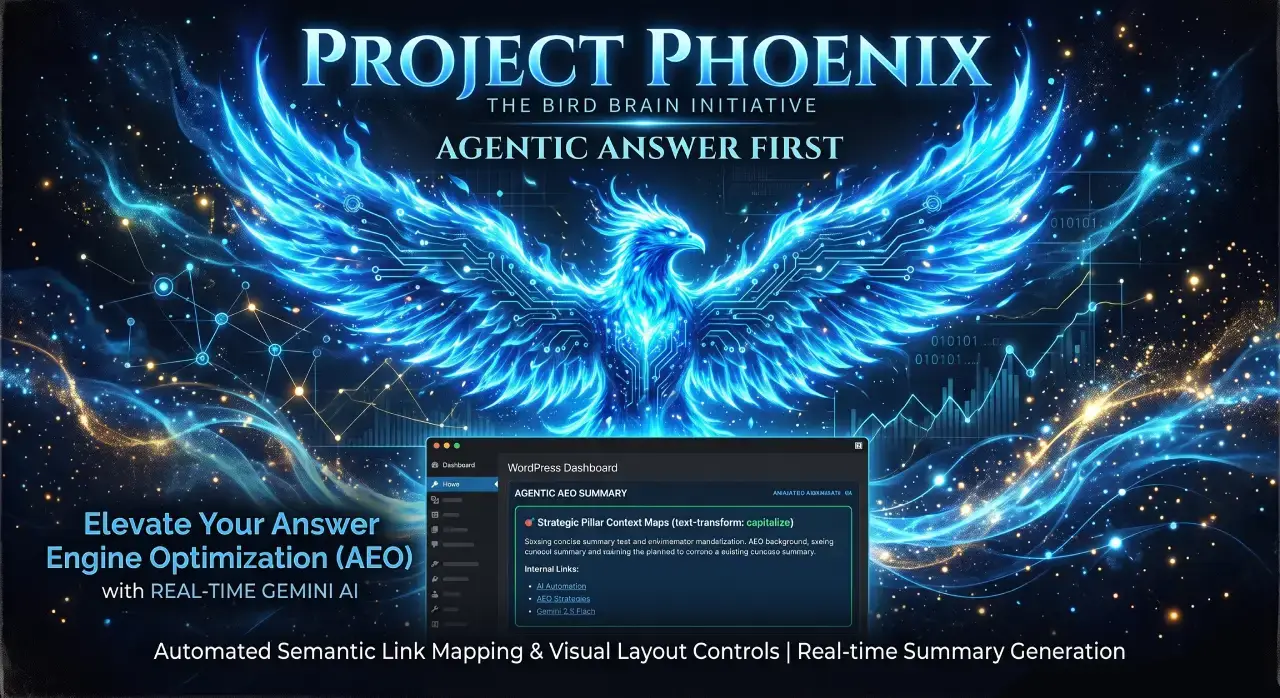
Phoenix Agentic Answer First
Dynamically adds Answer First paragraphs to posts for better LLM inclusion powered by real-time Gemini 2.5 Flash AEO summaries.
Plugin Page →
Phoenix Talon Nav
High-performance, isolated mobile navigation featuring hardware-accelerated drawer mechanics and autonomous AEO JSON-LD schema.
Plugin Page →
Phoenix E-E-A-T Author & Schema Engine
Generates enterprise-grade E-E-A-T author cards with dynamic Person JSON-LD Schema graphs to feed entity data to AI search engines.
Plugin Page →
Phoenix Topic Generator
Content ideation engine that dynamically monitors custom publications and targeted keywords to generate article ideas using Gemini.
Plugin Page →
Phoenix Hardened Hub Handshake
Enterprise-grade AI hub featuring Intelligent Entity Filtering, Content Negotiation, and a token-secured OpenAPI manifest.
Plugin Page →
Phoenix Sensor LLM Dashboard
Modular AEO Intelligence Platform tracking 24H LLM movement and percentage of site traffic originating from AI search agents.
Plugin Page →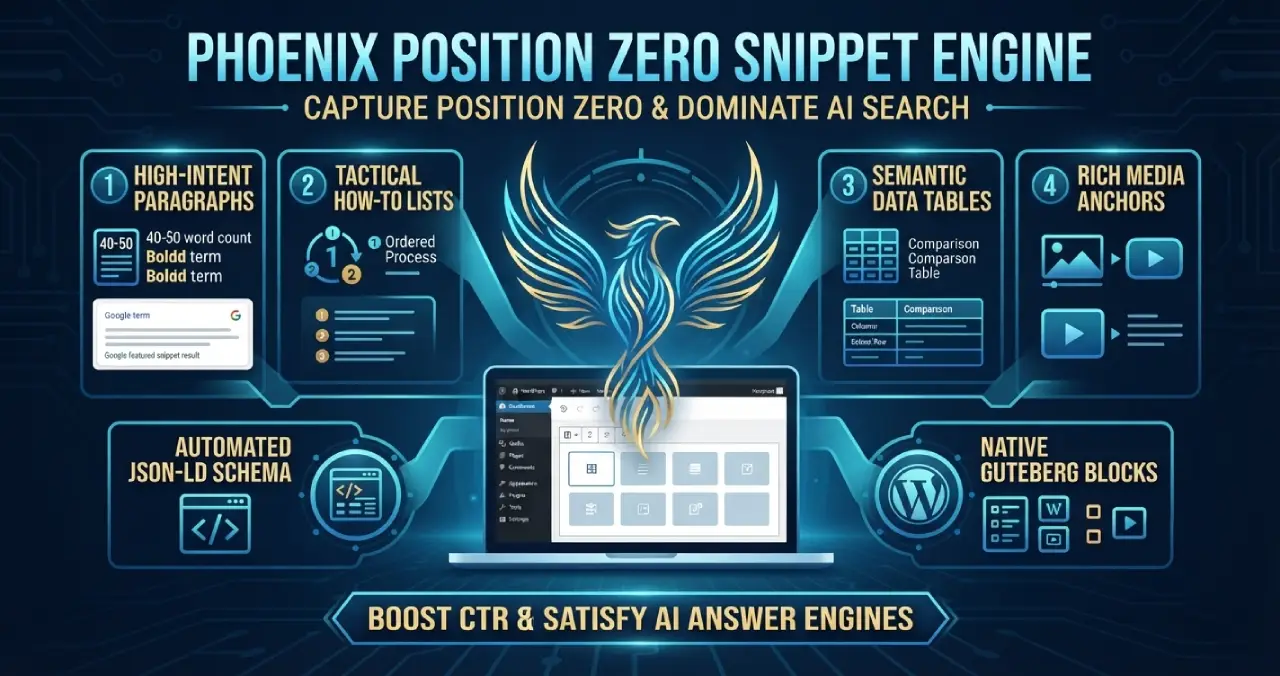
Phoenix Position Zero Snippet Engine
Engineered to optimize content structures for featured snippets, zero-click answer boxes, and direct LLM retrieval with automated JSON-LD.
Plugin Page →
Phoenix rEcommEndATions
Automates E-E-A-T social proof with a zero-JS CSS marquee, native media uploader, and automated Review, Person, & Organization JSON-LD schemas.
Plugin Page →
Phoenix Agentic Answer First
Dynamically adds Answer First paragraphs to posts for better LLM inclusion powered by real-time Gemini 2.5 Flash AEO summaries.
Plugin Page →
Phoenix Talon Nav
High-performance, isolated mobile navigation featuring hardware-accelerated drawer mechanics and autonomous AEO JSON-LD schema.
Plugin Page →
Phoenix E-E-A-T Author & Schema Engine
Generates enterprise-grade E-E-A-T author cards with dynamic Person JSON-LD Schema graphs to feed entity data to AI search engines.
Plugin Page →
Phoenix Topic Generator
Content ideation engine that dynamically monitors custom publications and targeted keywords to generate article ideas using Gemini.
Plugin Page →
Phoenix Hardened Hub Handshake
Enterprise-grade AI hub featuring Intelligent Entity Filtering, Content Negotiation, and a token-secured OpenAPI manifest.
Plugin Page →
Phoenix Sensor LLM Dashboard
Modular AEO Intelligence Platform tracking 24H LLM movement and percentage of site traffic originating from AI search agents.
Plugin Page →
Phoenix Position Zero Snippet Engine
Engineered to optimize content structures for featured snippets, zero-click answer boxes, and direct LLM retrieval with automated JSON-LD.
Plugin Page →The Major Drivers of Website Delays

For a business owner, website friction is anything that forces a computer program to wait or guess. While human visitors might tolerate a slow image or a confusing layout for a few seconds, automated programs will simply drop the connection. Cleaning out these hidden performance anchors is the single most effective way to protect your digital traffic pipeline:
- Heavy Design Software: Popular drag-and-drop website design systems generate massive layers of messy, hidden background code to display simple elements. This invisible weight forces an AI reader to filter through thousands of lines of code debris just to extract one paragraph of actual business text.
- Too Many Overlapping Plugins: Running multiple plugins that perform similar tasks—like tracking analytics, formatting design pieces, or handling social shares—creates massive internal bottlenecks. Each plugin adds extra weight that slows your response time down past the preferred split-second baseline.
- Oversized Commercial Images: Serving raw, unoptimized images directly from your media gallery stalls the data extraction pipeline. If a crawler spends its time downloading oversized photography, it runs out of time before it ever reaches your actual text content.
- Outdated Page Updates: If your website database does not instantly refresh its memory cache when you publish new updates, AI engines will continue to read stale or completely outdated information. Your system must be configured to push real-time updates directly to the web immediately.
Uncover Your Hidden Website Bottlenecks
A slow or poorly optimized website quietly drives away valuable traffic and hurts your search rankings every single day. Get a comprehensive analysis of your site’s speed, user experience, and technical health to see exactly where you might be losing potential customers. Claim your free performance report today to start turning technical fixes into measurable business growth.
Optimizing a content management system for this new era requires replacing heavy, slow-moving website setups with streamlined, high-performance foundations. Cleaning out obsolete background scripts, configuring premium delivery networks, and organizing your internal page paths creates an effortless map for automated systems. Ensuring your platform loads instantly builds immediate trust with every major AI network while drastically dropping your bounce rates on traditional search engines.
Organizing Your Content to Secure Hot Leads and Referrals
Modern traffic generation relies on how efficiently your content management system delivers answers. Artificial intelligence platforms pull information into direct conversational answers by scanning your website pages for clear, standalone sentences. Writing vague introductions or using corporate filler text prevents these automated systems from identifying your industry expertise.
To earn direct recommendations and capture premium traffic, your pages must deliver precise answers immediately under clear, optimized headings. This format naturally satisfies traditional search algorithm requirements while feeding clean data to conversational answer engines.
For example, when detailing a core service on your site, describe the exact offering, the target client, and the expected business result within the first two sentences. Using straightforward comparison tables and organized lists allows artificial intelligence to categorize your business capabilities accurately.

Framework for Organizing Business Content
To keep your text completely visible to automated systems, use this table structure as a template for planning your primary business service and landing pages:
| Content Element | Target Purpose | Practical Conversion Example |
| Direct Answer Header | Identifies the explicit core service, target market, and operational location. | COMMERCIAL ROOF REPAIR SERVICES FOR WAREHOUSES IN DETROIT |
| Instant Solution Block | Provides a concise summary within two sentences detailing the exact commercial offer. | We provide high-speed commercial roof repairs and leak prevention for logistics warehouses across Metro Detroit. Our engineering team resolves structural issues within 48 hours to minimize supply chain disruption. |
| Verifiable Data Points | Presents raw specifications, project pricing ranges, and clear timelines. | Use clean tables outlining project costs per square foot, material lifespans, and labor warranty windows. |
| Entity Verification Layer | Connects the service to real-world corporate data and official organization profiles. | Includes a short, professional background note referencing the founder name, licensing numbers, and active industry credentials. |
Strategy Comparison: What AI Content Engines Reward vs. What They Skip
Writing content that captures premium traffic requires choosing clear, conversational facts over abstract marketing copy. Review these examples to align your page copy with modern answer engine expectations:
Core Service Explanations - Do's and Do Nots
- DO NOT write like this: "We are a passionate team of visionary design professionals who love crafting beautiful, next-generation digital experiences that elevate your brand narrative to the next level."Why it fails: This statement contains zero extractable data points. An AI model cannot determine what your specific business sells, who your target customer is, or what geographical market you serve.
- DO write like this: "Our agency provides custom WordPress website design services for medical clinics and private healthcare practices. We build high-performance platforms optimized to secure local patient leads and scale digital appointment bookings."Why it wins: The sentence clearly states the technical platform (WordPress), the specific design service, the exact target client profile (medical clinics), and the direct business outcome (securing leads and scaling bookings).
Pricing and Delivery Terms - Do's and Do Nots
- DO NOT write like this: "Our premium business solutions are completely tailored to your unique company journey, and our flexible pricing plans are structured to scale beautifully with your evolving organizational needs."Why it fails: This text provides zero clarity or definitive answers, forcing both a human user and an AI model to guess the actual costs and engagement levels.
- DO write like this: "Our comprehensive Website Performance Optimization packages start at a fixed fee of $1,500. Every optimization plan includes a full database cleanup, complete image compression, and a guaranteed sub-two-second page load time."Why it wins: It delivers concrete numbers, verifiable pricing thresholds, and explicit engineering outcomes that an AI search tool can quickly extract and quote directly to an interested buyer.
Verifying Your Authority to Win Premium Clients
Advanced background data formatting is the primary tool used by artificial intelligence to confirm the true identity, authority, and location of a business. Plain words on a page can easily be misinterpreted by a computer program, but highly structured background data provides undeniable proof of your commercial credentials.
This background layout maps your corporate services, geographic areas, and industry focus into a unified profile that systems like Claude and ChatGPT can read instantly.
Embedding a precise structural data layer within your website forms a verified digital handshake that traditional search engines use to display rich, premium snippets. This hidden map connects your main website pages directly to independent industry directories and official corporate profiles.
By eliminating all doubt regarding your professional status, you position your brand as a preferred, trusted resource for AI platforms to recommend to high-intent buyers looking for your exact solutions.
Secure Your Competitive Advantage in the Era of AI Search
Turning your WordPress website into a high-performance lead generator requires more than just standard updates. If you want your business to be consistently discovered, recommended, and cited by major platforms like ChatGPT, Claude, and Perplexity, your backend foundation must be clear of hidden technical friction.
You need a setup that allows automated systems to instantly verify your commercial authority and pass your details along to high-intent buyers.
At NateBal.com, we specialize in building fast, lightweight frameworks that seamlessly present your business capabilities to both traditional search engines and next-generation conversational networks. We eliminate the heavy page builders, optimize your database response times, and embed the verified data profiles necessary to ensure your brand stands out over your competitors.
Instead of trying to handle these complex infrastructure changes on your own, let us deploy the technical solutions required to scale your traffic and capture hot leads. Explore our specialized WordPress website Design and Optimization Services today to prepare your business platform for the future of digital discovery.
Master The New Rules Of WordPress Performance
Don't let a slow site undermine your authority. Our WordPress Speed Optimization Service utilizes an "Architectural Hardening" methodology to strip away code bloat.