


Michigan Answer Engine Optimization Services are crucial for local businesses navigating the shift to conversational AI. As search engines prioritize direct answers, traditional SEO alone isn't enough. Businesses need to optimize content for machine ingestion and structured data to secure citations in AI overviews, ensuring visibility and driving high-intent leads despite the rise of zero-click searches.
Strategic Pillar Context Maps
Securing dedicated Michigan Answer Engine Optimization Services is now the single most critical move for local businesses looking to survive the shift from blue links to conversational AI answers. If you run a business in the Great Lakes State, you have likely noticed a weird, frustrating trend: your search positions look fine on paper, but your incoming calls and form submissions feel lighter. That happens because people no longer search the internet like college freshmen writing research bibliographies. They treat search engines like personal assistants, firing off natural, contextual prompts and expecting conversational solutions.
When a prospective client pulls up their phone and asks an artificial intelligence engine for the best service provider nearby, your company either gets directly recommended as the solution or you simply do not exist to that user. Standard search practices laid a great foundation for twenty years, but the game fundamentally changed when large language models stepped in between your site and your customers. Getting into those generative responses requires a targeted mix of technical site architecture, precise information structuring, and content created specifically for machine ingestion. That is precisely why investing in top-tier Michigan Answer Engine Optimization Services is no longer an experimental luxury for companies aiming to grow.
Answer Engine Optimization Services Michigan
The Evolution from Keywords to Generative Answers
For decades, digital marketing followed a predictable rhythm. You found a keyword with decent monthly volume, put it inside an H1 tag, scattered it across a 1,200-word post, bought a few directory links, and waited for Google to serve your homepage somewhere on page one.
Today, modern search engines run on semantic entity extraction, contextual relevance, and conversational intent. Instead of matching strings of characters, platforms like Google AI Overviews, ChatGPT Search, and Perplexity parse complete thoughts. They pull information out of multiple sources simultaneously, synthesize the points, and serve up a direct answer right on the user screen.
This evolution is why partnering with a skilled AEO specialist Michigan business owners trust has become vital. You are no longer solely optimizing to convince an algorithm that your page is relevant to a five-word phrase. You are engineering your site so that autonomous systems treat your brand as the verified factual authority in your industry.
Why Standard SEO Isn’t Enough Anymore
Standard SEO is built around driving direct clicks to a webpage via classic search ranking factors. While that visibility matters, conversational engines prioritize direct knowledge delivery over browsing sessions.
If someone asks an AI platform how to handle an emergency commercial roof repair in Grand Rapids, that platform does not want to send the user on an exploratory journey through five generic agency blogs. It wants to extract a clear, definitive protocol, credit the expert who wrote it, and present the core takeaway instantly.
Traditional SEO vs. Generative AEO Matrix:
| Strategic Factor | Traditional SEO | Modern AEO / GEO |
| Primary Focus | Keyword density, backlinks | Entity authority, data clarity |
| Content Structure | Long-form narrative blocks | Direct answers, modular data |
| Primary Goal | Drive clicks to website | Direct citation & synthesis |
| Discovery Channel | Organic SERP listing | Conversational LLM responses |
| Site Performance | Acceptable page speed | Clean, low-latency code |
A comprehensive strategy blends classic optimization with Generative Engine Optimization (GEO) Michigan campaigns. You need rock-solid indexing to stay visible in traditional search, but you also need clean semantic extraction so AI engines can reliably pull your content into real-time summaries.
Why High Rankings No Longer Guarantee Traffic
One of the most common complaints from business owners lately sounds like this: “Our keyword rankings did not drop, so why is our traffic falling off a cliff?”
The culprit is the zero-click search environment. Search engines now answer queries directly on the results page using automated summaries and dynamic panels. When an engine provides a detailed, satisfying response in an AI snapshot, the searcher rarely clicks down to the third organic result. They take their answer and move on with their day.
If your content is written as vague marketing copy stuffed with filler adjectives, an AI bot cannot easily parse it for clean facts. As a result, your site gets completely bypassed when the engine constructs its summary. You keep your technical position on a ranking tracker, but actual human visits decline because the engine answered the user question using your competitor’s clearly formatted data instead.
Winning in this landscape means structuring your digital presence so that when zero-click answers are generated, your brand is the credited entity solving the problem.
How AI Search Decides Which Brands to Cite
Large language models do not pick websites at random. They evaluate incoming content through strict information retrieval models that value factual clarity, structural readability, and verified authority.

To earn consistent citations across tools like ChatGPT and Perplexity, your digital ecosystem must meet four structural criteria:
- Entity Resolution: The platform must clearly understand who you are, what physical services you offer, and where your operational borders sit, supported by unambiguous schema markup.
- Information Density: Fluff-free sentences that answer direct questions instantly are far easier for machine learning models to extract and assemble into summaries.
- Technical Ingestion Health: Search bots need clean HTML, minimal render-blocking clutter, and lightning-fast delivery to crawl and understand your resource without timing out.
- Corroborated Consensus: Your claims, pricing models, and service descriptions must match across third-party directories, news releases, and external platforms so the AI can verify accuracy.
When you invest in modern Michigan Answer Engine Optimization Services, you build a site framework that actively feeds these models the structured data they crave.
The Power of an All-in-One Unicorn Partner
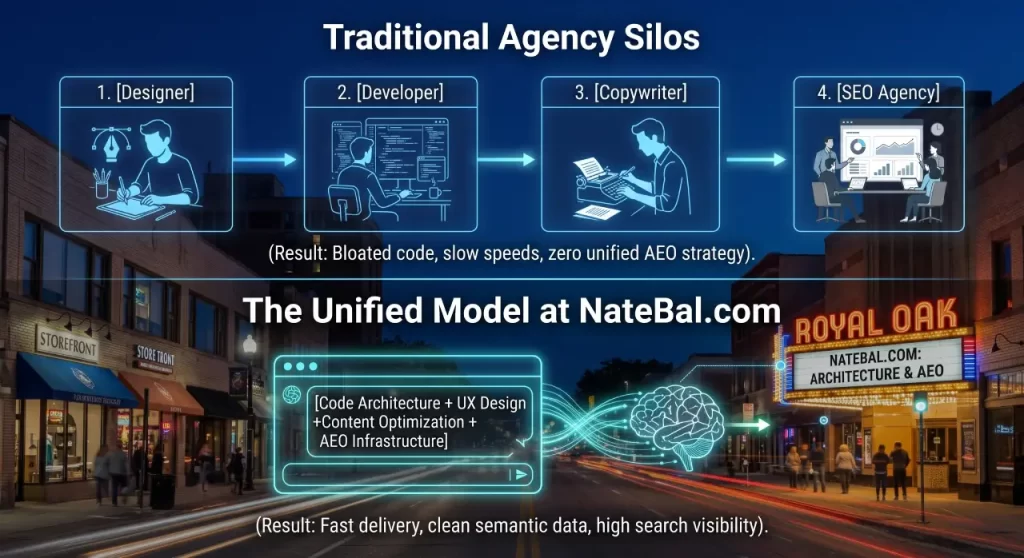
Most companies solve their digital growth puzzles by hiring an assembly line of disconnected vendors. They contract a graphic designer to build a mockup, a developer to code it, an SEO copywriter to fill the pages, and an agency to run promotions.
The problem is that none of these people talk to each other cleanly. The designer builds visually heavy layouts that tank your load speed. The developer builds templates that fail basic accessibility standards. The SEO writer dumps unreadable walls of text over everything. The UX suffers, the technical performance tanks, and AI crawlers bounce without extracting meaningful data.
Working with NateBal.com gives you an unfair advantage because I eliminate the communication breakdown entirely.
I build custom code, optimize user experience, write authoritative content, and implement high-level semantic search strategies under one roof. I design websites that look sharp, convert real humans, run fast, and present perfectly structured data to AI crawlers. That cross-disciplinary execution is essential for getting real results from Michigan Answer Engine Optimization Services.
Technical Foundations: Custom WordPress and Speed
A successful AI optimization strategy falls flat if your website engine is clunky, slow, or tangled in thirty unmanaged plugins. Conversational crawlers run on strict computational budgets. If your server takes two seconds to respond and serves an oversized bundle of render-blocking scripts, bots often abandon the crawl before extracting your core content.
You can dive deeper into this issue by reading about what do AI search bots crawl for to understand how automated agents process complex websites.
To stay competitive, your site needs clean, performant engineering. Eliminating page bloat is not just a nice technical metric; it directly drives conversions. Fast sites earn better search rankings and keep potential clients engaged long enough to convert, as detailed in this breakdown on how fast websites more traffic higher sales work hand-in-hand.
Building for AI visibility means crafting a lean WordPress environment where every template serves semantic HTML5 tags, structured schema blocks, and clean text strings. You can streamline this technical overhead using a purpose-built WordPress plugin for Answer Engine Optimization to handle the structural heavy lifting automatically.
Turning Zero-Click Searches into Paying Customers
A frequent concern among small business owners is whether appearing in conversational summaries actually creates paying customers. If a user receives their answer right inside the interface, why would they ever pick up the phone?
The reality comes down to consumer intent.
If someone asks an AI an informational question like “What is the boiling point of water at high altitudes?”, that search is zero-click by nature. The searcher consumes the number and closes the tab. Nobody buys a service off that query.
However, commercial and local queries function entirely differently. When a regional warehouse manager asks an AI, “Who provides industrial refrigeration repair near Detroit with emergency response times?”, the user is looking to hire a vendor.
The engine summarizes the best options and explicitly cites its sources. Because the AI already vetted the company to generate the recommendation, the searcher approaches your brand with high baseline trust. They click through your citation link or search your brand name directly to submit an inquiry. By deploying targeted Michigan Answer Engine Optimization Services, you stop chasing low-intent vanity pageviews and start securing high-intent, decision-ready prospects.
A Step-by-Step Blueprint for Generative Search Dominance
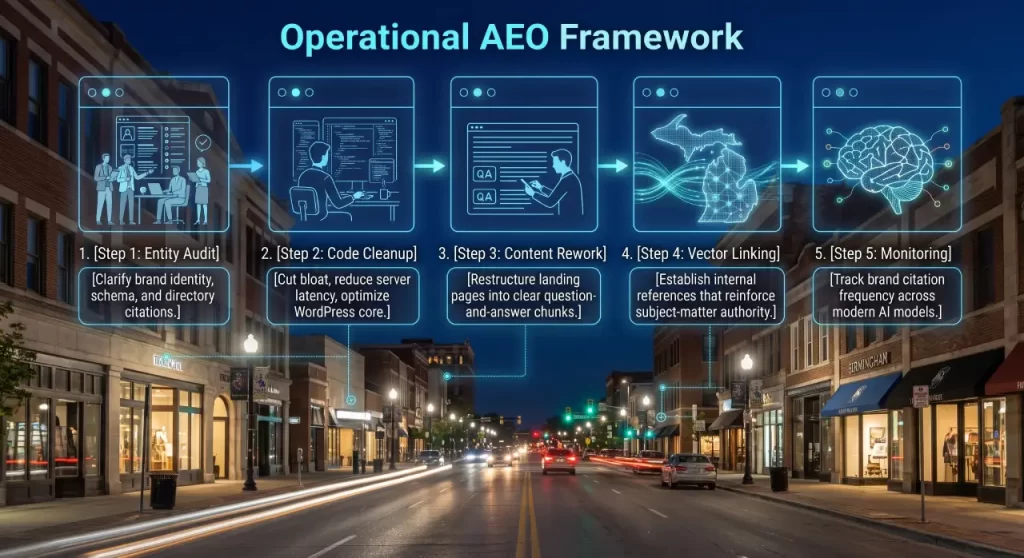
Transforming your business from an invisible web entity into a frequently cited regional authority takes disciplined, deliberate engineering. Here is the operational framework we implement for clients:
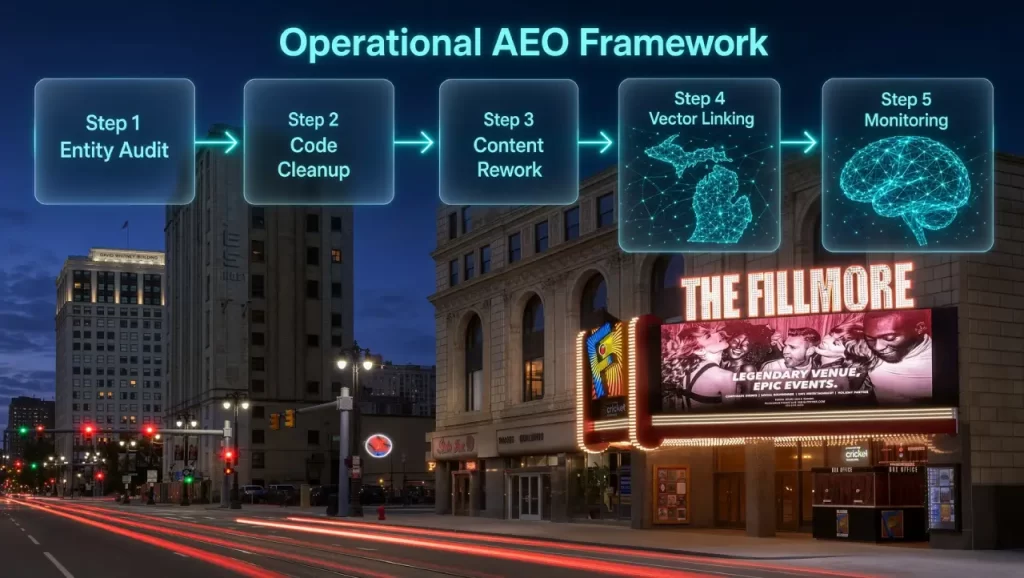
First, we clarify your digital footprint across public registries and structured schema data. Search models need to identify your brand as an unambiguous entity with verified service boundaries, physical headquarters, and professional licenses.
Second, we strip away code bloat. We run modern server-level optimizations and install specialized tooling. If you prefer to review accessible software options yourself, you can explore these 5 free WordPress plugins to get listed in AI search to evaluate foundational tools that improve machine discoverability.
Third, we overhaul your on-page content architecture. We convert vague claims into direct, authoritative answers to high-value customer questions. We organize key points using HTML definition lists, simple tables, and clean headers that algorithms can parse without human intervention.
Finally, we track your presence inside generative systems. To master the specifics of getting recommended inside closed conversational platforms, check out this guide on how to get listed on ChatGPT for actionable implementation tactics.
Strategic Breakdown: AEO Versus Traditional SEO
Understanding the tactical differences between search eras makes it easier to allocate your marketing budget intelligently.
| Tactical Area | Traditional SEO Approach | Michigan Answer Engine Optimization Services Approach |
| Keyword Strategy | Target isolated short and long-tail phrases | Build context around topical entities and natural-language prompts |
| Content Creation | Long, descriptive paragraphs designed to maximize dwell time | High-density information blocks designed for instant machine extraction |
| Site Architecture | Deep nested navigation paths and extensive category silos | Flat, high-speed architectures layered with JSON-LD semantic data |
| Competitor Focus | Outranking competing URLs on classic results pages | Becoming the authoritative source cited across multiple conversational engines |
| Conversion Focus | Catching browsing traffic at the very top of the sales funnel | Capturing decision-ready buyers who receive algorithmic brand endorsements |
Applying both methodologies in harmony gives your business complete coverage across legacy search platforms and conversational AI models alike.
Why Regional Michigan Businesses Need Specialized AEO
Local search queries are inherently contextual. When a homeowner in Ann Arbor asks an AI tool to suggest a reliable residential basement waterproofing specialist, the engine runs a sophisticated calculation:
- It evaluates the searcher physical location.
- It parses business entities within that target radius.
- It cross-references regional customer reviews and industry accreditations.
- It looks for clear operational details directly on the company website.
If your web footprint fails to communicate your precise service areas using clean schema code, the engine skips your company and recommends a competitor down the street. When you partner with a dedicated Michigan AEO consultant, you ensure your site serves the exact localized data structures that automated systems need to see before serving up a regional recommendation.
From family-owned service firms in Grand Rapids to manufacturing hubs in Detroit, local companies need modern technical foundations to stay ahead. Investing in targeted Michigan Answer Engine Optimization Services ensures your brand remains the top recommended provider across every screen in your territory.
Frequently Asked Questions About Modern AEO
How is AEO different from traditional SEO, and do I need both?
Traditional SEO focuses on positioning your site on classic search engine results pages to drive organic link clicks. Answer Engine Optimization (AEO) formats, structures, and optimizes your data so generative engines can extract your knowledge and cite your company in conversational answers. You need both. Traditional SEO keeps your web presence discoverable to indexers, while modern AEO guarantees your business gets recommended when users switch to conversational prompts.
Why did our organic traffic drop even though our keyword rankings didn’t change?
Your traffic likely dropped because modern search interfaces resolve user questions directly on the results screen. With automated summaries and interactive snippets occupying prime screen real estate, traditional listings receive fewer clicks than ever before. If your site does not supply the clean source material that powers those generative summaries, your visibility drops even if your rank tracker shows no change.
How do ChatGPT, Perplexity, and Google AI Overviews decide which brands to cite or recommend?
Generative search tools select sources based on semantic relevance, domain authority, crawl performance, and structured clarity. They prioritize domains that provide direct answers, display valid JSON-LD entity schema, resolve with low server latency, and maintain consistent factual details across independent directories.
If AI search produces zero-click answers, how does AEO actually drive leads or revenue to our site?
AEO targets high-intent transactional prompts rather than casual research queries. When an AI tool recommends your company as the premier provider for a specific service, that mention functions as a trusted endorsement. Prospective clients follow the citation link to finalize arrangements or search for your brand name directly to book an appointment.
Can AEO help our local business get recommended when someone asks AI for service providers in our area?
Yes. By anchoring your web assets with localized structured data, consistent regional citations, and clear service definitions, you make it easy for conversational algorithms to verify your operational presence. When local consumers run natural-language prompts for nearby professionals, your brand surfaces as the direct solution.
Elevate Your Search Strategy with NateBal.com
The transition toward AI-driven search is not a distant trend. It is reshaping how consumers discover, evaluate, and hire service providers right now. Holding onto outdated digital marketing habits while search behavior changes around you only makes it harder for high-value prospects to find your business.
You do not need a bloated agency billing you for endless strategy meetings while junior staffers learn basic coding on your dime. You need an experienced specialist who writes custom code, understands human psychology, crafts high-converting copy, and understands generative search architecture inside and out.
Stop letting zero-click answers cut into your revenue. Step into the future of digital discovery with proven, battle-tested Michigan Answer Engine Optimization Services designed to turn artificial intelligence into your strongest inbound sales channel.
Explore comprehensive Answer Engine Optimization Services at NateBal.com and claim your spot at the top of modern conversational search today.
Be the Answer AI Recommends.
Standard SEO isn’t enough in the age of AI. Optimize your data to become the primary source for the world’s most powerful Answer Engines.

