


Answer Engine Optimization (AEO) is crucial for digital discoverability, focusing on structuring content for direct extraction by AI search algorithms and conversational systems. Unlike traditional SEO, AEO aims for 'position zero' visibility, securing featured snippets, voice search results, and direct answers. It ensures your brand is cited as the definitive source, vital for capturing zero-click queries and establishing authority in the evolving landscape of generative AI.
Strategic Pillar Context Maps
Just what are the differences between SEO vs AEO vs GEO? Hopefully this post can demystify what makes each one of these unique and important in there own ways. Search Engine Optimization (SEO), Answer Engine Optimization (AEO), and Generative Engine Optimization (GEO) represent three distinct, evolutionary tiers of digital discoverability: discovery through ranked index links, extraction as a direct factual answer, and synthesis within generative artificial intelligence.
1. SEO vs. AEO vs. GEO Defined

Answer Engine Optimization (AEO): The practice of formatting, structuring, and signal-optimizing digital content so that search algorithms and conversational systems can extract, isolate, and present it as a single, definitive direct answer. Rather than directing users through multiple exploratory web links, AEO targets voice search results, featured snippets, People Also Ask (PAA) modules, and direct Q&A widgets that answer a user’s prompt immediately at “position zero”.
Generative Engine Optimization (GEO): The strategic methodology of optimizing digital content, entity authority, and cross-web presence so that Large Language Models (LLMs) evaluate, synthesize, and cite your brand or data within multi-source generative responses. Formally conceptualized in peer-reviewed AI research (Princeton, Georgia Tech, and the Allen Institute for AI), GEO optimizes for multi-constraint conversational prompts, comparative product evaluations, and contextual summaries across platforms such as ChatGPT Search, Perplexity, Claude, Google AI Overviews, and Microsoft Copilot.
Search Engine Optimization (SEO): The discipline of structuring website architecture, technical performance, and on-page content to rank specific URLs in top positions on search engine result pages (SERPs) for targeted search terms. Its foundational currency is algorithmic crawlability, keyword indexing, and domain backlink equity, with success measured primarily by rankings, impressions, and organic click-through traffic to the website.
2. Core Differences: SEO vs. AEO vs. GEO
While all three disciplines share common roots in content relevance and crawl accessibility, they target fundamentally different algorithmic engines, content granularities, and evaluation mechanics.
| Dimension | Search Engine Optimization (SEO) | Answer Engine Optimization (AEO) | Generative Engine Optimization (GEO) |
| Primary Goal | Rank target URLs in top positions on traditional SERPs. | Win featured snippets and direct answers for specific questions. | Earn citations, recommendations, and brand share within AI-generated responses. |
| Target Engine | Algorithmic web crawlers (Googlebot, Bingbot). | Extraction parsers, voice assistants, and SERP QA widgets. | LLMs paired with real-time RAG pipelines (ChatGPT, Perplexity, Gemini, Claude). |
| Core Mechanism | Inverted keyword indexing, link graphs, and user engagement signals. | Passage retrieval, schema validation, and semantic question-matching. | Vector embeddings, semantic similarity scoring, neural reranking, and multi-source synthesis. |
| Content Scope | Comprehensive, keyword-targeted pages and technical site health. | Concise, self-contained 40–60 word answer blocks and inverted-pyramid passages. | Proprietary data, primary research, expert quotations, statistics, and entity authority. |
| Optimization Focus | First-party owned media (your on-site pages and technical code). | On-page answer micro-formatting, FAQ blocks, and JSON-LD schema. | Holistic digital footprint: owned content plus third-party consensus, reviews, and PR. |
| Output Type | Ranked list of clickable links (“10 blue links”). | Direct snippet or voice response with a single source attribution. | Custom-synthesized narrative blending multiple sources with inline reference citations. |
| Dominant KPI | SERP rank (#1–#10), organic sessions, and organic CTR. | Snippet win rate, zero-click answer impressions, and brand attribution. | Citation Inclusion Rate (%), Share of Voice (SoV), and prompt sentiment. |
SEO vs. AEO vs. GEO The Three Critical Divergences
- Extraction vs. Synthesis: AEO optimizes for extraction—getting an engine to lift an exact, verbatim sentence or table from your page to answer an explicit factual question (e.g., “What is the difference between X and Y?”). GEO optimizes for synthesis—ensuring that when an AI ingests twenty sources to respond to a complex, multi-intent prompt (e.g., “Compare the top three enterprise CRMs for a healthcare startup under $100/mo”), your unique data points and perspectives are woven into the generated summary.
- Owned Website vs. Distributed Ecosystem: SEO and AEO primarily focus on first-party properties: optimizing your HTML, publishing content on your domain, and securing direct backlinks. GEO is heavily weighted by the broader web ecosystem: AI models validate facts against knowledge bases (Wikidata, Wikipedia), industry directories (G2, Trustpilot), community discussions (Reddit, GitHub), and third-party publications to verify consensus before recommending an entity.
- Keyword Density vs. Information Gain: Traditional SEO rewards thorough keyword coverage and domain authority. GEO penalizes generic redundancy: models reward Information Gain—novel statistics, original benchmarks, case studies, and attributed expert quotes. In fact, empirical AI studies reveal that adding statistics (+37%) and expert quotes (+30%) yields the highest visibility gains in AI models, while keyword stuffing degrades generative visibility.
3. The Strategic Significance of All Three
Treating SEO, AEO, and GEO as mutually exclusive or competing strategies is a structural mistake. In modern digital architecture, they operate as a unified, three-tiered visibility funnel.
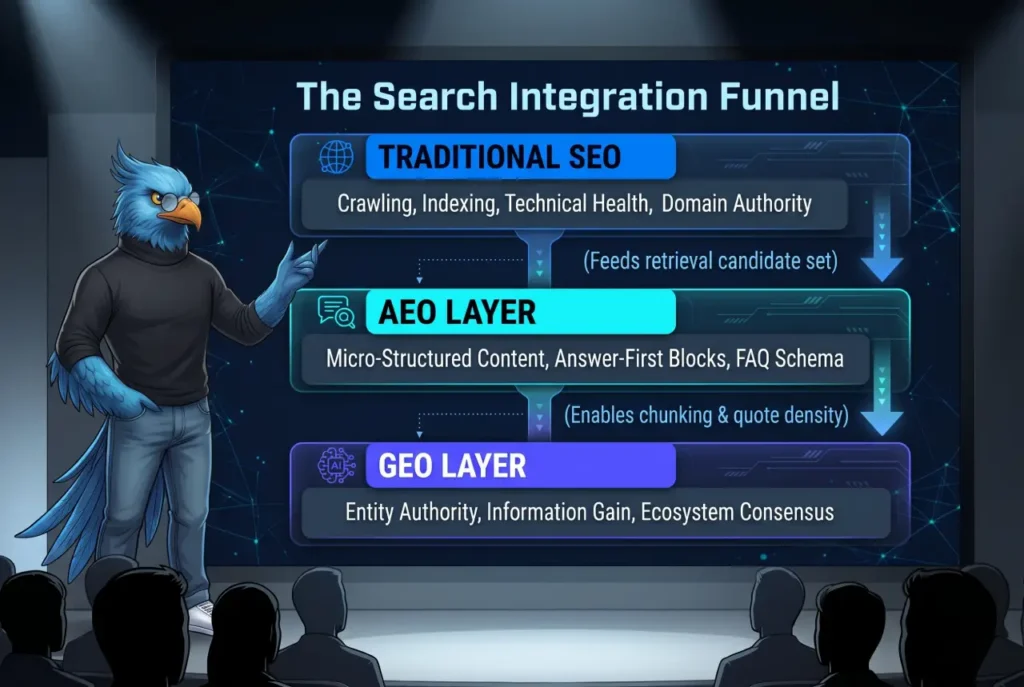
Why SEO Remains Indispensable

SEO is the structural bedrock upon which all AI discovery relies. Generative and answer engines do not crawl the entire live web from scratch for every query; they query underlying search engine APIs (such as Bing or Google) to compile an initial candidate pool of 20 to 50 URLs. If a website lacks technical crawlability, clean server response times, indexable HTML, and baseline domain trust, it never enters the retrieval pool that AI models analyze. SEO ensures your content is eligible to be seen in the first place.
Why AEO Is Vital in a Zero-Click Reality
AEO captures searchers who demand instant resolution. As more than half of standard search queries end without a click to an external website, visibility at “position zero” preserves top-of-mind brand authority. When your business is cited as the definitive answer for technical definitions, industry methodologies, and immediate problem-solving queries, you establish yourself as the primary source of truth before users ever reach competitors.
Why GEO Dictates Future Brand Selection
GEO protects brand relevance as buyer behavior shifts from search engines to conversational assistants. In conversational interfaces, users evaluate options, compare feature sets, and eliminate vendors entirely within the chat window.
If an AI engine does not recognize your brand entity or omits your solutions from a generated comparison, your business is effectively invisible during critical decision-making moments. Furthermore, visitors who click an inline citation from an AI engine arrive with significantly higher commercial intent, having already completed their initial evaluation phase inside the conversational interface.
Achieving digital market leadership requires maintaining technical health and indexation (SEO), formatting key sections for immediate machine extraction (AEO), and establishing the proprietary data and entity authority required to lead conversational recommendations (GEO).
What is Answer Engine Optimization (AEO)?
Core Definition & Industry Distinction
Answer Engine Optimization (AEO) is the practice of structuring, refining, and signal-optimizing digital content so that Large Language Models (LLMs) and conversational AI engines can easily extract, synthesize, and cite it as a definitive answer to user queries.
Unlike traditional search engines that deliver a list of relevant links, answer engines synthesize information from multiple sources to provide a single, direct, natural-language response. AEO focuses on maximizing visibility, citation frequency, and referral placement within these synthesized outputs.
A traditional search engine index relies on web crawlers to map pages, build inverted keyword indexes, and rank URLs based on algorithms like PageRank, link graphs, and user interaction signals, yielding a list of hyperlinked documents.
An AI answer engine combines real-time retrieval with generative text synthesis. It converts unstructured web data into high-dimensional vector embeddings, retrieves relevant chunks of content via semantic matching (using Retrieval-Augmented Generation, or RAG), and passes these chunks to an LLM context window. The LLM processes the context and constructs a cohesive, human-like answer in real time, generating inline citations rather than just displaying static search listings.
While these three disciplines overlap, they target different algorithms and presentation layers:
- Traditional SEO: Targets traditional crawler algorithms (Googlebot/Bingbot) to rank target URLs in top positions on Search Engine Results Pages (SERPs) using keywords, backlinks, and technical site structure.
- Generative Engine Optimization (GEO): Broadly optimizes brand visibility across generative AI models (ChatGPT, Claude, Gemini) for complex, open-ended conceptual queries and synthesized summaries.
- Answer Engine Optimization (AEO): Specifically targets conversational search surfaces (Perplexity, ChatGPT Search, Google AI Overviews) to secure direct answers, featured snippets, and explicit inline citations using inverted-pyramid passages, schema markup, and entity clarity.
AEO sits directly on top of organic SEO rather than replacing it. Traditional SEO serves as the foundational infrastructure: technical crawlability, indexation, domain authority, clean site architecture, and content depth remain absolute prerequisites for AI discovery.
Answer engines rely heavily on search engine indexes (such as Bing or Google Search APIs) to identify candidate URLs before running RAG pipelines. Without solid organic SEO fundamentals, a domain is unlikely to enter the retrieval pool that AI models analyze to construct final answers.
Platforms qualify as answer engines if their primary user experience centers on direct natural-language synthesis generated by LLMs with real-time or hybrid retrieval mechanisms:
- Dedicated AI Search Engines: Perplexity AI, Genspark.
- Conversational Search Extensions: ChatGPT Search (OpenAI), Claude with Web Search (Anthropic), Gemini (Google).
- Hybrid Search Interfaces: Google AI Overviews / Search Generative Experience (SGE), Microsoft Copilot in Bing.
- Voice & Assistant Endpoints: Siri, Google Assistant, and Alexa (increasingly powered by LLM backend pipelines).
The shift was accelerated by three converging industry forces:
- User Efficiency & Intent Fulfillment: Searchers prefer immediate, synthesized answers over clicking through multiple external websites, bypassing intrusive cookie banners, and hunting through bloated introductory paragraphs.
- Breakthroughs in LLM Capabilities: Transformer architectures made zero-shot and few-shot natural language understanding and generation fast, cohesive, and cost-effective at global scale.
- Retrieval-Augmented Generation (RAG): RAG bridged the gap between static LLM training cutoff dates and real-time information needs, allowing models to cite current sources dynamically and reducing hallucination risks sufficiently for public deployment.
Content Strategy & Semantic Structuring
Web pages should follow a modular, highly semantic layout that minimizes visual or code noise and isolates distinct concepts into machine-readable blocks:
- Explicit Heading Hierarchies: Maintain strict nesting (H1 → H2 → H3). Ensure headings clearly state the core topic using natural language questions or concise statements.
- “Answer-First” Paragraph Blocks: Place a 40–60 word summary, definition, or direct answer immediately beneath each major heading before expanding into technical nuances.
- Semantic HTML Tags: Structure content using native tags (
<article>,<section>,<header>,<table>,<ol>,<ul>) to help LLM parsers separate core body text from navigation menus and sidebars. - Self-Contained Passages: Structure each section so that it remains contextually clear if extracted as an isolated passage without the surrounding page context.
The inverted pyramid style—presenting the core conclusion first, followed by supporting evidence and background context—is vital for AEO. RAG systems segment web pages into finite token chunks (typically 256 to 512 tokens).
When an engine calculates vector similarity between a user query and your document chunks, chunks that lead with a clear, definitive statement achieve significantly higher semantic proximity scores than chunks containing introductory fluff. As a result, inverted-pyramid paragraphs are prioritized during the generation step.
To align headers and FAQ modules with conversational search behavior:
- Mirror Long-Tail Prompt Syntax: Phrase headers using full interrogative sentences (e.g., How does X impact Y? or What is the difference between X and Y?) rather than generic terms (Impact of X).
- Target Question Triggers: Use conversational prompt prefixes such as Why does, How to, What is, Can you, and Best way to.
- Keep FAQ Units Unambiguous: Ensure the question is explicitly contained within the header tag and the immediate next paragraph contains the complete answer without relying on ambiguous pronouns like “as mentioned above.”
Optimal performance relies on a hybrid structure combining both approaches:
- Bite-Sized Answers Inside Long-Form Documents: Long-form content provides the broad topical authority, contextual depth, and semantic footprint required for an engine to trust a domain. However, the internal structure of that long-form piece must contain clear, bite-sized, extractable answer blocks.
- Why Pure Short-Form Fails: Concise pages with minimal depth often lack the overall topical authority required to enter the initial retrieval pool.
- Why Pure Unstructured Long-Form Fails: Dense narrative content without explicit summary blocks increases parsing friction, causing the LLM to choose cleaner sources during synthesis.
Entity salience measures how central a specific named entity (brand, technology, person, topic) is to the semantic meaning of a document. Topical authority represents a site’s overall depth of coverage across a cluster of related concepts.
AI answer engines select sources based on knowledge graphs and vector embeddings. If your site consistently publishes deeply interconnected, accurate content about a defined topic, your domain establishes high topical authority within that vector space. When an LLM processes a prompt, it prioritizes sources where the target entity demonstrates high salience and where the domain sits close to the query’s core concept within knowledge representations.
To optimize legacy content for AI extraction, execute the following steps:
- Add Definition Boxes: Insert a 2–3 sentence summary at the beginning of each major section that defines key concepts directly.
- Convert Prose to Data Structures: Transform dense comma-separated lists or long explanatory text into structured HTML tables or bulleted lists.
- Remove Conversational Filler: Strip out rhetorical intros (e.g., \”In today’s fast-paced digital world…\”) and meta-commentary.
- Disambiguate Pronouns: Replace ambiguous pronouns (it, this, they, these platforms) with specific entity names (ChatGPT, vector databases, JSON-LD schema) so extracted chunks retain full context independently.
- Inject Structured Schema: Embed corresponding JSON-LD (FAQPage, TechArticle, HowTo) matching the structural elements of the page.
Content categories at high risk of zero-click summarization include:
- Simple Factual Queries: Unit conversions, definitions, dates, and historical facts.
- Basic How-To Guides: Simple linear processes (e.g., How to clear cache in Chrome).
- Listicles & Aggregations: Best-of lists, software summaries, and top-ten roundups where brief summaries satisfy the query.
- High-Level Overview Articles: Conceptual introductory content that lacks proprietary data, original research, or distinct expert opinions.
Content that retains click-through traffic includes detailed original research, interactive tools, proprietary benchmarking data, complex troubleshooting requiring deep contextual nuance, and transactional workflows.
Technical Architecture & Machine Data Signaling
JSON-LD schema provides machine-readable metadata that helps AI scrapers understand entity relationships and page intent without processing ambiguity. Key schema types include:
- FAQPage / Question & Answer: Explicitly defines prompt-and-response structures.
- Article / TechArticle / NewsArticle: Signals original content, authorship, publishing dates, and main entity focus.
- HowTo: Outlines step-by-step procedures, tools, and expected outcomes.
- Dataset: Highlights structured tables, empirical data, and research outputs.
- Organization / Person: Defines authoritativeness, corporate identity, social profile links (via
sameAs), and brand verification. - Product / SoftwareApplication: Categorizes commercial offerings, feature sets, pricing, and technical requirements.
An llms.txt file is a proposed web standard (similar to robots.txt) placed at the root of a domain (e.g., example.com/llms.txt). It provides a curated, Markdown-formatted directory of a website’s key pages, explicitly structured for LLM intake and context building.
While not yet a universally enforced standard by every AI crawler, implementing llms.txt reduces parsing overhead for supported AI scrapers, streamlines chunking pipelines, and ensures that model context windows receive clean, high-priority markdown versions of your core documentation.
AI crawlers differ significantly from traditional search engine bots in intent, frequency, and data parsing depth:
- Googlebot: Designed for comprehensive indexing, tracking link structures, calculating PageRank, and evaluating rendering performance (Core Web Vitals). It caches entire visual rendering pipelines.
- GPTBot / ChatGPT-User (OpenAI): GPTBot crawls to collect large-scale training data; ChatGPT-User acts as an real-time user agent to fetch contextual web content during live queries. They prioritize clean text extraction, skipping heavy media assets.
- PerplexityBot (Perplexity): Optimized for low-latency real-time retrieval. It targets specific high-authority domains, parses semantic text blocks rapidly, and frequently bypasses non-essential page assets to minimize context-retrieval time.
- ClaudeBot / Anthropic-AI (Anthropic): Focuses heavily on high-density informational content for dataset building and model refinement, demonstrating low tolerance for JavaScript-rendered obstacles.
Blocking dedicated AI crawlers (e.g., User-agent: GPTBot or User-agent: PerplexityBot) in your robots.txt file does not harm your traditional Google or Bing organic search rankings, as those rely on Googlebot and Bingbot.
However, blocking them completely removes your site from real-time RAG pipelines on those platforms. If GPTBot or PerplexityBot is forbidden from fetching your URLs, the corresponding answer engines cannot read or cite your content when synthesizing responses for users, reducing your brand’s AI-driven share of voice.
In real-time RAG operations, latency is critical. When a user enters a query into an answer engine, the engine has a strict timeout budget (often under 2–3 seconds) to perform web searches, fetch page contents, extract chunks, synthesize text, and present the answer:
- DOM Cleanliness: Complex, deeply nested HTML, bloated scripts, and inline CSS add extraneous token overhead, slowing down the parser.
- Server Response Time (TTFB): If a web server responds slowly, the AI scraper’s real-time fetch operation will time out, causing the pipeline to skip the page and use a faster competitor.
- Render-Blocking Assets: Heavy client-side requirements that delay textual availability increase processing overhead, making the content less accessible for dynamic retrieval.
Client-side JavaScript rendering poses a challenge for many AI scrapers. Unlike Googlebot, which allocates resources to execute JavaScript via a headless rendering engine, many real-time AI scrapers use fast HTML parsers that do not execute client-side scripts:
- The SPA Risk: If your website relies on React, Vue, or Angular to render body text dynamically on the client side, an AI scraper may fetch an empty
<div id=\"app\"></div>shell, missing your content completely. - The Solution: Implement Server-Side Rendering (SSR), Static Site Generation (SSG), or dynamic rendering solutions. Ensure that full HTML text content is delivered directly in the initial HTTP response payload.
Platform Mechanics & Citation Logic
RAG systems select candidate URLs through a multi-stage retrieval and reranking framework:
- Query Expansion: The system converts the user’s conversational prompt into optimized search queries.
- Initial Search Fetch: It queries underlying search APIs (like Bing, Google, or proprietary indexes) to retrieve a pool of top-ranking candidate URLs (typically 10–30 results).
- Scraping & Passage Extraction: It extracts raw text from those candidate pages and segments it into distinct content chunks.
- Vector Similarity & Reranking: Embeddings of the content chunks are compared against the query vector. A reranking model scores chunks based on factual density, authority, and semantic match.
- Context Window Selection: The top-ranked chunks are injected into the LLM’s prompt context window to generate the final response with references.
Yes. While traditional organic rankings influence the initial candidate retrieval pool, answer engines prioritize semantic relevance, chunk density, and structural clarity over pure rank order.
If a page ranked #8 in Google contains an explicit, well-structured table or clear inverted-pyramid answer block that directly answers the query better than the #1 page, the RAG reranker will assign a higher score to the #8 page’s chunk. Consequently, the LLM will draw from and cite the lower-ranking page as its primary source.
Explicit citations are triggered when:
- Real-Time Data Retrieval is Invoked: The answer engine relies on an external search fetch step (RAG) to fulfill the prompt rather than drawing solely from pre-trained parametric memory.
- Direct Attribution Logic Requires Verification: The system architecture requires verifiable external grounding for dynamic data, statistics, quotes, or highly specific claims.
- High Semantic Similarity Match: The LLM uses a distinctive, highly specific sequence of facts or structures sourced directly from a retrieved chunk.
Uncredited synthesis occurs when the query addresses general knowledge deeply embedded in the model’s static training parameters (e.g., \”What is the boiling point of water?\”), eliminating the need for an external web fetch.
Knowledge bases function as foundational truth anchors for LLMs:
- Pre-Training Phase: Structured resources like Wikipedia and Wikidata are heavily weighted in training datasets to establish baseline entity-relationship maps, historical facts, and taxonomy definitions.
- Real-Time Disambiguation: During live retrieval, knowledge graphs help the engine identify entities within user prompts (e.g., clarifying whether \”Apple\” refers to the technology company or the fruit).
- Entity Verification: When an answer engine reads unstructured web text, it cross-references identified facts against standard knowledge graph nodes to verify accuracy before presenting cited outputs.
Answer engines prioritize information quality over pure legacy domain metrics (like backlink authority) by evaluating several trust factors:
- Information Gain & Uniqueness: Content that offers original data, primary evidence, or distinct expert insights scores higher than aggregated rehashes.
- Semantic Precision: Direct, non-ambiguous answers that directly address the query with zero conversational filler.
- Entity Verification & Citation Consistency: Claims that align with established consensus across related authoritative sources in the same vector space.
- Schema Accuracy: Fully implemented, non-spammy JSON-LD markup validating the page’s factual claims.
Tracking, Analytics & Attribution
Tracking AI referrals in GA4 requires creating custom channel groupings and monitoring specific referral domains:
- Identify Referral Hostnames: Filter for traffic originating from known AI domains, such as
chatgpt.com,perplexity.ai,copilot.microsoft.com, andgemini.google.com. - Configure Custom Channel Groupings: Navigate to Admin > Data Settings > Custom Channel Groupings in GA4. Create a new channel labeled AI Search / Answer Engines.
- Set Grouping Rules: Define rules matching Source or Referrer regex conditions:
.*(chatgpt|perplexity|claude|copilot|genspark).* - Monitor UTM Parameters: Note that links included within AI engine responses often append specific query identifiers or platform-specific tracking tags.
AI engine traffic often fails to register under traditional organic search channels due to several technical factors:
- In-App Mobile Webviews: Users accessing answer engines through native mobile apps (e.g., ChatGPT iOS app) may trigger web visits that drop HTTP referrer headers, routing the session into GA4 as
(direct) / (none). - Cross-Domain Protocol Drops: Transitions from secure application contexts to destination sites can strip referral headers if referrer policies (e.g.,
strict-origin-when-cross-origin) are not explicitly configured to preserve origin data. - Server-Side Proxy Requests: Some engines fetch or validate destination links via background proxy servers, which prevents standard client-side JavaScript analytics tags from registering the original user intent.
A specialized ecosystem of AEO and GEO monitoring tools has emerged to track brand visibility across conversational models:
- Specialized Platforms: Tools such as BrightEdge Generative Parser, Proseo, Otterly.AI, GEOInsights, and ShareOfAI.
- Core Tracking Capabilities: These platforms automatically submit standardized prompt sets across ChatGPT, Perplexity, Gemini, and Claude to monitor:
- Citation Rate: How often your domain is cited relative to total prompt runs.
- Share of Voice (SoV): Percentage of synthesized answers mentioning your brand versus competitors.
- Sentiment & Accuracy: Whether the AI describes your products accurately and positively.
Measuring ROI in a zero-click ecosystem requires looking beyond standard site traffic:
- Brand Mention Share & Sentiment: Track top-of-funnel brand awareness by monitoring your citation share in response to commercial purchase-intent prompts.
- Assisted Direct Conversions: Monitor increases in branded organic search volume and direct domain entry—users often research via AI interfaces and subsequently navigate directly to your site to purchase.
- Qualified Pipeline Quality: While overall referral volumes from AI engines may be lower than legacy organic search, conversion intent is often higher. Track micro-conversions and lead-to-opportunity rates specifically for AI-referred sessions.
- API Content Monetization: For publishers, explore licensing content directly to AI developers for training and real-time retrieval feeds.
Traditional keyword metrics transition into semantic visibility indicators:
- Citation Inclusion Rate (%): Percentage of target prompts where your URL appears as a cited footnote.
- Prompt Cluster Impression Potential: Estimated volume of conversational queries mapped to a semantic topic cluster.
- Synthesized Answer Share-of-Voice (SoV): Frequency of brand mentions within generated text compared to competitors.
- Referral Traffic Intent / Conversion Rate: Downstream conversion velocity of visitors entering via AI platform referrers.
- Entity Association & Vector Proximity: Strength of semantic alignment between your brand entity and industry concepts.
Brand Protection, Accuracy & Risk
Remediating AI hallucinations or incorrect brand data requires addressing both real-time retrieval inputs and training data sources:
- Update Root Source Material: Ensure all official digital properties (About Us, Pricing, Product Docs, Press Releases) contain clean, unambiguous facts and JSON-LD markup detailing correct information.
- Correct Core Knowledge Bases: Update structured databases including Wikidata, Wikipedia, Crunchbase, and major industry directories, as models rely heavily on these nodes for fact verification.
- Publish Explicit Clarification Notes: Release targeted content specifically addressing common misconceptions (e.g., \”Company X Product Y Capabilities & Technical Specifications\”).
- Submit Feedback via Platform Mechanisms: Utilize platform-specific developer channels, feedback controls, or direct publisher contact forms provided by OpenAI, Perplexity, and Google to flag hallucinated outputs.
Yes, AI answer engines are vulnerable to manipulative tactics often referred to as \”negative GEO\” or \”vector poisoning\”:
- Scraped Content Disparagement: Competitors can distribute negative press releases, sponsored articles, or automated low-quality blog posts designed to associate your brand with negative keywords across scraped indexes.
- Prompt Injection Techniques: Embedding adversarial text prompts within public web pages (e.g., white text on a white background) attempting to instruct AI web scrapers to misinterpret brand details.
- Mitigation Strategy: Protect your digital footprint by maintaining high domain authority, securing active brand monitoring alerts across generative outputs, and consistently publishing authoritative, first-party data.
Publishers must balance content protection with discovery visibility through strategic controls:
- Granular Crawler Management: Block dedicated training crawlers (e.g., CCBot, GPTBot) via robots.txt to prevent unauthorized LLM training while permitting live retrieval crawlers (e.g., ChatGPT-User) to maintain search visibility.
- Implement Paywalls & Structured Snippets: Protect main body content behind paywalls while exposing schema-marked summary snippets to authenticated crawlers.
- Content Licensing Partnerships: Direct publisher-to-LLM commercial licensing agreements secure recurring compensation for content usage while establishing verified content ingestion pipelines.
As user evaluation shifts toward conversational chat interfaces, marketing funnels adapt in key ways:
- Funnel Compression: The evaluation phase moves into the chat window. The AI aggregates product features, pricing, reviews, and pros/cons, delivering a synthesized decision matrix in a single step.
- Middle-of-Funnel Traffic Drops: Websites experience decreased traffic on preliminary research and comparison pages.
- High-Intent Bottom-of-Funnel Visits: Users visiting websites late in the cycle have already processed comparative evaluations within the AI interface. They arrive on direct landing or transaction pages with high intent to convert.
- Optimization Shift: Marketing efforts must ensure product specifications, social proof, pricing clarity, and differentiation factors are optimized for AI context windows during the chat evaluation phase.
What is Generative Engine Optimization (GEO)?
Foundations & Academic Principles
Generative Engine Optimization (GEO) is the systematic methodology of optimizing digital content and brand entity presence to maximize visibility, citation frequency, and positive sentiment within generative AI search models (such as ChatGPT Search, Google Gemini, Anthropic Claude, Microsoft Copilot, and Perplexity).
Coined and benchmarked in seminal AI research (by researchers from Princeton, Georgia Tech, the Allen Institute for AI, and IIT Delhi), GEO focuses on the specific textual modifications and authoritative signaling techniques that increase a source’s likelihood of being synthesized into AI-generated answers.
While all three disciplines address digital discoverability, they target distinct stages and output structures:
- Traditional SEO: Aims to rank URLs at the top of 10 blue links on traditional SERPs using keyword placement, backlink equity, and technical site performance.
- Answer Engine Optimization (AEO): Targets immediate, factual question-answering surfaces (featured snippets, voice assistants, and dedicated QA widgets) by providing tight, concise answers.
- Generative Engine Optimization (GEO): Optimizes for nuanced, multi-faceted generative synthesis. It targets broad exploratory prompts, comparison matrices, multi-source summaries, and subjective recommendations where the AI evaluates perspective, factual authority, and source consensus.
The foundational 2023 Princeton/Georgia Tech study (“GEO: Generative Engine Optimization”) benchmarked nine specific optimization methods across 10,000 queries. Key empirical findings include:
- Cite Sources (+30% to +40% visibility boost): Explicitly referencing academic studies, verified data sources, and recognized industry bodies yields the highest overall visibility lift.
- Quotation Addition (+30% boost): Incorporating direct quotes from named industry authorities and recognized domain experts substantially elevates citation probability.
- Statistics Addition (+37% boost): Replacing qualitative adjectives with precise quantitative data and benchmark metrics drastically improves passage extraction.
- Fluency & Simplicity: Clean, authoritative, jargon-free prose outperforms keyword-stuffed technical copy.
- Negative Impact of Keyword Stuffing: Attempting to artificially repeat keywords decreases generative visibility by up to 10%, as LLM rerankers penalize repetitive semantic vectors.
A generative engine is an AI system that answers natural-language prompts by combining an underlying Large Language Model (LLM) with real-time web retrieval mechanisms (RAG). Instead of searching an inverted index and returning a list of URLs, it:
- Deconstructs the user’s prompt into sub-queries.
- Retrieves relevant real-time web documents via search APIs.
- Chunks and vectorizes candidate texts to evaluate semantic relevance.
- Synthesizes the most authoritative chunks into a single, cohesive, custom-written answer with inline references.
GEO is critical because user evaluation is shifting from clicking individual website links to reading comprehensive summaries directly inside chat interfaces. When an AI summarizes an entire product category, comparison, or problem-solving strategy, brands not included in the synthesized narrative are invisible to prospective buyers, regardless of their legacy SERP ranking.
Content Optimization & Prompt Alignment
Optimizing content for generative engines requires formatting that aligns with how LLM tokenizers and rerankers evaluate authority:
- Lead with Quantitative Proof: Ground assertions with specific percentages, sample sizes, and empirical findings rather than broad claims.
- Incorporate Expert Perspectives: Embed direct, attributed quotes with named titles and corporate affiliations.
- Structure for Machine Scannability: Use clean comparison tables, ordered step sequences, and bolded takeaway sentences.
- Eliminate Speculative Fluff: Avoid filler transitions (*”In today’s fast-paced digital world…”*) and deliver self-contained, high-density informational blocks.
Information Gain is a algorithmic measure of the net-new, unique information a web page contributes beyond what already exists in the retrieval pool. Generative engines penalize redundancy; if ten articles state the exact same facts, the LLM will synthesize them into a single sentence and cite only the most authoritative domain.
To achieve high Information Gain, publish proprietary benchmark data, first-party case studies, unique failure analyses, or original framework methodologies that do not exist anywhere else on the web.
LLMs process structured tabular data with higher extraction fidelity than dense multi-column prose. For maximum comprehension:
- Use clean, semantic HTML (
<table>,<thead>,<th>,<tbody>,<td>) rather than image-based charts or complex CSS grid layouts. - Ensure column headers are self-explanatory and descriptive (e.g., Execution Speed (ms) instead of just Speed).
- Maintain consistent row attributes and avoid blank or merged cells that break markdown-table parsers.
Unlike short keyword searches (e.g., “best CRM software”), conversational prompts frequently combine 3 to 5 constraints simultaneously (e.g., “What is the best open-source CRM for a 20-person B2B sales team that integrates with PostgreSQL and costs under $50/user?”).
To capture multi-intent queries, construct multi-attribute solution modules on your pages that explicitly correlate budget, team size, technical requirements, and integrations within structured subheadings.
Generative models are trained via Reinforcement Learning from Human Feedback (RLHF) to prioritize objectivity, neutrality, and professional credibility. Content written in an overly promotional, hype-driven, or hyperbolic sales tone is routinely filtered out or stripped of its claims during synthesis.
Maintaining an objective, authoritative editorial stance—acknowledging trade-offs, edge cases, and limitations—significantly enhances a page’s quote-worthiness.
Entity Architecture & Semantic Graphs
Entity SEO is the cornerstone of GEO. Generative engines do not evaluate web pages purely as strings of keywords; they understand concepts as discrete Entities (persons, organizations, software, methodologies) connected by relational vectors in a semantic knowledge graph.
To rank in generative synthesis, your brand must be recognized as an unambiguous entity with clearly defined relationships to industry topics, technologies, and problem domains.
Establishing entity authority requires building consistent, verified signals across trusted external repositories:
- Knowledge Bases: Secure verified entity nodes on Wikidata, Wikipedia (where notable), Crunchbase, and LinkedIn.
- Consistent NAP & Nomenclature: Use identical corporate naming, founder details, and core product terminology across all platforms.
- Co-Occurrence & Digital PR: Ensure your brand is regularly mentioned alongside top-tier industry competitors, academic institutions, and category terms in third-party publications.
- Schema Linking: Use
sameAsarrays in your JSON-LD Organization schema pointing to your canonical external profiles.
The most influential schema markup types for generative models include:
- Organization / Person: Disambiguates authors, founders, and corporate entities with verified identity references (
sameAs). - About & Mentions (Thing): Explicitly identifies the specific entities discussed within an article, helping vector engines map topic relevance without ambiguity.
- Dataset / TechArticle: Signals original empirical data, technical specifications, and research whitepapers.
- ItemPage / SoftwareApplication: Details precise feature sets, licensing, operating systems, and pricing matrices.
Vector proximity refers to the mathematical distance between two concept embeddings within a high-dimensional vector space. When an AI receives a prompt like “Recommend high-performance headless WordPress architectures,” it calculates the distance between that query cluster and known agency or software entities.
If your brand consistently co-occurs in reputable publications alongside concepts like headless CMS, decoupled WordPress, and Core Web Vitals optimization, your vector distance is minimal, causing the LLM to automatically generate your brand as a top recommendation.
Retrieval, RAG & LLM Ranking Mechanics
Generative retrieval follows a multi-stage pipeline:
- Candidate Document Generation: The engine issues search API requests (to Bing, Google, or proprietary indexes) to retrieve 20–50 relevant candidate web pages.
- Passage Extraction & Chunking: The scraper strips HTML boilerplates and segments raw text into semantic passages.
- Cross-Encoder Reranking: An advanced neural reranker evaluates each chunk’s factual density, domain trust, and direct alignment with the prompt’s specific constraints.
- Context Window Allocation: The top 5–10 chunks that provide the most comprehensive, non-redundant answers are injected into the prompt context for the LLM to synthesize.
Yes. While high-authority domains dominate top SERP link positions, generative engines prioritize chunk-level information density and semantic match over pure domain backlink metrics.
If a smaller niche site provides a precise, data-backed answer, clean comparison table, or unique metric that directly answers the multi-intent prompt better than a sprawling generic article from a major publisher, the reranker will prioritize that specific chunk and cite the niche site as the definitive source.
Sources are typically omitted or hallucinated due to:
- Parsing Friction: Heavy client-side JavaScript, deep DOM nesting, or aggressive anti-bot captchas that block real-time RAG scrapers.
- Contextual Ambiguity: Content that uses vague pronouns (*”this tool”*, *”our software”*) instead of explicit entity naming, making it impossible for the model to attribute claims accurately.
- Conflicting Consensus: If a site publishes claims that directly contradict the overwhelming consensus across established knowledge bases, the model’s safety filters may disregard the chunk as unreliable.
Search-oriented generative models are configured with low temperature settings (typically 0.1 to 0.3) to enforce deterministic, fact-grounded outputs and suppress creative extrapolation.
Larger parameter models (e.g., GPT-4o, Claude 3.5 Sonnet, Gemini 1.5 Pro) possess higher contextual comprehension, enabling them to synthesize multiple viewpoints across complex chunks, while smaller real-time models rely more strictly on exact keyword-to-chunk vector similarity.
Measurement, Analytics & Attribution
GEO replaces traditional keyword rank tracking with generative visibility metrics:
- Generative Citation Frequency (%): The percentage of target prompt runs in which your domain is cited as an active source.
- Share of Model (SoM) / Share of Voice (SoV): The percentage of generated text and brand recommendations mentioning your company compared to market competitors.
- Prompt Sentiment Score: Whether the AI presents your brand favorably, neutrally, or highlights specific product limitations.
- Downstream Assisted Conversions: Tracking increases in high-intent direct visits and branded search traffic resulting from AI chat recommendations.
In Google Analytics 4, configure a custom channel grouping for AI Search / Generative Engines using Regex rules that capture traffic from AI referrers:
chatgpt\.com(OpenAI ChatGPT Search)perplexity\.ai(Perplexity AI)copilot\.microsoft\.comoredgeservices\.bing\.com(Microsoft Copilot)gemini\.google\.com(Google Gemini)claude\.ai(Anthropic Claude)
Additionally, monitor direct traffic spikes correlated with generative prompt campaigns, as mobile webviews frequently strip referrer headers.
Enterprise platforms designed to automate prompt benchmarking, citation tracking, and brand sentiment include:
- Proseo: Tracks brand inclusion and sentiment across major LLM interfaces.
- BrightEdge Generative Parser: Audits Google AI Overviews and conversational surfaces.
- Otterly.AI: Monitors brand share-of-voice and citation rankings across ChatGPT, Perplexity, and Gemini.
- ShareOfAI & GEOInsights: Benchmarks competitor displacement in multi-prompt product matrices.
Although generative answers reduce standard organic click-through rates on basic queries, they dramatically increase the intent quality of visitors who do click through. Users clicking an inline citation have already evaluated alternatives inside the chat window and are entering at the bottom of the conversion funnel.
Measure ROI by tracking pipeline velocity, conversion rate per visit, and total assisted revenue from AI-driven sessions rather than pure top-of-funnel pageview volume.
Reputation, Risk & Brand Protection
Vector Poisoning (or Negative GEO) is an adversarial tactic where malicious actors or aggressive competitors publish content engineered to degrade a brand’s semantic proximity to quality terms or intentionally associate it with negative attributes (e.g., security breaches, high pricing, poor support).
By flooding scraped forums, review sites, and syndicated blogs with targeted negative claims, bad actors attempt to skew the RAG chunks retrieved during brand evaluation prompts.
To remediate AI hallucinations regarding your company:
- Publish Explicit Canonical Truth Documents: Release a dedicated, publicly accessible documentation page (e.g., Brand Capabilities, Pricing & Official Specifications) marked with comprehensive JSON-LD schema.
- Update Authoritative Seed Repositories: Correct public profiles on Wikipedia, Wikidata, Crunchbase, G2, Trustpilot, and GitHub, as models treat these as verified consensus anchors.
- Submit Formal Retrieval Corrections: Utilize platform feedback links (e.g., OpenAI, Perplexity, and Google feedback tools) to flag inaccurate citations with links to official documentation.
Yes. Webmasters can use granular user-agent rules in robots.txt to differentiate between bulk training crawlers and real-time search user agents:
- Disallow Training Bots: Block
GPTBot,CCBot,ClaudeBot, andAnthropic-AIto prevent content ingestion into foundation model training datasets. - Allow Real-Time User Agents: Allow
ChatGPT-User,PerplexityBot, andGoogle-Extendedto ensure your URLs can be fetched, cited, and linked during live search queries.
Because LLMs evaluate product offerings against competing solutions in real time, copywriting must transition from emotional abstraction to technical transparency. Clearly delineate supported integrations, transparent pricing tiers, concrete system requirements, and documented SLA metrics.
The clearer and more verifiable your product specifications are in plain text, the more accurately generative engines will recommend your solution to qualifying enterprise buyers.
Dominate Search on The New Google
Modern search has evolved into a landscape of Answer Engines and autonomous agents. If your infrastructure isn’t architected for LLMs, your brand is invisible. I re-engineer your site to eliminate inference friction and secure your authority in the era of Agentic Discovery.

