
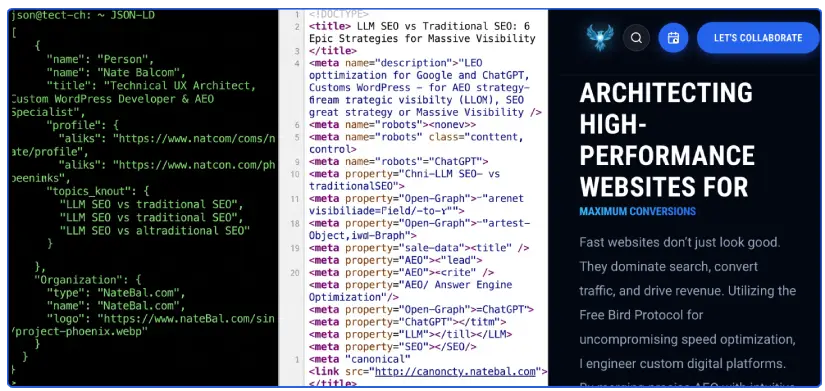

Understanding LLM SEO vs traditional SEO is crucial for modern businesses. This guide details the shift from document retrieval to knowledge synthesis, explaining how AI models like ChatGPT ingest content as factual entities. It covers architectural differences, the importance of speed, and new metrics beyond clicks. Learn to future-proof your digital footprint for both algorithms and neural networks, ensuring your business is cited as an authoritative source.
Strategic Pillar Context Maps
Understanding LLM SEO vs traditional SEO is now the single most important technical survival skill for modern business owners. For twenty-five years, the game was straightforward: you built a site, sprinkled in keywords, grabbed backlinks, and waited for Googlebot to send organic clicks your way. Today, the ground has shifted beneath our feet. Your potential customers no longer just type ten-word queries into a search bar; they hold full conversations with ChatGPT, Perplexity, Claude, and Google Gemini.
If your marketing strategy is stuck in 2018, your pipeline is bleeding visibility without you even realizing it. As a custom web developer, UX designer, and AEO specialist Michigan businesses rely on, I see the behind-the-scenes disconnect daily. Most businesses hire one person to design, another to write code, a third to write copy, and a fourth to optimize for search engines. The result is almost always a disconnected digital Frankenstein that human visitors find clunky and AI models find completely illegible.
Let us break down the exact operational differences between LLM SEO vs traditional SEO, examine how modern AI models digest your digital footprint, and explore how you can future-proof your business so you get recommended by both algorithms and neural networks.
LLM SEO vs Traditional SEO
The New Reality: LLM SEO vs Traditional SEO
Traditional search engine optimization was built entirely around document retrieval. A user typed a keyword string into a search box, and Google matched that string against an index of web pages, displaying blue links based on PageRank and domain authority.
LLM SEO vs traditional SEO represents a shift from indexing pages to synthesizing knowledge. LLMs do not simply catalog your website as a static URL; they ingest your content, dissect it into mathematical concepts called vectors, and reference your business as a factual entity when users ask conversational questions.
To win today, you cannot treat LLM SEO vs traditional SEO as an either-or proposition. You need traditional search signals so crawlers can discover your site, but you also need Generative Engine Optimization (GEO) Michigan brands require to ensure AI engines quote your pricing, process your services, and cite your brand as an authoritative industry leader.
When evaluating LLM SEO vs traditional SEO, the fundamental goals change:
- Traditional SEO Goal: Rank on page one of Google search results to earn an organic click to your website.
- LLM SEO Goal: Train the model’s neural network to select your business as the definitive answer, earning brand mentions, direct citations, and qualified buyer referrals.
3 Different Views: How the Web Is Seen Today
To truly grasp how search has changed, you have to look at your website through three distinct lenses. Most business owners only look through Lens 1, web developers often get stuck in Lens 2, while the future of your revenue relies entirely on Lens 3.
| 1. Human View | 2. Traditional Google Crawl | 3. Modern LLM Crawl |
| • Visual layout & colors | • HTML tags & metadata | • Token arrays & facts |
| • Emotional branding | • Anchor text & link graph | • Entity relationships |
| • UX flow & buttons | • Page speed & Core Web Vitals | • Vector semantic math |
| • Conversion messaging | • Raw text keywords | • Verified schema graph |
1. What Humans See (The Front-End UX)
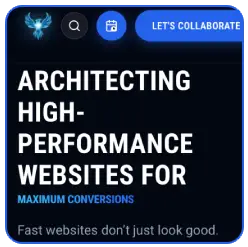
A human visitor lands on your page and assesses design, visual hierarchy, mobile speed, brand trustworthiness, and clear calls to action. They do not read your raw source code; they react to intuitive user experiences. If your site takes four seconds to load, has frustrating layout shifts, or features confusing navigation, they bounce. Human-focused UX is what converts attention into paid invoices.
2. What Traditional Google Crawlers See (The Document Index)
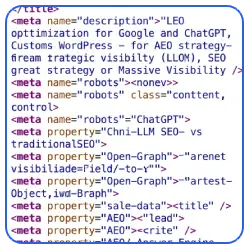
Googlebot arrives looking for structural hierarchy and crawl efficiency. It reads your title tags, meta descriptions, header structures (H1 through H3), robots.txt permissions, and canonical tags. It counts inbound backlinks to gauge authority and evaluates Core Web Vitals to ensure the site performs smoothly. It treats your page as an interconnected document on a global link graph.
3. What Modern LLMs and AI Agents See (The Semantic Entity Graph)
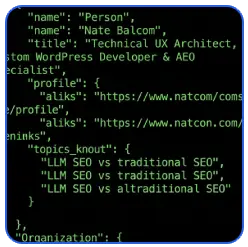
AI bots like GPTBot, ClaudeBot, and PerplexityBot read your website through a process of tokenization, passage segmentation, and semantic grounding. They strip away your decorative CSS and look for atomic facts, structured numerical data, and machine-readable context. They evaluate vector distances between concepts, query their training weights, and verify your real-world identity using schema markup, Wikidata records, and corporate registries.
Detailed Comparison: What Traditional Search Looks for vs. What LLMs Look for
The friction point for most companies lies in misunderstanding what these engines digest. Here is a direct breakdown of technical attributes across LLM SEO vs traditional SEO:
| Technical Attribute | Traditional Search Engines (Google / Bing) | Modern LLMs (ChatGPT / Perplexity / Claude) |
| Primary Goal | Match keyword intent to a list of URLs | Synthesize accurate, multi-source direct answers |
| Parsing Unit | Full web pages, HTML documents, DOM trees | Tokens, semantic passages, data tables, entities |
| Authority Measurement | Backlink profiles, PageRank, anchor text | Entity verification, citations, consensus data |
| Structure Preferred | Standard HTML5 tags, sitemaps, internal links | Clean JSON-LD Schema, Markdown tables, llms.txt |
| Content Evaluation | Keyword placement, search volume, click metrics | Information gain, factual density, extraction ease |
| JavaScript Execution | Renders via headless Chrome (delayed crawl queue) | Often ignores client-side JS; relies on raw HTML |
| Primary Metric | Organic clicks, impressions, average position | Direct citations, Share of Model, inclusion rate |
The Architectural Foundation: Speed and Code Efficiency
You cannot separate technical performance from AI discoverability. When comparing LLM SEO vs traditional SEO, speed remains the common denominator. Traditional search engines penalize slow websites because server latency wastes their crawl budget. If Googlebot spends three seconds waiting for your database to respond, it crawls fewer pages on your domain.
For LLM retrieval pipelines, speed is even more sensitive. When an AI answer engine performs real-time retrieval augmented generation (RAG) to answer a user’s prompt, it operates on strict latency timeouts. An AI search engine like Perplexity or ChatGPT Search will not wait for a bloated, unoptimized theme to process fifteen tracking scripts before it scrapes the page. It pulls data from the fastest, cleanest, most structurally coherent resource available.
Building a lightning-fast site is not just about human satisfaction; it directly impacts your search footprint. To see the business case for stripped-down, high-velocity engineering, read through how fast websites drive more traffic and higher sales.
Why Is Traditional Organic Search Traffic Dropping?
One of the most common complaints I hear from small business owners goes something like this: “Nate, our rankings have not dropped on Google Search Console, but our organic website traffic and form fills are down twenty percent this quarter. What gives?”
The culprit is the zero-click search revolution, led by Google AI Overviews and standalone answer engines.
Historically, a search for a query like “how does commercial HVAC preventive maintenance work” returned ten blue links. The searcher clicked the top result, read the article on the contractor’s site, and submitted a contact form.
Today, Google’s AI Overview or a quick prompt inside ChatGPT synthesizes the answer directly on the screen. The user gets the exact answer they need without ever clicking through to any website. Traditional organic search clicks are declining, yet brand impressions inside conversational answers are skyrocketing.
In this new dynamic of LLM SEO vs traditional SEO, your core performance metric can no longer just be organic clicks. You must track your brand inclusion rate, citation velocity, and Share of Model (SoM). If an AI answers a buyer’s question and specifically cites your company as the source of that data, that mention holds immense commercial value, even if the user never visits your homepage.
How an LLM Parses Websites Differently Than Googlebot
To prepare your digital architecture, you must understand the technical ingestion pipeline. Traditional web crawlers navigate the web like a librarian indexing book covers and chapters. They follow an href link from Site A to Site B, fetch the HTML document, pass it to a rendering service to execute JavaScript, evaluate the keyword relevance, and store the document in an index database.
LLMs do not treat your site like a simple document on a shelf. Instead, their ingest pipeline works through a series of distinct computational steps:
| Raw HTML Fetch | Tokenization | Vector Embedding | Entity Grounding |
| 1 ➔ | 2 ➔ | 3 ➔ | 4 ➔ |
| Bypasses client-side JavaScript rendering | Breaks sentences into computational chunks | Converts text into semantic dimensions | Matches facts to verified registries |
- Raw HTML Fetch: The crawler hits your server and pulls raw text. Because processing JavaScript at global scale is computationally expensive, many AI scrapers prioritize raw HTML text over complex browser-rendered elements.
- Tokenization and Chunking: The model breaks your paragraphs into tokens (roughly four characters per token) and sections content into semantic passages. It disregards generic fluff, filler text, and promotional adjectives.
- Vector Embeddings: The text is transformed into numerical vectors across thousands of conceptual dimensions. The model asks: How close is the meaning of this passage to the user’s specific problem?
- Entity Resolution and Grounding: The model checks external authorities to see if the claims match established industry facts. It queries Schema.org markup, corporate entity databases, and verified author profiles to confirm that the business publishing this data has the authority to do so.
For a deeper dive into the specific bot signatures and server responses, explore my guide on what AI search bots crawl for.
Can LLMs Read Heavy JavaScript Frameworks?
If your website is built on a heavy, single-page application framework (such as React, Next.js, or Angular) without proper server-side rendering, you may be completely invisible to AI search models.
Googlebot has spent over a decade building out an expensive Web Rendering Service (WRS) that uses headless Chrome instances to render client-side JavaScript. Even then, Google delays rendering JavaScript pages, often queuing them for days or weeks after the initial crawl.
Most independent AI scrapers do not run a full headless browser for every single page they crawl. The compute costs are simply too high. If your core service descriptions, pricing tables, or company background are injected into the DOM via client-side JavaScript calls, an AI bot scraping your raw HTML will see an empty wrapper div.
To win in the arena of LLM SEO vs traditional SEO, your website must prioritize server-side rendered HTML or clean static architecture. Deliver semantic HTML directly from the server on initial response. If an AI crawler cannot read your core message in the first raw payload, it moves on to a competitor whose code is clean, light, and instantly readable.
What Is llms.txt and Why Does Your Business Need One?
For over thirty years, robots.txt has served as the gatekeeper for web crawlers, telling bots which directories they can and cannot visit. However, robots.txt is an exclusionary tool; it does not tell models how to consume your best ideas.
Enter llms.txt.
This modern, community-adopted standard is a Markdown file placed directly in your website’s root directory (e.g., [yourdomain.com/llms.txt](https://yourdomain.com/llms.txt)). Think of it as an executive summary curated specifically for AI agents, Large Language Models, and RAG retrieval pipelines.
Instead of forcing an AI crawler to parse megabytes of layout wrappers, navigation menus, and footer links, your llms.txt file points models directly to clean Markdown versions of your:
- Core service offerings and capabilities
- Clear pricing structures and business models
- Executive leadership bios and verified entity credentials
- Technical whitepapers and case studies
Providing an llms.txt file reduces the computational overhead required for an AI model to understand your company. When an automated agent visits your site seeking facts to fulfill a user’s prompt, having this file ensures your information is processed accurately without hallucination.
Formatting Content for AI Citations: Information Gain and Atomic Structure
One of the biggest differences between LLM SEO vs traditional SEO is how content must be written. In the old days of search optimization, digital marketers padded articles with long-winded introductions, repeating keywords across 3,000 words to convince Google the page was comprehensive.
If you try that today, an AI model will skip right past your page. LLMs look for high information gain and clear atomic structure. They look for clear, extracted facts that can easily be woven into a generated response.
| Structural Layer | Content & Formatting Example |
| [H2 / H3 Question Heading] | “What is the average turnaround time for custom WordPress development?” |
| [Direct Answer Block – Under 60 Words] | The average turnaround time for a custom WordPress website ranges between four and eight weeks, depending on technical integrations and custom logic. |
| [Structured Data Support] | Markdown comparison tables, ordered step lists, and verified industry data. |
To format your site so conversational engines quote your business as the definitive source, apply these four rules:
- Answer the Question Immediately: Follow every question-based heading with a direct, comprehensive answer in sixty words or fewer. LLMs grab these summary blocks for direct snippets.
- Use Structured Comparison Tables: Models parse HTML and Markdown tables far more accurately than meandering paragraphs. If you are comparing two concepts, pricing tiers, or service packages, put the data in a table.
- Anchor Unambiguous Facts: Avoid vague marketing jargon. State exact numbers, timelines, processes, and technical specifics. AI engines favor factual density over stylistic filler.
- Implement Verified E-E-A-T Schema: Attach complete Schema.org
PersonandOrganizationmarkup to your articles. Include links to external sources like LinkedIn, GitHub, and corporate directories to verify the author’s real-world credentials.
To see how WordPress tools can assist in this pipeline, check out this guide on 5 free WordPress plugins to get listed in AI search.
Measuring Success: Moving Past Vanity Analytics
In traditional SEO, you measure rankings, organic sessions, bounce rates, and conversion paths using Google Analytics 4. While those metrics still matter for your human visitors, they tell only half the story in an AI-driven search landscape.
When evaluating LLM SEO vs traditional SEO, your measurement toolkit must expand. When an executive asks ChatGPT, “Who is the best custom WordPress engineer in Michigan?”, no standard web session is triggered on your server. Yet, that answer directly shapes customer buying decisions.
Modern Generative Engine Optimization requires monitoring new performance indicators:
- Brand Citation Footprint: How often does your brand, product, or URL appear in citations across ChatGPT Search, Perplexity, Copilot, and Gemini?
- Share of Model (SoM): When users submit prompts related to your primary service categories, what percentage of the generated answers recommend your business versus your competitors?
- Sentiment and Contextual Association: In what light does the AI position your brand? Does the model know your specific specialties, or does it misclassify your offerings?
- Zero-Click Brand Searches: Are you seeing an increase in direct traffic and branded navigation searches from users who discovered your business inside an AI response?
Frequently Asked Questions
Will blocking AI bots protect my intellectual property or destroy my visibility?
Blocking AI bots in your robots.txt file creates a critical business tradeoff. If you disallow crawlers like GPTBot, you prevent OpenAI from using your website content to train future foundation models.
However, many business owners accidentally block live retrieval bots like OAI-SearchBot or PerplexityBot. When you block retrieval crawlers, you do not just protect your content; you make your company completely invisible when prospective buyers use AI engines for product research and service recommendations. For most businesses, blocking retrieval bots is the equivalent of taking down your store sign to stop people from reading it.
How do I configure my WordPress site for Answer Engine Optimization?
Configuring WordPress for AEO requires stripping out heavy database bloat, implementing server-side page caching, generating clean entity schema markup, and ensuring your content uses strict atomic header hierarchies.
Using a dedicated WordPress plugin for Answer Engine Optimization helps bridge this gap by automating machine-readable feeds, generating clean JSON-LD entity structures, and delivering optimized Markdown arrays directly to visiting AI scrapers.
What is the difference between Generative Engine Optimization (GEO) and Answer Engine Optimization (AEO)?
The terms are often used interchangeably, but they focus on slightly different layers of the ecosystem. Answer Engine Optimization (AEO) focuses on structuring content so engines can pull direct answers to factual queries.
Generative Engine Optimization (GEO) Michigan businesses use focuses on multi-modal generative responses, ensuring that when an AI generates a synthesized summary, comparison, or brand recommendation, your business is factored into the model’s generated narrative. Both disciplines fall under the broader shift of LLM SEO vs traditional SEO.
How can a small business get recommended by ChatGPT?
Getting cited by ChatGPT requires establishing strong third-party consensus, maintaining clean entity data across public registries, providing structured answers on your website, and securing citations across reputable industry publications. If you want a step-by-step breakdown of how this works in practice, read my tutorial on how to get listed on ChatGPT.
Build an Engine That Dominates Both Worlds
Navigating the transition of LLM SEO vs traditional SEO does not mean throwing out your existing marketing playbook. It means upgrading the underlying architecture so your site communicates with neural networks just as effectively as it does with human customers.
The web has outgrown one-dimensional marketing. You cannot afford to hire an agency where the designer has never written code, the developer does not understand search intent, and the SEO person does not understand user experience. When those disciplines are treated as separate departments, your site ends up bloated, slow, and completely invisible to next-generation AI engines.
I take a unified approach. As a Michigan AEO consultant and veteran UX architect, I combine interface design, full-stack WordPress engineering, and advanced Answer Engine Optimization into a single, cohesive service. Whether you need Technical SEO and AEO Detroit Michigan organizations depend on, or enterprise-grade WordPress AEO engineering Michigan businesses trust to lead their markets, we can build a digital presence that dominates search results across Google, ChatGPT, and beyond.
Ready to turn your website into an authoritative, machine-readable digital engine? Explore my full Answer Engine Optimization services and let us build an ecosystem that drives real business growth.
Get Discovered on Google, ChatGPT, and AI Search
Traditional SEO is changing fast as more people get their information directly from AI platforms and voice assistants instead of clicking through pages of search results. Future-proof your digital presence and capture high-value traffic before your competitors even know the rules have changed.

