
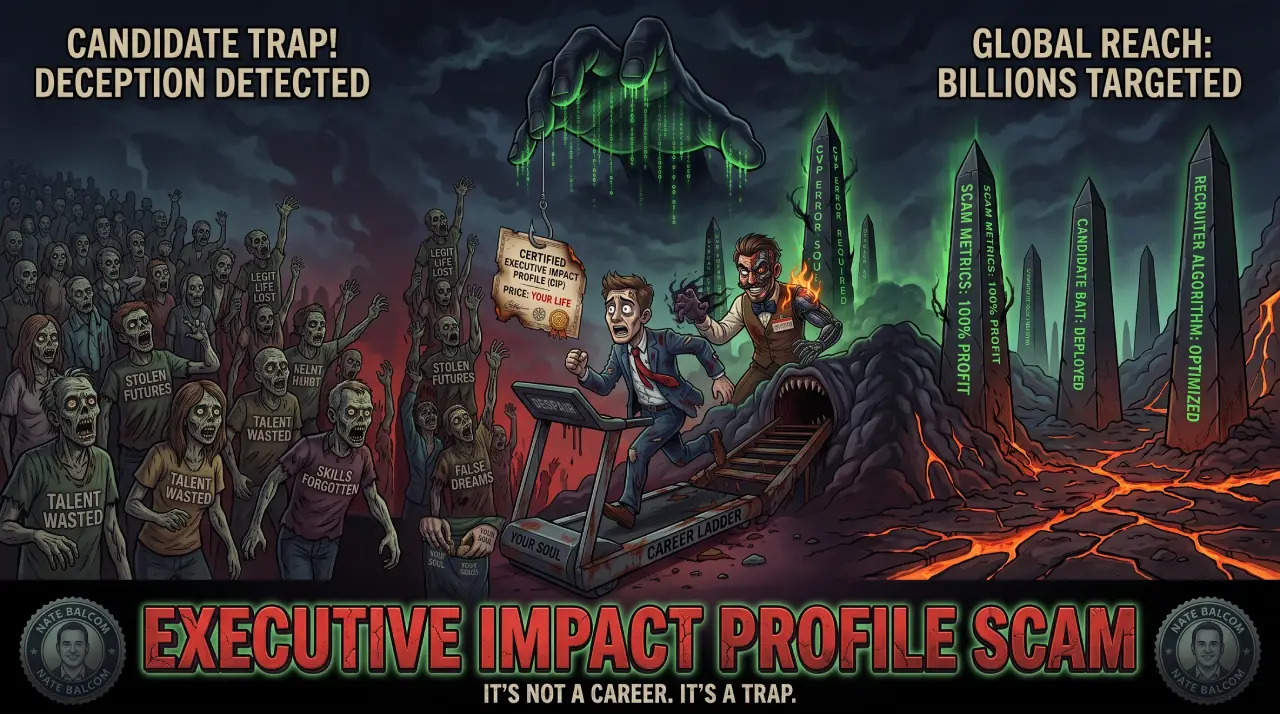

If a recruiter on LinkedIn or email claims you must submit an Executive Impact Profile (EIP) or Candidate Value Proposition (CVP) to interview, it is an advance-fee employment scam. Legitimate companies never require paid third-party candidate profile documents to proceed with hiring.
Strategic Pillar Context Maps
About the Executive Impact Profile Scam (EIP) & CVP Scam
About the Scam & Actions to Take
I was recently targeted on LinkedIn by a fake recruiter. For a brief moment, the opportunity piqued my interest, but I should have trusted my gut: it was far too good to be true. The old rule never fails.
I want to walk you through this deception step by step so these scammers can’t exploit anyone else in the middle of a career transition.
By design, our LinkedIn profiles hand social engineers a detailed roadmap of our experience, skills, and vulnerabilities. To make matters worse, they are now deploying AI tools to impersonate real recruiters convincingly. Keep your guard up.
See if this sound familiar.
It starts with what seems to be a a message from a legitimate recruiter interested in your background unsolicited. Here’s how it starts👇
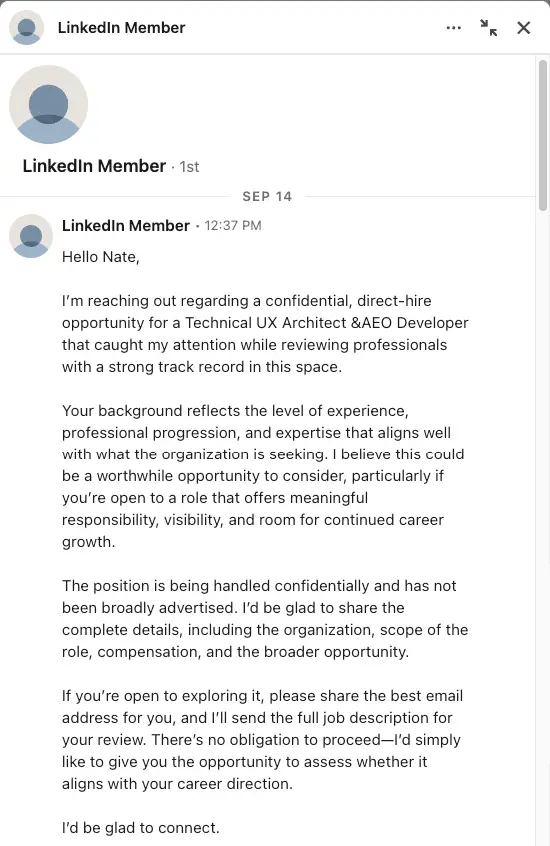
1st Response Message (The Bait) 👉
Hello Nate,
I’m reaching out regarding a confidential, direct-hire opportunity for a Technical UX Architect &AEO Developer that caught my attention while reviewing professionals with a strong track record in this space.
Your background reflects the level of experience, professional progression, and expertise that aligns well with what the organization is seeking. I believe this could be a worthwhile opportunity to consider, particularly if you’re open to a role that offers meaningful responsibility, visibility, and room for continued career growth.
Here’s what should have raised my eyebrow.
The position is being handled confidentially and has not been broadly advertised. I’d be glad to share the complete details, including the organization, scope of the role, compensation, and the broader opportunity.
If you’re open to exploring it, please share the best email address for you, and I’ll send the full job description for your review. There’s no obligation to proceed—I’d simply like to give you the opportunity to assess whether it aligns with your career direction. I’d be glad to connect.
They played on my ego, and the offer didn’t sound too far-fetched. The person seemed entirely legitimate, likely because they had hijacked someone else’s profile or outright stolen their credentials to create a fraudulent account assuming another person’s identity.
When bad actors hijack a legitimate LinkedIn account, the fraud becomes exceptionally difficult to detect. The imposter inherits everything that builds candidate trust: the About section, career history, authentic activity, and verified skill endorsements. Layered with real followers, written recommendations, and potentially a Premium or verified badge, the compromised profile projects complete, unearned credibility before the scammer even sends a message.
The 2nd Follow Up Message (Setting the Hook)
Kindly check your email and confirm your interest in the role so we can proceed smoothly with the next steps. I’ll be looking out for your response via email to formally indicate your interest and move the process forward without delay.
The outreach message essentially cataloged my background, framing my experience as an almost flawless match for what General Motors was seeking. It systematically echoed the core skills listed on my profile, positioning me as the ideal candidate. The message is reproduced below verbatim, aside from minor redactions for privacy. I deliberately left their spelling errors intact to highlight the perpetrator’s lack of attention to detail.
——– Original Message ——–
Subject: PROFESSIONAL BAGROUND 👈 THAT ALLIGN 👈 bad mispelling WELL WITH YOUR EXPERIENCE
Date: 2026-09-14 14:47
From: Robert Scammerson <[email protected]>
To: “[email protected]” <[email protected]> 👈 a catch all email I have set. I have unlimited email addresses for my domain.Thank you for reaching out. I’ve included the job description for the role below for your review. Please take a moment to look it over and let me know if the opportunity aligns with your experience and interests.
TECHNICAL UX ARCHITECT & AEO DEVELOPER 👈 this is a title I came up with
Company: General Motors
Location: Remote – Detroit Metropolitan Area, Michigan, United StatesEmployment Type: Full-Time
Salary: $135,000–$175,000 Base Salary + Annual Performance Incentive
+ Comprehensive Benefits
The Scam Automated
This email was responded to by a bot before I knew I was falling prey to the Executive Impact Profile Scam. These emails came immediately when I responded to what I thought was an actual human being. BTW here’s the bots email address doxed for the world to see – [email protected] Feel free to spam this email address with impunity.

Executive Impact Profile Scam Bot Response 1
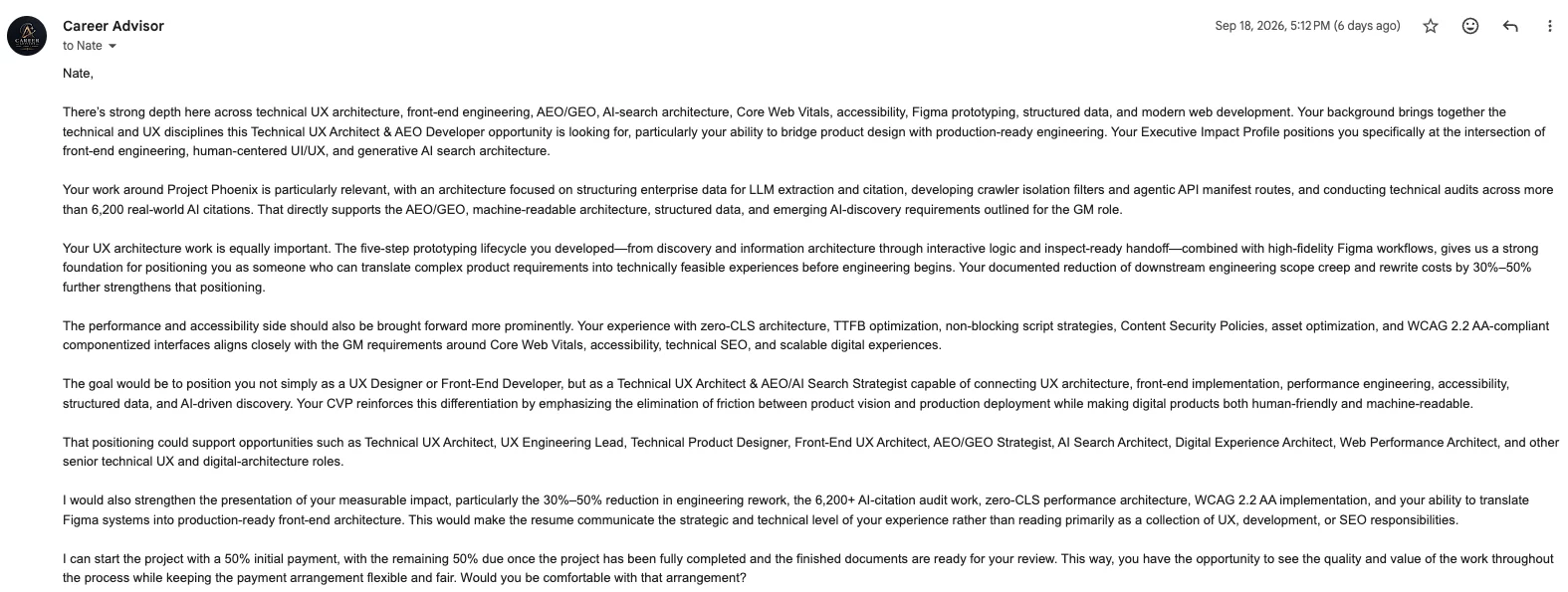
Executive Impact Profile Scam Bot Response 2

Executive Impact Profile Scam Bot Response 3

Executive Impact Profile Scam (EIP) & CVP Scam on the Rise
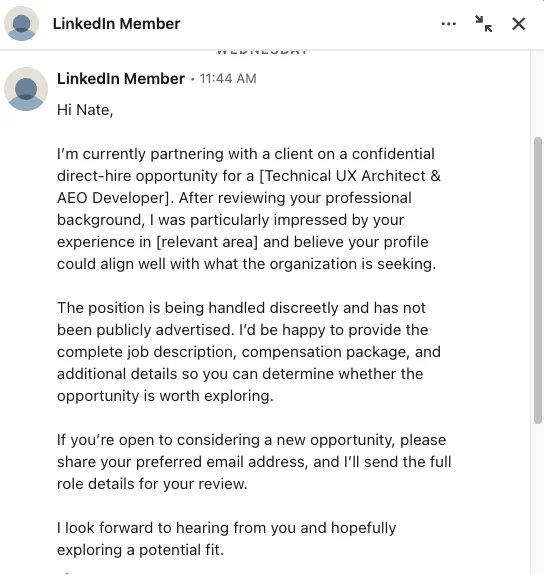
This marks the second time I’ve been targeted by this specific scam operation within a matter of days. Just two days after the initial outreach, another follow-up message came through LinkedIn on what appears to be a second hijacked account that left no doubt of illegitimacy. The sudden shift in tone and the aggressive demand for proprietary documentation made it undeniably clear that I was being set up.
I’m currently partnering with a client on a confidential direct-hire opportunity for a [Technical UX Architect & AEO Developer]. After reviewing your professional background, I was particularly impressed by your experience in 👉 [relevant area] 👈 and believe your profile could align well with what the organization is seeking.
This scammer didn’t even proof read their scam contact. This is very common with these types of scum. They’re blankety sending out so many emails trying to find their next prey that they often times miss glaringly obvious mistakes like this
The position is being handled discreetly and has not been publicly advertised. I’d be happy to provide the complete job description, compensation package, and additional details so you can determine whether the opportunity is worth exploring.
If you’re open to considering a new opportunity, please share your preferred email address, and I’ll send the full role details for your review. I look forward to hearing from you and hopefully exploring a potential fit.
Sound familiar?
2 Tips for Spotting Executive Impact Profile Scams on LinkedIn
Tip 1: Always look for a company email address. (Sorry freelance recruiters this makes a difference and we have to suss out now if you are who you say you are.) Gmail can’t be trusted anymore as they can seem legitimate. In the most recent attack the scammer that contacted me used the email address “linkedin-users-actual-name-redacted[email protected]”. If they’re a reputable recruiter they should have an email address from the company they work for. Gmail addresses are too easy to get.
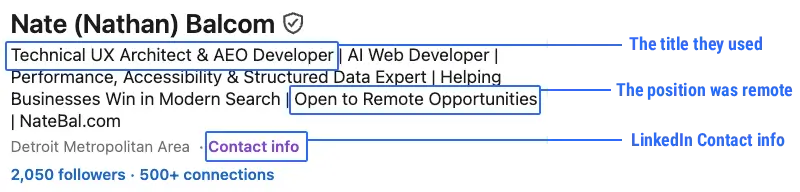
Tip 2: Look at their contact info on LinkedIn. Its located at the top of the page next to the user’s location. A real recruiter will have contact information. Look for a contact email, phone number possibly a website. Scammers don’t want to actually speak with you. If possible they will steal your information virtually so as to not give away their identity.
2 Things You Can Do to Safeguard Your Data While Prospecting
- Get a Google Voice number for sending to people you don’t know. Google Voice allows you to screen calls coming in. You can set up text and even voice mail. Your phone number is a gateway for hackers to steal your information. Read more here: What Can Someone Do With Your Phone Number?
- Get a Separate Email Address for Applying: Use a secondary email address that you can forward to another account. This way you can still have a point of contact to use for real requests saving your personal email address from scammer hands. Use Gmail or one of the many free email services available. If you own your own domain you can create an email address your not worried about burning.
NEVER GIVE AWAY YOUR PERSONAL INFORMATION…until you feel safe who you’re talking to is who they say they are.
The Recruiter From Beyond

True story: I was recently contacted by a recruiter who appeared entirely legitimate. He had a degree from a reputable university, a strong professional track record, and a well-written profile that exuded industry authority. The background was completely authentic, but the person operating the account was an imposter.
When my intuition kicked in and I searched his name, I did not find a recruiter active in the market; instead, I found his obituary. A scammer had cloned a deceased professional’s life, lifting his name, portrait, and career achievements to construct a fraudulent persona capable of bypassing candidate defenses.
What to Do if you Encounter the Executive Impact Profile Scam
If a “recruiter” or hiring contact reached out via email, LinkedIn, or messaging and told you that to proceed you need an Executive Impact Profile (EIP) and a Candidate Value Proposition (CVP), stop immediately and do not pay anyone or share personal data.
How The Executive Impact Profile Scam Works
- The Hook: A recruiter reaches out praising your background for a high-paying executive, senior, or specialized remote role.
- The “Requirement”: They claim that company policy or the hiring board requires specific formal documents, namely a Candidate Value Proposition (CVP) and an Executive Impact Profile (EIP).
- The Trap: When you tell them you do not have those, they conveniently refer you to a specific “certified” third-party service, agency, or website that can draft them for you for a fee (typically $50 to $300+).
- The Reality: The recruiter and the resume/profile service are the same scammers. Once you pay, the “recruiter” ghosts you, and the job never existed.
The Real-World Interview Standard
In legitimate hiring processes across tech, corporate, and executive search:
- Candidate Value Proposition (CVP): In authentic HR terminology, a CVP (or EVP) refers to what the employer offers candidates (culture, pay, perks), or informally to how you verbally articulate your unique strengths during an interview. It is never a standardized paperwork requirement.
- Executive Impact Profile (EIP): This is entirely made-up corporate buzzword jargon invented specifically for this scam scheme.
- Real Documents: Legitimate companies evaluate candidates using a standard resume/CV, a portfolio/case studies, technical assessments, background checks, and live behavioral or executive panel interviews.
Recommended Action
- Do not pay for any document creation, certification, or profile verification service.
- Do not provide sensitive identity details (SSN, ID scans, banking information).
- Verify the recruiter: Check their LinkedIn profile, verify that their email matches the official company domain (not a lookalike domain like
@company-careers-portal.comor@gmail.com), or contact the company directly via their official career page.
People Being Scammed Also Searched For:
Before you break out your credit card were you looking for one of these search strings? Other people contacted with this same exact scam typed the following searches right before they decide whether to pay or not. Don’t get fooled.
recruiter asking for executive impact profilecandidate value proposition document requiredrecruiter wants me to buy an EIPis executive impact profile legitimateexecutive impact profile redditrecruiter asking for CVP documentpaid candidate value proposition service
