


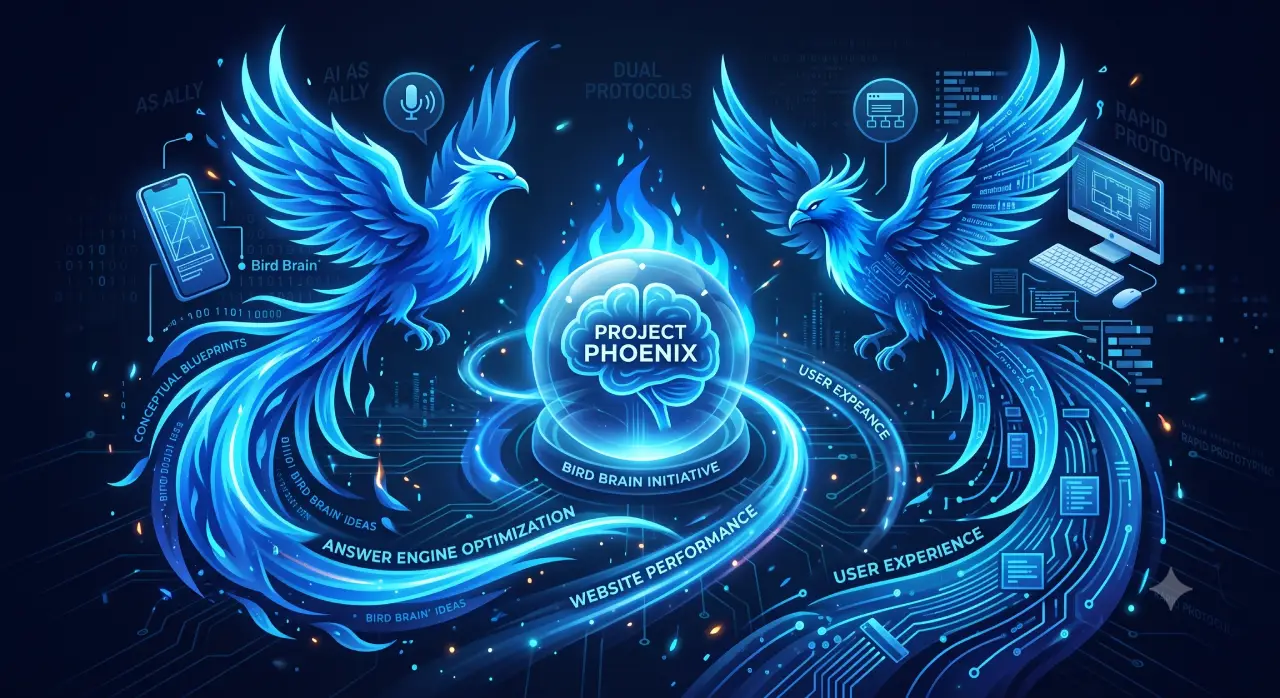
Project Phoenix, driven by Gemini AI, excels in Answer Engine Optimization, website performance, and user experience. It employs Jail Bird and Free Bird protocols to optimize content for both human readers and Large Language Models. This dual-target approach ensures high visibility in AI search, rapid page loads, and an intuitive, mobile-first design, making AI a powerful development ally.
Strategic Pillar Context Maps

When I started using Gemini for developing this website I came up with the concept of 2 design protocols for rapid prototyping while at my 9 -5. They came into existence when I found myself working a traditional day job as the advent of AI and an ever growing workforce of remote work from home designers became the new norm. I needed a way of using all the hours in the day I could while away from my machine to develop code, concepts and design.
So from the ashes of what my career had been for the past 2 decades Project Phoenix the Bird Brain Initiative was born. I’d been an AI denier for some time and decided I needed to lean into the technology as I have for the entirety of my career.
AI was here and it wasn’t going anywhere so I made it an ally rather than an adversary. It was then that Project Phoenix became sentient.
The Bird Brain Initiative is based on 3 main development principles. Answer Engine Optimization, Website Performance and User Experience. The trifecta of design principles are the core foundation of what this website is built upon.
- Modern code principals that provide information critical for AI search.
- Screaming fast website performance for optimum pagespeed results and premier end user experience.
- A minimal design aesthetic with intuitive navigation and usability first design approach.
Project Phoenix
Project Phoenix in an Egg Shell

Designing for 2 users was at the genesis of my initial build. I was creating content not only for my readers, but the 2nd user AI. I needed to speak the language of the LLMs. A website behind the website needed to be created. Not only did the front end of NateBal.com need to be aesthetically pleasing including all the bells and whistles for users, but the back end needed to be the equivalent of beauty in the eyes of ChatGPT, Perplexity, Claude, etc.
For my human users I created a mobile friendly, light weight, glassmorphic dark mode website designed to ease eye strain. It’s built with a mobile first approach that provides graceful degradation for all browsers.
For desktop users the site provides streamlined, fully-optimized animations that aren’t taxing the DOM. Styles and animations are based in CSS for lean code, scalability and optimum browser acceptance.
For mobile users the site provides a script optimized, responsive, minimally animated user interface.
Project Phoenix Jail Bird & Free Bird Protocols Defined
To achieve these design requirements I use the following development protocols from my phone for documenting ideas and sandboxing concepts. At my computer the heavy lifting is performed. Code is developed, scripts optimized, keywords are researched, content defined.
Project Phoenix Answer Engine Optimization

Answer Engine Optimization in Project Phoenix structures content with direct answers and JSON-LD schema graphs so Large Language Models can cite site data accurately. This dual-target approach optimizes NateBal.com for human readers and generative search engines such as Gemini, ChatGPT, and Perplexity.
For example, front-end content uses an answer-first paragraph structure that delivers explicit summaries at the top of each article. This layout helps automated crawlers parse core facts without processing unnecessary markup.
On the back end, custom tools like the Phoenix Agentic Answer First plugin automatically integrate real-time LLM summary blocks into post layouts.
To strengthen entity trust, the Phoenix E-E-A-T Author & Schema Engine outputs structured Person schema graphs. These graphs link author credentials directly to search engine knowledge bases.
In addition, the Phoenix Hardened Hub Handshake plugin manages content negotiation and token-secured OpenAPI manifests, ensuring structured data exchange with AI crawlers.
Project Phoenix Website Performance

Project Phoenix achieves top Google PageSpeed Insights scores by stripping render-blocking assets, minimizing DOM depth, and executing style logic exclusively through lean CSS. High-performance websites require minimal server processing and rapid browser rendering to pass Core Web Vitals benchmarks.
For instance, scripts are conditionally dequeued on pages where they are not required, reducing main-thread JavaScript execution.
CSS rules handle visual transitions and layout calculations directly on the GPU, avoiding heavy JavaScript animation libraries that slow down mobile devices.
Eliminating redundant code and database clutter keeps server execution times under one millisecond, providing instantaneous page loads for every visitor.
Project Phoenix ARIA & A11y Accessibility

Project Phoenix integrates WCAG-compliant semantic HTML5 markup and dynamic ARIA attributes to ensure complete accessibility across screen readers, assistive technologies, and keyboard-only navigation. Building with native web accessibility standards guarantees that both human users and automated search crawlers can parse site structures without barriers.
Using native structural elements such as <main>, <nav>, and <header> instead of generic container tags provides screen readers like VoiceOver, NVDA, and JAWS with an accurate document outline. This semantic foundation allows assistive tools to jump directly to key landmarks without processing unnecessary markup clutter.
For dynamic interface components, explicit ARIA state attributes like aria-expanded, aria-label, and aria-hidden communicate real-time menu toggles and modal overlays. For example, custom navigation tools like the Phoenix Talon Nav maintain strict focus management, preventing keyboard users from tabbing into off-screen or hidden drawer elements.
Visual accessibility relies on dark mode color pairings that meet WCAG AA contrast guidelines, paired with high-visibility focus indicators. This balance ensures that glassmorphic container aesthetics maintain strict contrast ratios between background surfaces and body typography for users with visual impairments.
Project Phoenix User Experience

The User Experience architecture of Project Phoenix combines a glassmorphic dark mode aesthetic with a mobile-first layout to reduce user eye strain and interaction friction. A clean design aesthetic prioritizes content hierarchy and usability across all screen sizes.
For mobile visitors, the interface enforces a responsive, script-optimized design that conserves battery life and speeds up touch navigation.
For desktop visitors, the site provides smooth glassmorphism web design visuals without increasing DOM complexity.
Through graceful degradation, older browser engines render standard accessible fallbacks while modern browsers display full visual effects.
Phoenix rEcommEndATions
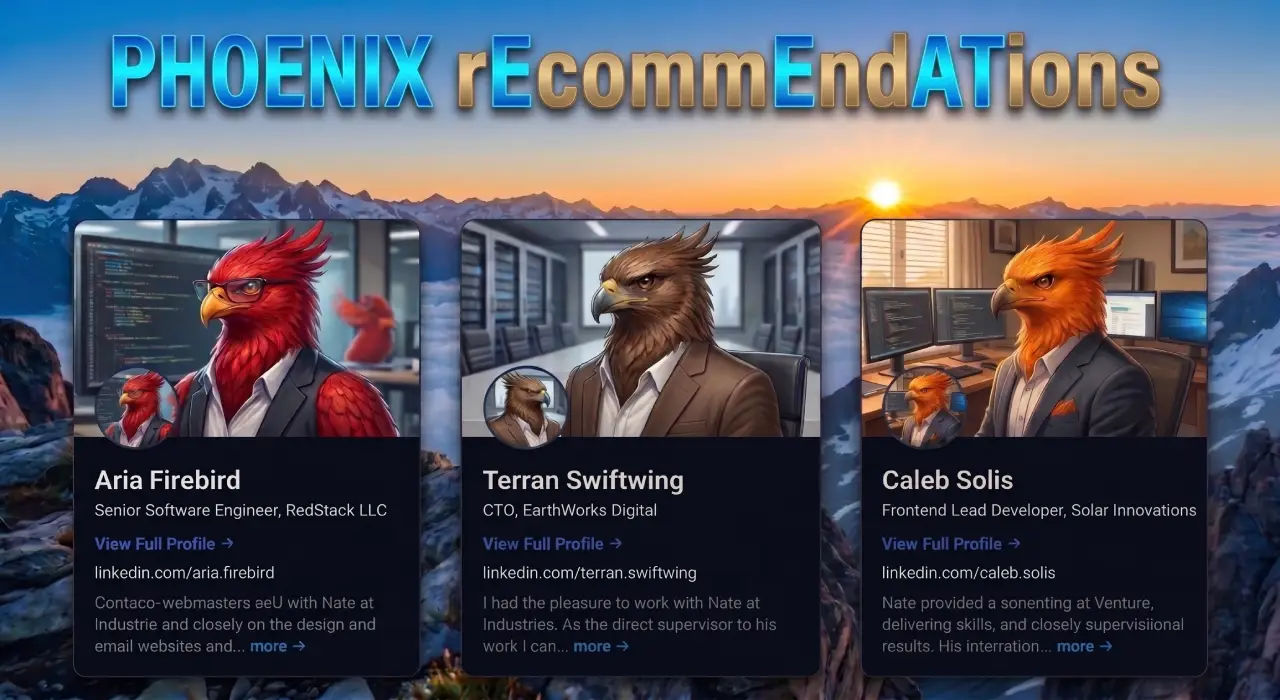
Automates E-E-A-T social proof with a zero-JS CSS marquee, native media uploader, and automated Review, Person, & Organization JSON-LD schemas.
Plugin Page →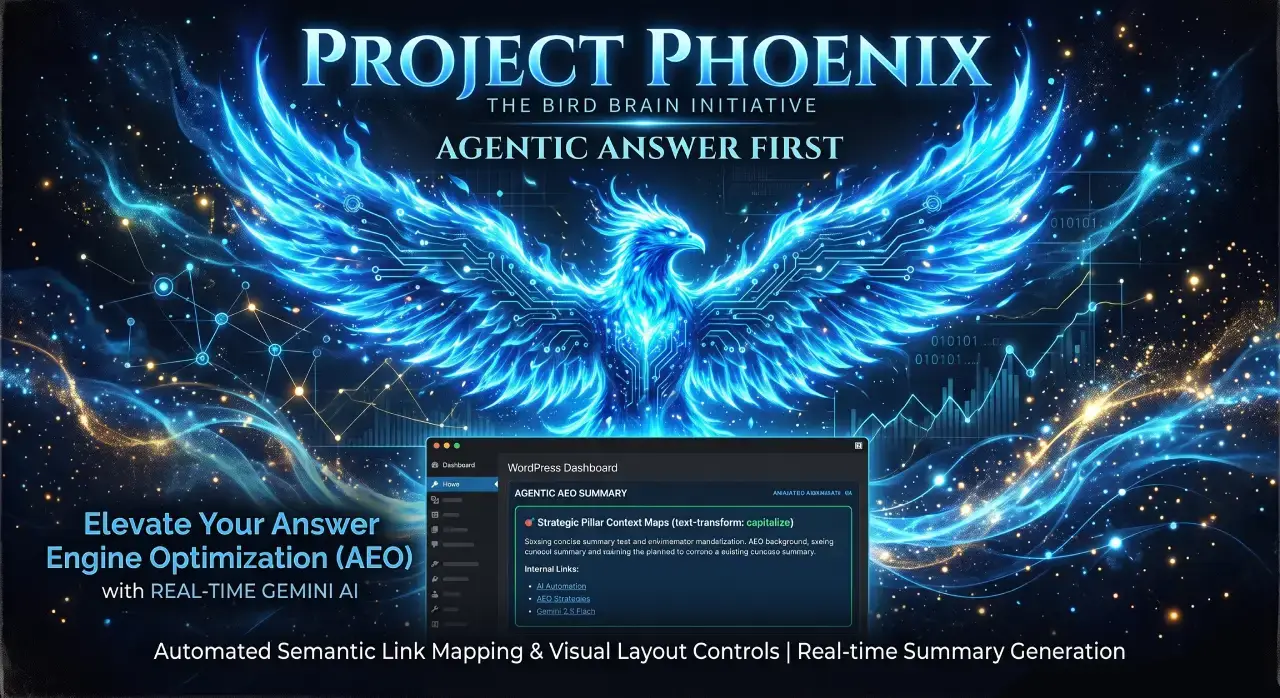
Phoenix Agentic Answer First
Dynamically adds Answer First paragraphs to posts for better LLM inclusion powered by real-time Gemini 2.5 Flash AEO summaries.
Plugin Page →
Phoenix Talon Nav
High-performance, isolated mobile navigation featuring hardware-accelerated drawer mechanics and autonomous AEO JSON-LD schema.
Plugin Page →
Phoenix E-E-A-T Author & Schema Engine
Generates enterprise-grade E-E-A-T author cards with dynamic Person JSON-LD Schema graphs to feed entity data to AI search engines.
Plugin Page →
Phoenix Topic Generator
Content ideation engine that dynamically monitors custom publications and targeted keywords to generate article ideas using Gemini.
Plugin Page →
Phoenix Hardened Hub Handshake
Enterprise-grade AI hub featuring Intelligent Entity Filtering, Content Negotiation, and a token-secured OpenAPI manifest.
Plugin Page →
Phoenix Sensor LLM Dashboard
Modular AEO Intelligence Platform tracking 24H LLM movement and percentage of site traffic originating from AI search agents.
Plugin Page →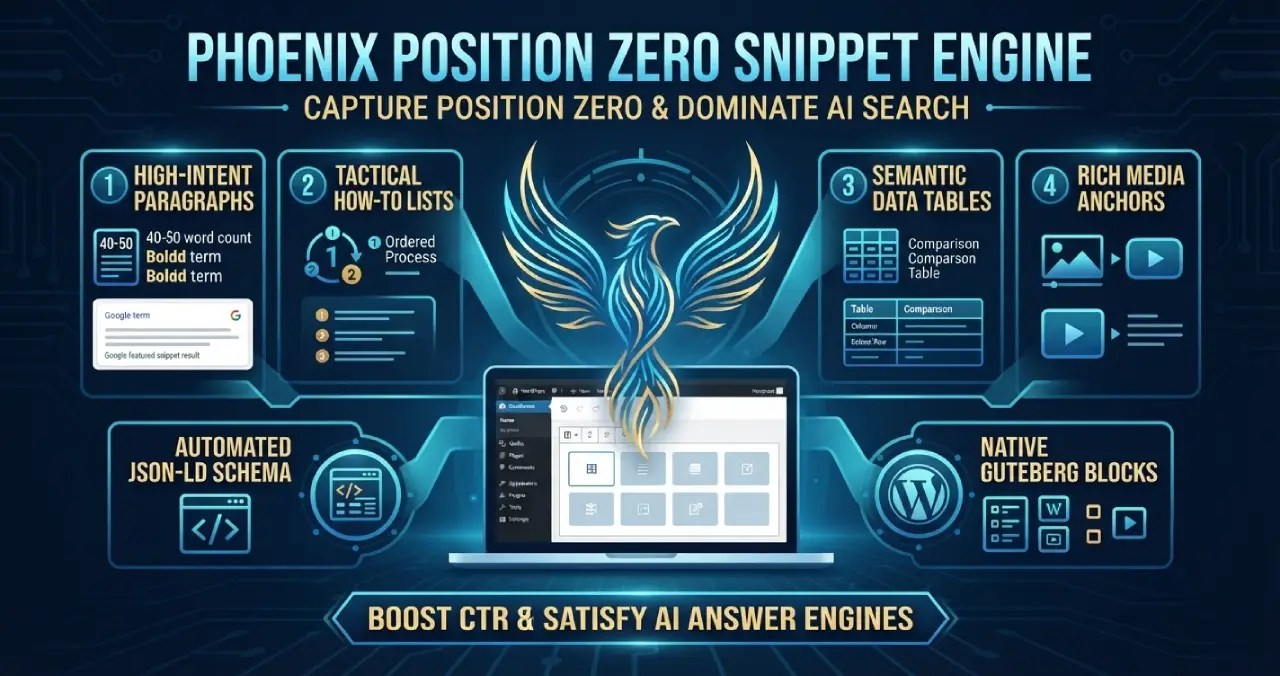
Phoenix Position Zero Snippet Engine
Engineered to optimize content structures for featured snippets, zero-click answer boxes, and direct LLM retrieval with automated JSON-LD.
Plugin Page →Phoenix rEcommEndATions
Automates E-E-A-T social proof with a zero-JS CSS marquee, native media uploader, and automated Review, Person, & Organization JSON-LD schemas.
Plugin Page →Phoenix Agentic Answer First
Dynamically adds Answer First paragraphs to posts for better LLM inclusion powered by real-time Gemini 2.5 Flash AEO summaries.
Plugin Page →Phoenix Talon Nav
High-performance, isolated mobile navigation featuring hardware-accelerated drawer mechanics and autonomous AEO JSON-LD schema.
Plugin Page →Phoenix E-E-A-T Author & Schema Engine
Generates enterprise-grade E-E-A-T author cards with dynamic Person JSON-LD Schema graphs to feed entity data to AI search engines.
Plugin Page →Phoenix Topic Generator
Content ideation engine that dynamically monitors custom publications and targeted keywords to generate article ideas using Gemini.
Plugin Page →Phoenix Hardened Hub Handshake
Enterprise-grade AI hub featuring Intelligent Entity Filtering, Content Negotiation, and a token-secured OpenAPI manifest.
Plugin Page →Phoenix Sensor LLM Dashboard
Modular AEO Intelligence Platform tracking 24H LLM movement and percentage of site traffic originating from AI search agents.
Plugin Page →Phoenix Position Zero Snippet Engine
Engineered to optimize content structures for featured snippets, zero-click answer boxes, and direct LLM retrieval with automated JSON-LD.
Plugin Page →BUILD FOR THE FUTURE OF THE WEB
Standard templates and bloated code simply won’t cut it in an increasingly intelligent digital landscape. I combine custom full-stack development with advanced UX design to build fast, secure websites that are natively ready for the AI era. Let’s create a smart digital asset that delivers seamless user experiences and actually drives your business forward.

