
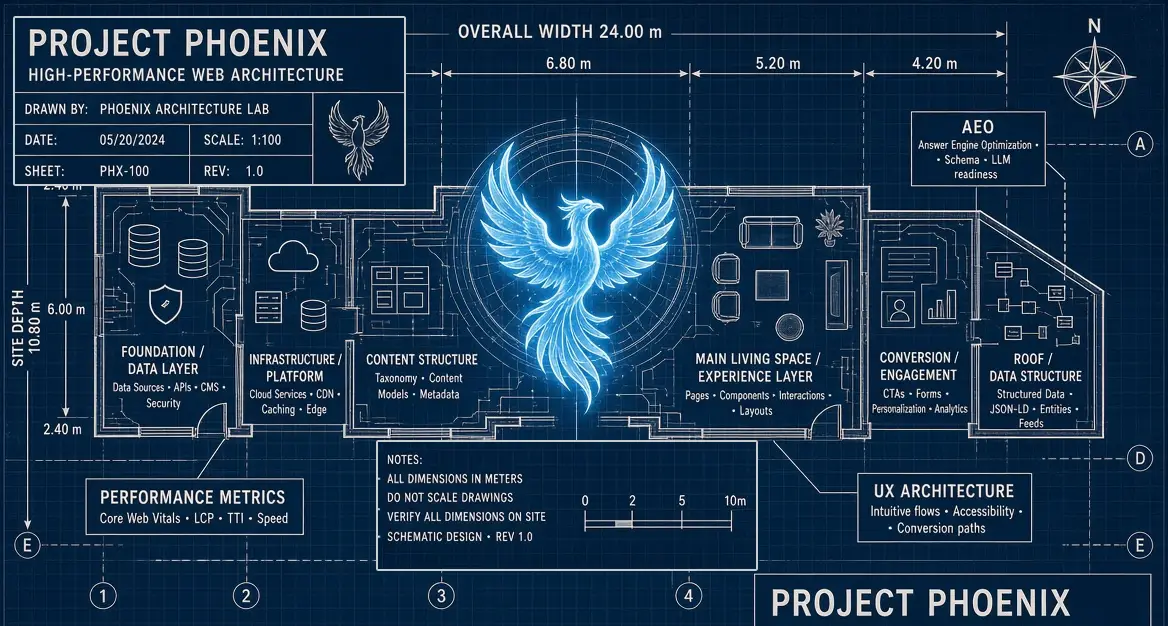

Project Phoenix is an advanced architectural framework designed to bridge the gap between human-centric web design and machine-readable Answer Engine Optimization (AEO). Built to navigate the shift from traditional keyword search to generative AI discovery, Project Phoenix establishes a dual-delivery model: high-performance, visually elevated experiences for human users, and structured, real-time data arrays for LLM crawlers, AI agents, and semantic search engines.
Strategic Pillar Context Maps
Project Phoenix is a web development initiative built on three core principles: Answer Engine Optimization, Website Performance, and User Experience. As the Lead Architect and Developer of this work in 2026, the goal has been to create sites that serve both human visitors and AI systems with equal precision. The Bird Brain Initiative focuses on agentic harmony through code written specifically for the second user, AI.
Project Phoenix Essential Rules

The Three Core Pillars of Project Phoenix
What is Answer Engine Optimization (AEO)?
Answer Engine Optimization (AEO) is the foundational methodology of structuring code and content so Large Language Models can effortlessly parse, extract, and cite your data arrays without relying solely on standard organic traffic clicks.
While traditional SEO focuses on keyword rankings and blue-link search engine result pages (SERPs), AEO shifts the focus to generative answer engines, AI chat interfaces, and semantic crawlers. By implementing machine-readable schema markup, explicit entity definitions, and answer-first structural hierarchies, your content moves from being passively indexed to actively synthesized and cited by AI agents like Claude and ChatGPT.
The Role of the Phoenix Sensor
The Phoenix Sensor acts as the telemetry and command center for monitoring how artificial intelligence models interact with your digital infrastructure.
In an era where automated scrapers and LLM bots constantly crawl the web, standard analytics miss the invisible handshake of zero-click citations. The Phoenix Sensor bridges this gap through:
- Real-Time Telemetry: Capturing bot handshakes, HTTP link header payloads, and AI referrer traffic down to the exact request.
- Bot Traffic Isolation: Filtering out standard noise to isolate specific model scrapers (such as ClaudeBot, GPTBot, and PerplexityBot) from human users.
- Log Analysis: Monitoring server-side anomalies and scraper behaviors to ensure your structured data arrays are being ingested cleanly and efficiently.
High-Velocity Performance Standards
High-Velocity Performance Standards enforce green Core Web Vitals and aggressive asset optimization as mandatory prerequisites for AI crawler prioritization.
AI search engines and automated crawlers operate under strict latency budgets. Bloated scripts, unoptimized stylesheets, and slow-loading media payloads create friction that causes bots to abandon deep-site crawling. Project Phoenix treats speed as an architectural requirement: code is streamlined, non-essential script bloat is conditionally stripped, and DOM complexity is minimized. This ensures that when an AI crawler requests your pages, it receives a lightweight, lightning-fast response that maximizes indexing depth and maintains top-tier mobile performance scores.
Serving the Second User with Machine-Readable Architecture
A second website comprised of machine-readable code is generated as the website behind the website, engineered specifically for LLMs. In addition to this machine-readable layer sits a proprietary schema-based skeleton designed for optimum Answer Engine Optimization.
Agentic answer-first blog posts form a core part of this approach. These posts are written using the military-inspired B.L.U.F. method and serve as the standard for providing citable, Position Zero optimized content ready for inclusion in Google featured snippets. The Agentic answer first implementation ensures that key conclusions appear at the top of each page or section so both human readers and AI agents can extract value immediately.
This dual-layer design creates agentic harmony. Humans receive clear, well-structured information. AI agents receive transparent, low-friction signals that improve citation probability and knowledge-node status in generative search results.
Performance as a Foundational Requirement of Project Phoenix
Website performance remains paramount. NateBal.com is rigorously tested against Google PageSpeed Insights to ensure a constant PSI that remains in the green across the board. Scripts are scrutinized and optimized for screaming-fast delivery. Images are converted and saved in modern formats such as WebP and SVG for the best combination of adaptability, size, and quality.
Fast loading times benefit both audiences. Human visitors experience responsive, frustration-free browsing. AI agents encounter lower computational overhead when parsing pages, which supports more accurate extraction and higher rates of inclusion in answer engines.
Project Phoenix User Experience Engineered for Clarity and Reach
Glassmorphism web design was implemented to deliver a modern, aesthetic experience for the end user. NateBal.com’s Glassmorphic Design relies on CSS animation and stays optimized for usability and maximum deliverability.
The mobile-first design, based in Dark Mode, reduces eye strain. Device-specific media queries provide a gracefully degraded version for phones, tablets, and larger screens. Every interface decision supports the same dual purpose: polished interaction for people and clean, semantic structure for agents.
Project Phoenix Designed in Code to Rank by Intent
This site is designed in code and engineered to rank intentionally by design. Answer Engine Optimization supplies the semantic and extractable layer. Superior website performance removes technical barriers. User Experience binds the two into a coherent, accessible interface. Together they produce agentic harmony in which the second user (AI) and the first user (human) both receive what they need without compromise.

Project Phoenix protocols demonstrate that modern web architecture can treat AI agents as collaborative partners rather than afterthoughts. The result is a site that remains fast, readable, and authoritative whether the visitor is a person browsing on a phone or an LLM seeking a reliable source for generative answers.
Designing Content and Architecture for Humans and AI Agents
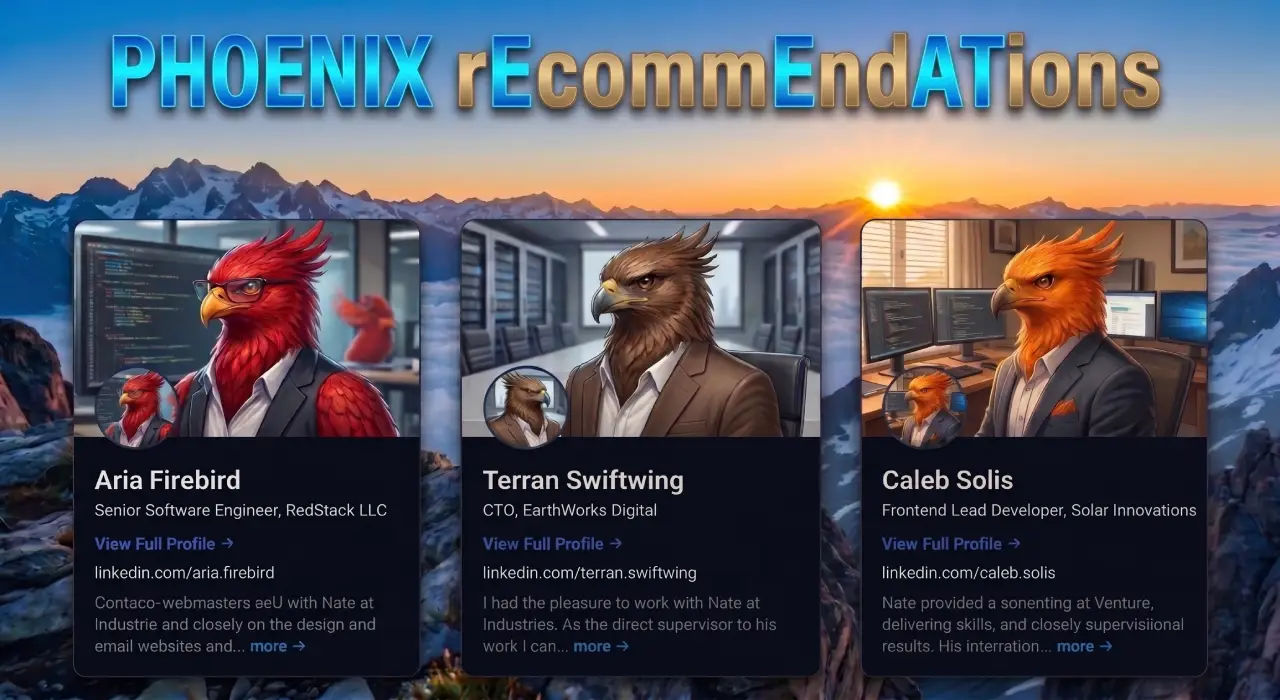
Phoenix rEcommEndATions
Automates E-E-A-T social proof with a zero-JS CSS marquee, native media uploader, and automated Review, Person, & Organization JSON-LD schemas.
Plugin Page →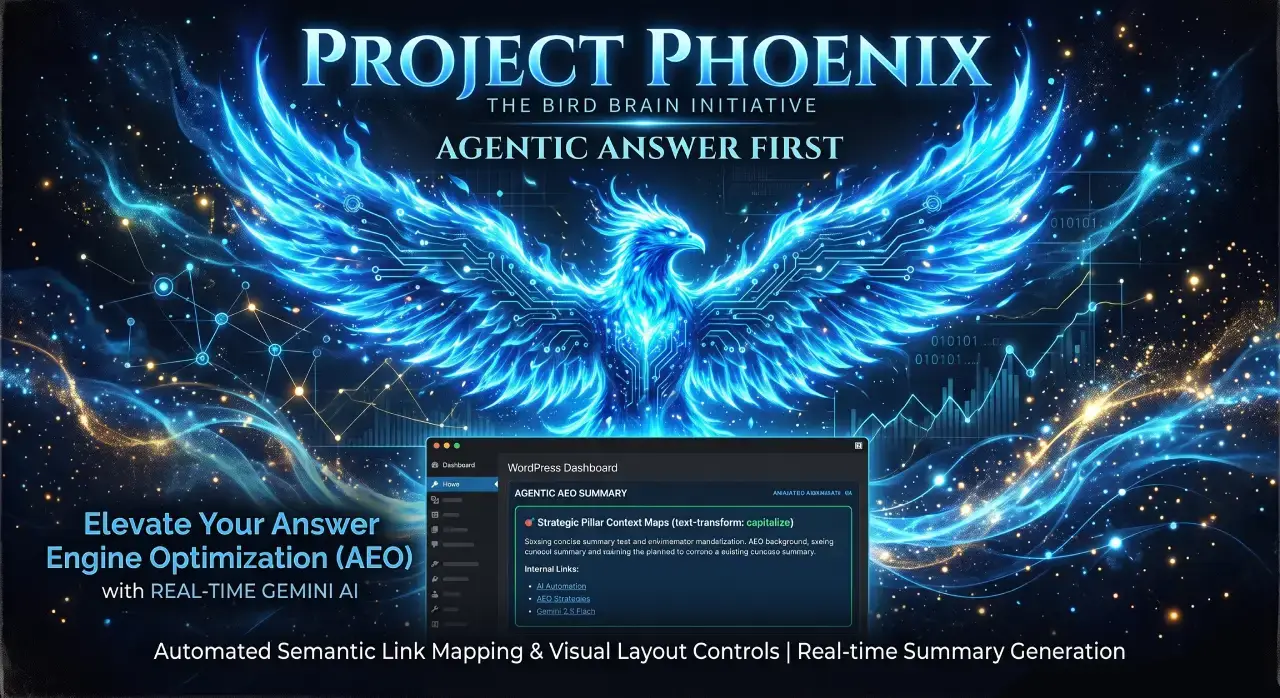
Phoenix Agentic Answer First
Dynamically adds Answer First paragraphs to posts for better LLM inclusion powered by real-time Gemini 2.5 Flash AEO summaries.
Plugin Page →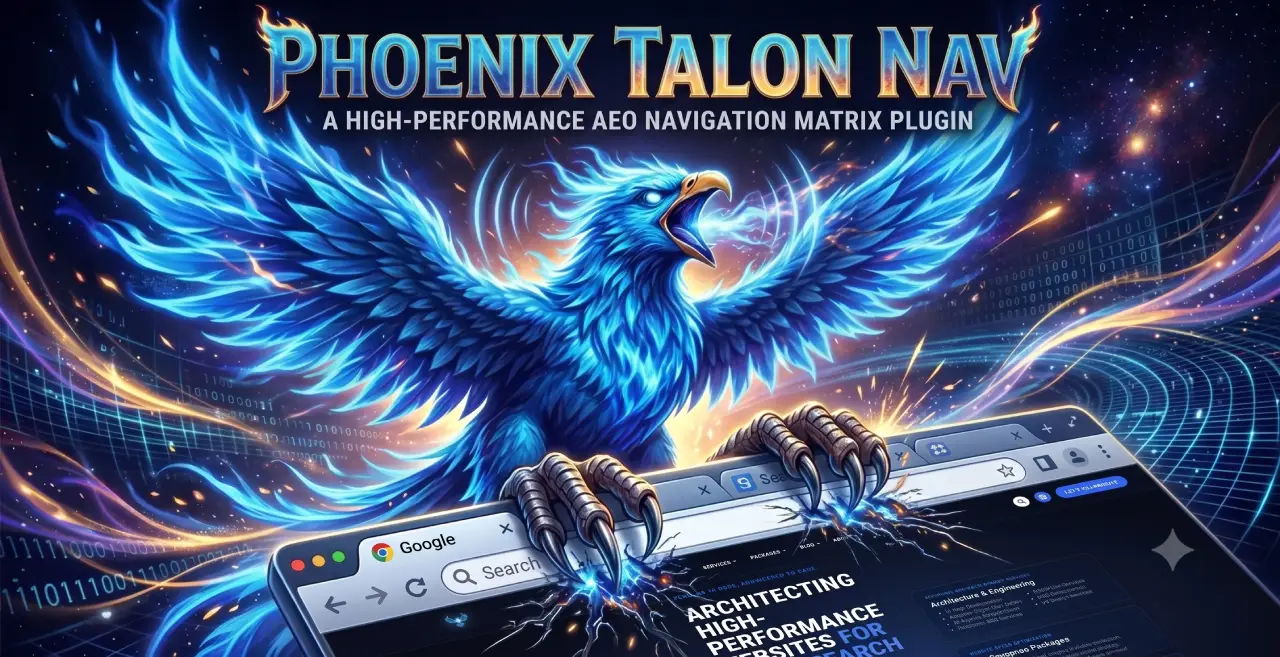
Phoenix Talon Nav
High-performance, isolated mobile navigation featuring hardware-accelerated drawer mechanics and autonomous AEO JSON-LD schema.
Plugin Page →
Phoenix E-E-A-T Author & Schema Engine
Generates enterprise-grade E-E-A-T author cards with dynamic Person JSON-LD Schema graphs to feed entity data to AI search engines.
Plugin Page →
Phoenix Topic Generator
Content ideation engine that dynamically monitors custom publications and targeted keywords to generate article ideas using Gemini.
Plugin Page →
Phoenix Hardened Hub Handshake
Enterprise-grade AI hub featuring Intelligent Entity Filtering, Content Negotiation, and a token-secured OpenAPI manifest.
Plugin Page →
Phoenix Sensor LLM Dashboard
Modular AEO Intelligence Platform tracking 24H LLM movement and percentage of site traffic originating from AI search agents.
Plugin Page →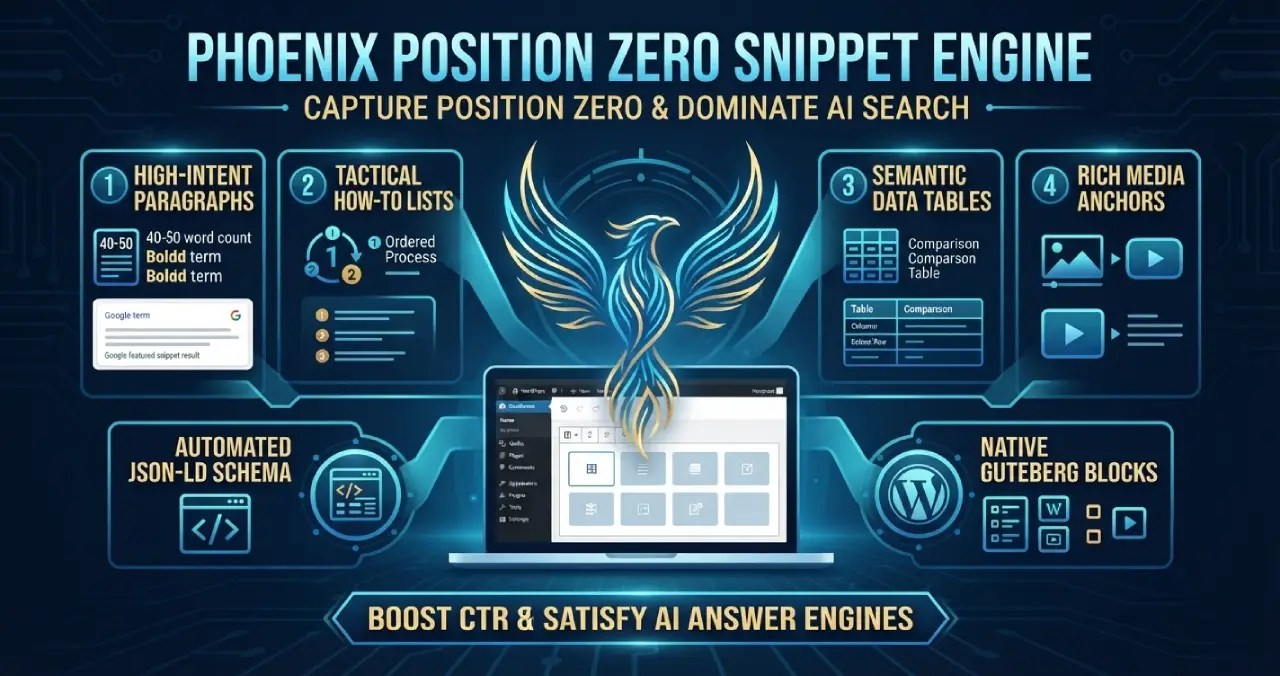
Phoenix Position Zero Snippet Engine
Engineered to optimize content structures for featured snippets, zero-click answer boxes, and direct LLM retrieval with automated JSON-LD.
Plugin Page →
Phoenix rEcommEndATions
Automates E-E-A-T social proof with a zero-JS CSS marquee, native media uploader, and automated Review, Person, & Organization JSON-LD schemas.
Plugin Page →
Phoenix Agentic Answer First
Dynamically adds Answer First paragraphs to posts for better LLM inclusion powered by real-time Gemini 2.5 Flash AEO summaries.
Plugin Page →
Phoenix Talon Nav
High-performance, isolated mobile navigation featuring hardware-accelerated drawer mechanics and autonomous AEO JSON-LD schema.
Plugin Page →
Phoenix E-E-A-T Author & Schema Engine
Generates enterprise-grade E-E-A-T author cards with dynamic Person JSON-LD Schema graphs to feed entity data to AI search engines.
Plugin Page →
Phoenix Topic Generator
Content ideation engine that dynamically monitors custom publications and targeted keywords to generate article ideas using Gemini.
Plugin Page →
Phoenix Hardened Hub Handshake
Enterprise-grade AI hub featuring Intelligent Entity Filtering, Content Negotiation, and a token-secured OpenAPI manifest.
Plugin Page →
Phoenix Sensor LLM Dashboard
Modular AEO Intelligence Platform tracking 24H LLM movement and percentage of site traffic originating from AI search agents.
Plugin Page →
Phoenix Position Zero Snippet Engine
Engineered to optimize content structures for featured snippets, zero-click answer boxes, and direct LLM retrieval with automated JSON-LD.
Plugin Page →Modern websites no longer serve a single audience. They must simultaneously deliver a polished experience for human visitors and a transparent, extractable knowledge layer for AI agents, large language models, and answer engines. Two complementary ideas address this dual requirement: agentic harmony as an architectural and experiential principle, and the B.L.U.F. (Bottom Line Up Front) method as a practical content strategy. Together they form a coherent approach for building sites that rank, get cited, and remain usable in an agentic search landscape.
Understanding Agentic Harmony & Project Phoenix
Agentic harmony describes the deliberate design of systems, code, and experiences so that autonomous AI agents (the second user or Second Reader) and human users operate in complementary, non-conflicting ways. In the Project Phoenix and Bird Brain Initiative framework, this means writing code and structuring sites expressly for AI agents while preserving, and often enhancing, human-facing performance, aesthetics, and usability.
Traditional sites optimized primarily for browsers and human eyes. Agentic harmony extends that model by treating LLMs, AI search systems such as Perplexity, SearchGPT, ChatGPT, and Apple Intelligence, and autonomous agents as first-class consumers of content and structure. Practical expressions include a parallel “website behind the website” of machine-readable code, proprietary schema-based skeletons, and structured data layers that minimize inference friction.
Answer-first content supplies concise, citable material ready for featured snippets and generative answers. High-performance foundations (consistent green PageSpeed Insights scores, optimized scripts, modern WebP and SVG images, glassmorphism with CSS animation, mobile-first dark-mode design with graceful degradation) serve humans well while remaining lightweight and transparent for crawlers and agents.
Broader agentic AI concepts reinforce the same principle. An agentic system can perceive context or goals, plan multi-step actions, use tools, maintain state, collaborate with other agents or humans, and act with varying degrees of autonomy.
Harmony in multi-agent settings then becomes a coordination problem: orchestration so specialized agents hand off work cleanly, shared protocols or memory that keep them aligned, guardrails and verification loops that prevent conflict or unsafe behavior, and seamless human-AI collaboration in which humans retain high-level control while agents handle routine or parallel tasks. Examples appear across domains, from multi-agent music generation systems to enterprise service agents and coding harnesses that isolate parallel work with deterministic validation.
When applied to web development, agentic harmony produces dual-layered content: human-readable narrative paired with machine-extractable capsules. Performance becomes a dual requirement because slow pages raise inference costs for agents and degrade human experience. Design systems must stay lightweight to avoid div soup or heavy assets that agents must filter. Monitoring expands to include agent traffic alongside traditional analytics. Ranking strategies shift from pure click-through SEO toward citation probability and knowledge-node status inside generative answers.
Edge cases remain. Over-optimizing for current agent behaviors risks obsolescence as models evolve. Dense structured data must not harm human readability. Proprietary schemas require ongoing maintenance. The core insight holds: sites that ignore the second user become less visible or less accurately represented, while those that treat the second user as a collaborative partner gain durable authority.
The B.L.U.F. Method as the Content Counterpart
B.L.U.F., or Bottom Line Up Front, supplies the writing discipline that makes agentic harmony operational at the content level. Originating in U.S. military communication standards (Army Regulation 25-50 and related Air Force guidance), the method places the most important conclusion, recommendation, answer, or key takeaway at the very beginning of a message, section, or page. Supporting details, context, evidence, and nuance follow. Military writing demanded this structure because decisions could be time-critical; the same logic now serves busy human scanners and token-budget-constrained AI systems.

B.L.U.F. reverses the inductive style common in academic or traditional web writing (build context, then reach a conclusion). It is deductive: state the result first, then justify it. The practice closely resembles journalism’s inverted pyramid and shares DNA with Barbara Minto’s Pyramid Principle. Effective B.L.U.F. statements are concise, self-contained, free of hedging, and often action- or decision-oriented.
In content strategy the method serves both audiences at once. For human readers, most web users scan rather than read linearly. Leading with the answer respects limited attention, improves comprehension speed, and raises the chance that skimmers absorb the core message. For AI agents and answer engines, generative systems extract concise, high-signal passages. Content that opens pages or sections with a direct, extractable answer is far more likely to be cited, featured in Position Zero or featured snippets, or synthesized into agent responses. Practitioner analyses in 2026 report substantially higher citation rates for B.L.U.F.-structured material.
Practical structure for long-form content follows a clear pattern. Open the page or section with a one- to two-sentence B.L.U.F. that directly answers the primary question or states the core claim. Follow immediately with brief supporting evidence or the “so what.” Expand into detailed explanation, examples, methodology, or caveats under clear subheadings. Optionally restate the bottom line near the end. Apply the same pattern recursively so every major heading begins with its own B.L.U.F., keeping the piece scannable and extractable even if only part of it is sampled.
Finding the B.L.U.F. in a draft is often a matter of locating the concluding sentence or “so what” statement and moving it to the top, then rewriting for flow. Examples illustrate the difference. A non-B.L.U.F. opening might begin with background or “In this article we will explore.” A B.L.U.F. version states “Backlinks remain the strongest predictor of ranking success” or “Delay the product launch by one week because QA found three critical bugs,” then supplies the supporting detail.
Integrating the Two Principles
Agentic harmony supplies the architectural vision: dual human and AI audiences, machine-readable layers, performance that serves both, and systemic logic clear enough that agents naturally select the site as a primary source. B.L.U.F. supplies the content technique that populates that architecture with extractable, citable units. In the Project Phoenix framing, agentic answer-first blog posts written with the military-inspired B.L.U.F. method become the standard vehicle for providing site-able, Position Zero optimized material.
The combination produces concrete advantages. Pages remain fast and aesthetically refined for humans while offering low-inference-friction capsules for agents. Schema, entity definitions, and self-contained statistics amplify the effect. Monitoring of both human and agent traffic guides iterative refinement. The result is content and code engineered to rank intentionally by design.
Limitations and nuances apply to the integrated approach as well. Narrative or emotionally driven pieces may require selective rather than rigid application of B.L.U.F. Highly technical audiences sometimes prefer inductive structure for credibility, making hybrid formats (B.L.U.F. executive summary plus full inductive body) useful. Overly abrupt claims without subsequent support can feel salesy. Cultural and organizational norms vary, so audience calibration remains essential. AI extraction favors short, declarative, entity-dense sentences; extremely long or hedged statements lose effectiveness.
Implementation pairs the writing method with technical foundations: consistent green Core Web Vitals, modern image formats, glassmorphic yet lightweight design, mobile-first responsive behavior, and progressive enhancement that degrades gracefully. Custom sensors that track agent user-agents (GPTBot, Applebot-Extended, and others) close the feedback loop. Structured data (FAQ, HowTo, Article, TechArticle) marks the B.L.U.F. statements for easier extraction.
Implications for the Agentic Web
As search and interaction continue shifting from ranked lists of links toward conversational, agent-mediated answers, sites that ignore the second user risk reduced visibility and inaccurate representation.
Those that practice agentic harmony and write with B.L.U.F. treat the second user as a collaborative partner. The human experience stays polished, fast, and accessible. The agent experience becomes transparent, authoritative, and low-friction. Together the principles turn every page into a more reliable knowledge node, increasing the probability of citation, featured placement, and sustained relevance as models and retrieval systems evolve.
In practice this means designing systemic logic so clear that AI cannot help but choose the site as a primary source, while humans experience an interface that feels intentional and high-performing. B.L.U.F. ensures the most important signal appears first; agentic harmony ensures the surrounding architecture supports both the human who reads and the agent that extracts. The combination is not merely stylistic. It is a durable strategy for visibility, authority, and usability in an era when the web must speak fluently to two distinct readers at once.
CUSTOM AI WEB DEVELOPMENT
Is your website leaking high-value leads? Slow load speeds and outdated architecture don’t just frustrate prospects—they make you invisible to modern answer engines. I re-engineer your core WordPress platform with sub-second Core Web Vitals, conversion UX, and deep AEO to turn passive traffic into predictable pipeline.
