
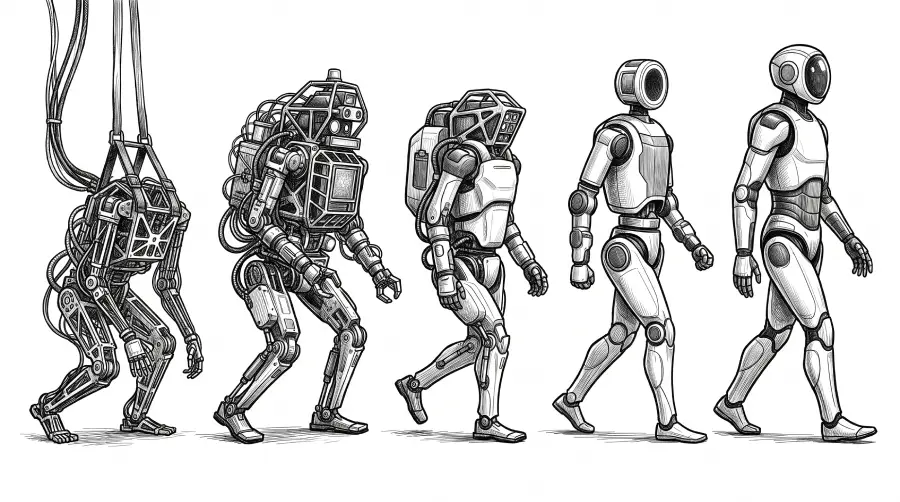
Witness the incredible evolution of the Boston Dynamics Atlas robot, from its 2009 Petman origins to the 2026 all-electric humanoid. This timeline details its journey through hydraulic and electric iterations, culminating in a production-ready robot with 56 degrees of freedom and Google DeepMind AI. See how it compares head-to-head against Tesla Optimus for industrial applications.
Strategic Pillar Context Maps
- Just as AI transforms robotics, understanding the strategies for LLM SEO is vital for modern search visibility.
- As AI-powered robots evolve, mastering AI Search with effective Answer Engine Optimization services becomes crucial for digital dominance.
- The rapid evolution of robotics mirrors the ongoing evolution of search strategy, from traditional SEO to AEO and GEO.
In 2009, Boston Dynamics unveiled Petman, a tethered military test dummy built to walk in chemical protection suits. By 2026, that research evolved into a production-ready, all-electric Atlas humanoid robot with 56 degrees of freedom, 360-degree rotating joints, and Google DeepMind AI ready to challenge Tesla Optimus on factory floors. Watch the complete evolution of Boston Dynamics robots from 2009 to 2026, then see how the 2026 electric Atlas stacks up head-to-head against Tesla Optimus.
Boston Dynamics Atlas vs. Tesla Optimus in 2026
- Boston Dynamics Atlas (2026 Production): Built for heavy industrial autonomy with 56 degrees of freedom, 50 kg (110 lb) peak lift capacity, IP67 weatherproofing, autonomous 3-minute battery swaps, and Google DeepMind Gemini Robotics AI inside Hyundai factories.
- Tesla Optimus (Gen 2 / Gen 3): Engineered for high-volume manufacturing scale, lighter 20 kg payload tasks, multi-actuator human-like hands, and end-to-end neural networks trained on Tesla’s FSD compute stack.
- The Bottom Line: Atlas wins on raw strength, agility, and immediate enterprise deployment; Optimus bets on mass-production economics. Jump to the full Atlas vs. Optimus comparison and video.
History of the Boston Dynamics Atlas Robot
- Petman (2009): Boston Dynamics’ First Bipedal Humanoid Prototype
- 2012 LS3 “Pack Mule”: Autonomous Quadruped Military Cargo Robot
- Atlas Robot (2013): Original DARPA Tethered Hydraulic Humanoid
- Atlas Robot Update (2013): Upgraded LIDAR Perception & Balance Control
- Atlas Robot (2015): “Atlas Unplugged” Untethered Battery-Powered Humanoid
- Spot Classic Robot (2015): Indoor & Outdoor Hydraulic Quadruped
- Atlas Robot (2016): Lightweight 3D-Printed Hydraulic Redesign
- Atlas Robot Update (2016): Single-Leg Dynamic Balance Demonstration
- Spot (Previously SpotMini) (2016): First All-Electric Quadruped Robot
- Atlas Robot (2017): Viral Standing Backflip & Box Jumps
- Atlas Robot (2018): Outdoor Trail Running & Log Leaping
- Atlas (2018): Multi-Tier Parkour Platform Bounding
- Atlas (2019): Gymnastic Parkour Routine & 360-Degree Spins
- Spot Launch (2019): Commercial Enterprise Quadruped Deployment
- Atlas Robot (2023): “Atlas Gets a Grip” Autonomous Manipulation & 540 Flip
- Atlas Robot (2024): Farewell to the Hydraulic Research Platform
- The All-New Atlas Robot (2024): Fully Electric Commercial Humanoid Debut
- Atlas Robot (2025): Autonomous Automotive Factory Parts Sorting
- Spot (2025): Orbit Fleet Management & AI Visual Anomaly Inspection
- Atlas Robot (2026 CES): Production Humanoid & Google DeepMind AI Partnership
- Atlas Robot (2026 Airborne): High-Impulse All-Electric Jumping & Landing
- Atlas Robot (2026 New Hands): Tactile Industrial Grippers with Palm Cameras
- Atlas Robot (2026 Wheels): Hybrid Wheeled Factory Material Transport
- Atlas Robot (2026 Viking Row): Synchronized Multi-Robot Fleet Coordination
- Atlas Robot (2026): Boston Dynamics & Hyundai Motor Group Metaplant Deployment
- Atlas Robot vs. Tesla Optimus: 2026 Specs & Capabilities Comparison
Petman 2009
Built for the U.S. Army to test chemical protection clothing, Petman was Boston Dynamics’ first anthropomorphic biped capable of balancing freely and walking with a natural heel-to-toe human gait at speeds up to 4.4 mph.
2012 LS3 (Legged Squad Support System) “Pack Mule”
A rugged quadruped designed for the U.S. Marine Corps to carry up to 400 pounds of gear across rough terrain for 20 miles while autonomously following troops via GPS and computer vision.
Boston Dynamics Atlas Robot 2013
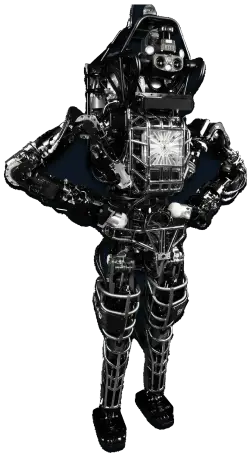
Unveiled for the DARPA Robotics Challenge, the original 6-foot-2, 330-pound hydraulic humanoid relied on an external power tether and off-board hydraulic pump to navigate disaster-response obstacle courses.
Boston Dynamics Atlas Robot Update 2013
Introduced upgraded sensor heads, refined stereo vision and LIDAR perception, and improved balance control so the tethered platform could handle debris, stairs, and uneven footing during DARPA trials.
Boston Dynamics Atlas Robot 2015 (New Update)
Rebuilt as “Atlas Unplugged,” this iteration shed its external tether by integrating an onboard 3.7 kWh lithium-ion battery pack and variable-pressure hydraulic pump into its backpack, with roughly 75% of the robot newly engineered.
Spot Classic Robot 2015
A 160-pound hydraulically actuated quadruped smaller and quieter than LS3, capable of climbing stairs, recovering from hard sideways kicks, and operating both indoors and outdoors.
Boston Dynamics Atlas Robot 2016
A dramatic redesign that shrank Atlas to 5 feet 9 inches and 180 pounds, featuring 3D-printed legs with embedded hydraulic lines that enabled graceful snow walking and autonomous box lifting.
Boston Dynamics Atlas Robot Update 2016
Demonstrated single-leg balancing on narrow wooden blocks and improved whole-body coordination, proving hydraulic humanoids could maintain dynamic equilibrium on minimal surface footprints.
Spot (Previously Spot Mini) 2016
Boston Dynamics’ first all-electric quadruped, weighing about 55 pounds (65 with its optional robotic arm) and running whisper-quiet for up to 90 minutes on a single battery charge.
Boston Dynamics Atlas Robot 2017
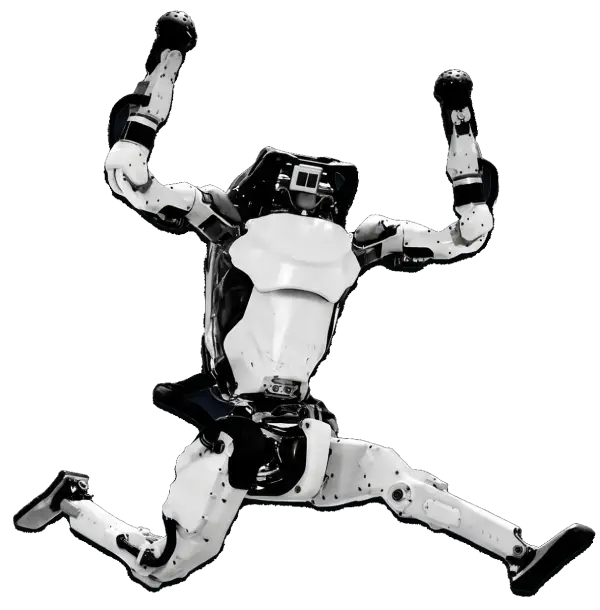
Made viral robotics history by executing synchronized box jumps, 180-degree mid-air spins, and a clean standing backflip using whole-body model predictive control.
Boston Dynamics Atlas Robot 2018
Transitioned from isolated stunts to continuous locomotion, jogging smoothly across grassy rolling terrain and leaping effortlessly over fallen logs without breaking stride.
Boston Dynamics Atlas Robot 2018 (Parkour)
Expanded dynamic mobility by bounding up a multi-tier set of 40 cm offset platforms in a single fluid sequence, requiring real-time footstep planning and full-body momentum control.
Boston Dynamics Atlas Robot 2019 (More Parkour)
Connected complex gymnastic movements into a seamless routine featuring handstands, forward rolls, split leaps, and 360-degree spins with an 80% success rate.
Spot Launch 2019
Marked Boston Dynamics’ commercial turning point as the bright yellow all-electric quadruped officially went on sale to businesses for industrial inspection, construction mapping, and public safety.
Atlas Robot 2023
Showcased real-world manipulation alongside parkour in the “Atlas Gets a Grip” demonstration, picking up heavy wooden planks, building a bridge, tossing a tool bag onto scaffolding, and finishing with an inverted 540-degree flip.
Atlas Robot (2024 – Farewell to Hydraulic Atlas)
Retired the iconic hydraulic research platform after more than a decade of breakthroughs with a retrospective highlight reel celebrating its falls, recoveries, and acrobatic milestones.
The All New Atlas Robot 2024
Debuted a sleek, fully electric commercial humanoid with a minimalist circular ring-light head, superhuman 360-degree joint rotation, and a stronger, wider range of motion unburdened by human anatomical limits.
Boston Dynamics Atlas Robot 2025
Transitioned from lab demos to autonomous factory workflows, showing the electric humanoid sorting automotive engine covers between mobile dollies and multi-tier storage bins using vision-language-action AI models.
Spot 2025
Expanded fleet intelligence with upgraded Orbit site-management software, AI-powered visual anomaly detection, and tighter integration into autonomous industrial plants alongside Hyundai facilities.
Atlas Robot 2026 CES
Made its public global stage debut at CES 2026 in Las Vegas, revealing the production-ready enterprise humanoid with 56 degrees of freedom, a 7.5-foot reach, 50 kg (110 lb) lift capacity, IP67 weather protection, and a Google DeepMind Gemini Robotics AI partnership.
Atlas Robot 2026 (Airborne)
Demonstrated high-impulse electric actuation and aerial attitude control, showing the all-electric platform launching off the ground and sticking stable landings without hydraulic accumulators.
Atlas Robot 2026 (New Hands)
Introduced rugged industrial grippers equipped with tactile finger and palm sensing plus integrated palm cameras for handling both heavy automotive components and delicate assembly parts.
Atlas Robot 2026 (Wheels)
Explored hybrid locomotion configurations pairing Atlas’s upper torso and manipulation capabilities with wheeled bases for high-speed, energy-efficient material transport across flat factory floors.
Atlas Robot 2026 (Viking Row)
Showcased synchronized multi-robot coordination and rhythmic upper-body power transfer, highlighting fleet-level balance, timing, and cooperative force control.
Atlas Robot 2026 (Boston Dynamics & Hyundai Motor Group)
Highlighted commercial deployment inside Hyundai Motor Group’s Metaplant facilities, combining Hyundai Mobis actuator manufacturing, Orbit fleet software, and autonomous 3-minute battery swapping for continuous multi-shift automotive assembly.
Atlas Robot vs. Tesla Optimus
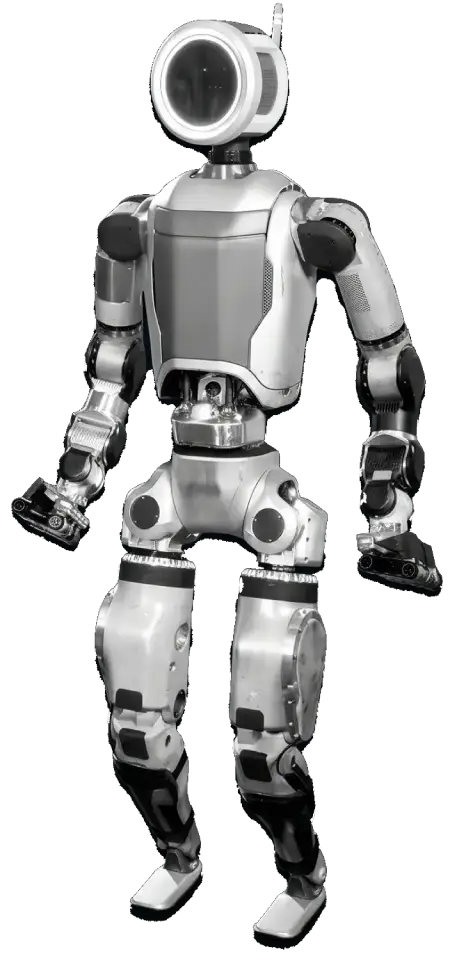
The biggest rivalry in 2026 humanoid robotics pits Boston Dynamics’ high-torque, 360-degree agile industrial workhorse against Tesla Optimus. While Boston Dynamics and Hyundai engineered the 2026 all-electric Atlas for heavy payloads, harsh environments, and continuous factory uptime, Tesla designed Optimus around lightweight efficiency, human-like finger dexterity, and mass-market EV supply chain scale.
| Spec & Capability | Boston Dynamics Atlas (2026 Electric) | Tesla Optimus (Gen 2 / Gen 3) |
|---|---|---|
| Degrees of Freedom | 56 total DoF with 360-degree rotating hip, waist, and neck joints | 28+ body DoF with human-style anatomical joint limits |
| Payload & Reach | 50 kg (110 lb) peak lift (30 kg sustained) and 2.3 m (7.5 ft) reach | Approximately 20 kg (45 lb) lift capacity |
| Hands & Manipulation | Tactile industrial grippers with palm cameras built for heavy assembly | 5-finger human-like hands (up to 22 DoF) optimized for fine dexterity |
| Power & Uptime | 4-hour runtime with autonomous 3-minute self-battery swapping | 2.3 kWh internal battery pack built for single-shift efficiency |
| AI & Control Stack | Model predictive control paired with Google DeepMind Gemini Robotics models | Vision-first end-to-end neural networks powered by Tesla FSD compute |
| Environment & Durability | IP67 water and dust resistant, rated from -20°C to 40°C | Designed primarily for climate-controlled indoor factory and commercial spaces |
| Manufacturing & Cost Strategy | Enterprise deployment with Hyundai Motor Group ($150K+ commercial tier) | High-volume Gigafactory mass production targeting $20,000 to $30,000 at scale |
Frequently Asked Questions: Boston Dynamics Atlas & Humanoid Robots (2026)
Which is stronger, the Boston Dynamics Atlas robot or Tesla Optimus?
The 2026 all-electric Boston Dynamics Atlas is significantly stronger, rated for a 50 kg (110 lb) peak lift and 30 kg sustained industrial payload with a 7.5-foot reach, compared to Tesla Optimus’s approximate 20 kg (45 lb) lift capacity.
When did Boston Dynamics switch Atlas from hydraulic to all-electric?
Boston Dynamics retired its hydraulic Atlas research platform in April 2024 and unveiled the all-new electric Atlas, which debuted in production-ready form at CES 2026 alongside Hyundai Motor Group and Google DeepMind.
How long can the 2026 electric Atlas robot run on a battery?
The 2026 production Atlas runs for roughly four hours per charge and features autonomous battery swapping, navigating to a charging station to exchange its own battery pack in under three minutes for continuous 24/7 factory operation.

Want to compare notes on something I wrote here or share your own perspective? Reach out directly via NateBal.com or connect on LinkedIn.