

A high-performing B2B service landing page is crucial for converting business visitors into qualified leads. This guide details how to build a lead-generating machine by focusing on architectural principles, user experience, and technical horsepower. Learn to address risk, clarify offers, and streamline the conversion path with outcome-driven headlines, social proof, minimized friction, and robust technical foundations, ensuring your page dominates modern search and drives pipeline revenue.
Strategic Pillar Context Maps

A high-performing b2b service landing page is the single hardest working asset in your marketing stack, yet most service businesses treat it like a digital business card that simply exists to list out capabilities.
If you run a B2B consultancy, agency, or specialized service firm, you already know the painful reality of modern web traffic. You spend real money on paid campaigns, grind out organic search rankings, or post daily on LinkedIn. Visitors click through, scroll for twelve seconds, hit the back button, and vanish forever into the ether.
Most business owners assume their pricing is off or their market is suddenly saturated. In reality, the issue is almost always architectural. Your visitors are interested, but your page is failing to lower their perceived risk, clarify your offer, and lead them smoothly toward a conversation.
Let us walk through how to build a modern, lead-generating machine from the ground up, complete with the technical horsepower and user experience principles required to make it actually perform.
What makes a B2B service landing page convert?
A high-converting B2B Service Landing Page converts by addressing risk, clarity, and decision-making for multiple stakeholders. Unlike B2C pages, it focuses on quantifiable business outcomes, strips all navigation distractions, displays verified social proof, and pairs low-friction forms with an explicit, single call to action.
Anatomy of a B2B Service Page
What Is a B2B Service Landing Page?
At its core, a dedicated b2b service landing page for business services is a standalone web page engineered around one singular objective: moving a qualified business buyer into a concrete sales interaction.
Unlike a generic homepage that serves ten different audiences with dozens of links, blog posts, and company news updates, this page acts with tunnel vision. It identifies a specific operational problem, outlines a tangible business outcome, proves that you can deliver that outcome, and asks the visitor to take one clear action.
Whether that action is scheduling a strategy session, requesting an engineering audit, or completing a scoping questionnaire, every paragraph, button, and visual asset on the page exists solely to facilitate that decision.
How to Create a High-Converting B2B Service Landing Page
Here is the exact step-by-step process required to build a page that turns business visitors into active pipeline:
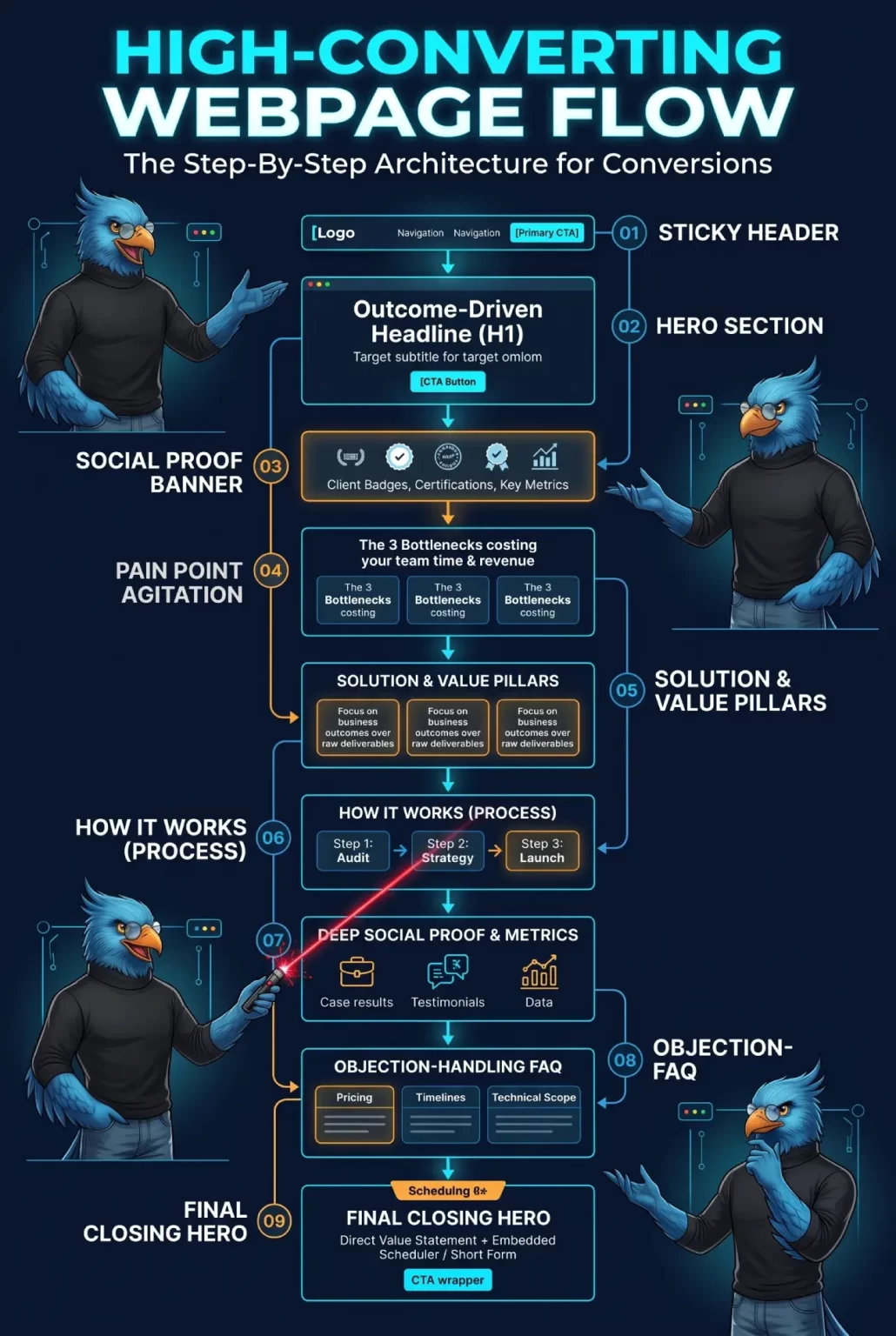
- State an outcome-driven headline: Communicate what your service achieves, who it is for, and the primary business transformation right at the top.
- Remove site navigation leaks: Strip away main menus, utility links, and footers to keep visitors focused on a single conversion path.
- Feature verifiable social proof: Position real client results, measurable ROI metrics, and buyer testimonials directly beneath the opening section.
- Map the solution to core pain points: Group your offerings into value pillars that directly address operational bottlenecks instead of raw tasks.
- Demystify the onboarding process: Lay out a three-step operational roadmap showing exactly what happens after booking.
- Minimize form friction: Limit initial inputs to essential qualifying fields or embed an automated calendar scheduler.
- Reinforce with risk-reversing FAQs: Answer common questions about pricing, project timelines, and technical requirements before the final call to action.
Anatomy of a B2B Service Landing Page That Actually Converts
When you strip away the subjective design trends of the month, successful B2B pages share a structural blueprint built on clarity and trust.
The Hero Section: Win or Lose in Five Seconds
The top fold of your page has one job: let the visitor know they are in the right room.
Business buyers are busy, impatient, and naturally skeptical. If your headline reads “Next-Generation Solutions for Forward-Thinking Enterprises,” you have lost them. That is corporate wallpaper. It says nothing, promises nothing, and solves nothing.
Your headline needs to follow a simple principle: State the clear outcome, name the audience, and address the primary obstacle.
- Weak Headline: Modern Web Development and SEO Services
- Strong Headline: Custom WordPress Engineering and AEO That Turns Search Traffic Into High-Value B2B Pipeline
Directly beneath that, your sub-headline should explain the mechanism. Who does the work, how does it function, and how fast can they expect results? Follow this immediately with your primary call to action button, accompanied by a piece of reassuring micro-copy such as “No pressure sales decks. Just actionable technical takeaways.”
The Proof Banner: Establishing Immediate Credibility
Before you start pitching your capabilities, validate your presence. Right beneath the hero container, display partner badges, recognized publications, or a concise strip of real outcomes.
If you are a solo practitioner or a specialized agency, you do not need Fortune 500 logos to look credible. Real data points work even better. Highlight stats like “100% Core Web Vitals Pass Rate,” “Average 2.4x Increase in Qualified Inbound Leads,” or “Sub-second Page Load Speeds.”
The Problem Agitation: Demonstrating Empathy
B2B buyers do not purchase services just because they like your portfolio. They purchase because something in their day-to-day operation is broken, slow, or burning cash.
Use this section to articulate two or three specific friction points your prospects deal with constantly:
- Development agencies that build flashy sites that crawl at a snail’s pace.
- SEO consultants who deliver dense spreadsheets of keywords without writing a single line of working code.
- UX designers who create artistic layouts that look great in a design mockup tool but utterly fail to convert business traffic.
When you describe a business owner’s problem more clearly than they can describe it themselves, they automatically assume you have the solution.
The Value Pillars: Outcomes Over Checklists
Avoid the temptation to list fifty tiny tasks you can perform. If you provide web development, do not waste prime page space talking about clean CSS or database normalization. Business owners do not care about syntax; they care about revenue, speed, and reliability.
Frame your deliverables as strategic pillars:
- Engineered for Speed: Building on lightweight foundations that secure top rankings and keep bounce rates near zero.
- Conversion-First UX: Structuring every template, click path, and layout to steer qualified prospects directly toward your sales calendar.
- Modern Search Visibility: Designing content and code architectures built for traditional search engines as well as generative AI answer platforms.
The Three-Step Process: Eliminating the Fear of the Unknown
Hiring an external service provider feels risky. Business owners worry about endless onboarding calls, blown budgets, and projects that drag on for six months without shipping.
You can vaporize this hesitation by showing a simple three-step timeline:
- Discovery and Technical Audit: We tear into your current setup, analyze user bottlenecks, and pinpoint exactly where you are losing revenue.
- Custom Implementation: We design, write, and build your custom solution without endless handoffs or communication black holes.
- Launch and Optimization: We deploy to production, verify every tracking pixel, and ensure performance metrics hit our target numbers.
Demystifying the engagement makes signing up feel manageable rather than daunting.
The Technical Engine Behind Conversions
You can craft the most compelling sales copy on earth, but if your page takes four seconds to load on a mobile device, your conversion rate is already ruined.
Speed is not just an arbitrary technical score; it is the silent killer of paid campaigns and organic search efforts alike. Research shows that every additional second of latency drops conversion rates by double-digit percentages.
A high-converting page requires rigorous engineering under the hood:
- Passing the Vitals: Meeting Google standards is non-negotiable. Dive deep into Google Core Web Vitals to understand how visual stability and browser responsiveness protect your bottom line.
- Diagnostic Audits: Regularly benchmark your templates using Google PageSpeed Insights to optimize website performance and catch bloated JavaScript libraries before they reach production.
- Targeted Speed Upgrades: If your current architecture is struggling under the weight of excessive plugins or unoptimized themes, deploying a dedicated performance speed accelerator package can instantly reclaim lost visitor interest.
- Measuring Bottom-Line Value: When pitching page speed improvements to your team, use the framework in how to calculate ROI of website speed optimization to tie technical improvements directly to pipeline revenue.
Beyond simple speed, modern visibility demands that your infrastructure supports next-generation search models. As business buyers shift their research habits toward large language models, setting up specialized Answer Engine Optimization services alongside custom AI web development ensures that your business gets cited, recommended, and surfaced by generative search engines when prospects look for industry authorities.
Real Questions Business Owners Ask About B2B Service Landing Page
When businesses invest in optimizing their service funnels, founders and marketing leads consistently run into the same strategic decisions. Here are clear answers to the most common questions:
What should the primary offer be if our service is complex or expensive?
If you sell a high-ticket B2B service running several thousand dollars a month, asking a stranger to “Buy Now” or “Sign a Contract” is an immediate non-starter. The commitment is simply too high.
At the same time, offering a generic “Free Consultation” often falls flat because visitors expect an aggressive, thirty-minute pitch deck disguised as advice.
The solution is to frame your initial offer around an objective, high-value asset with clear deliverables:
- A 20-minute Technical Discovery Review
- A Custom Growth and Architecture Teardown
- A Preliminary Scope and Feasibility Assessment
Give the interaction a defined agenda, promise zero sales pressure, and ensure the prospect walks away with valuable takeaways even if they never hire you.
Should we display our pricing on the B2B Service Landing Page?

This depends on your sales model, but for most service providers, a hybrid approach works best.
If your pricing is completely hidden, visitors assume you are prohibitively expensive or that you will quote them based on how deep their pockets look. If you display a single, rigid price, you risk eliminating prospects whose requirements fall just outside that specific box.
The winning strategy is to publish transparent starting rates or estimated project tiers (e.g., “Engagements typically start at $5,000” or “Monthly optimization sprints range from $2,500 to $6,000”). This instantly filters out unqualified tire-kickers who have a two-hundred-dollar budget, while assuring serious buyers that your pricing is grounded in reality.
Do we need separate B2B Service Landing Page for each vertical or persona?
If you are running paid search or targeted outbound campaigns, absolutely yes.
A generic page trying to speak simultaneously to medical practice managers, logistics directors, and B2B SaaS founders will end up appealing to none of them. The pain points of a logistics director (compliance, uptime, legacy software integrations) are entirely different from a venture-backed tech founder (pipeline velocity, developer productivity, scalable design systems).
You can keep your underlying page layout and technical stack identical, but tailor the headline, problem section, case studies, and terminology to match the exact search term or ad group driving the traffic.
What is considered an average or good conversion rate for B2B services?
For a high-ticket B2B service driving visitors directly to a calendar booking or a detailed project inquiry form, a conversion rate between 2.5% and 5% is a healthy baseline.
If you are seeing conversion rates below 1.5%, you likely have an alignment issue: your traffic quality does not match your offer, your page takes too long to load, or your messaging fails to communicate clear value.
Conversely, if you offer a low-friction asset like a specialized scoping calculator, benchmark report, or recorded audit, conversion rates can easily hit 10% to 15%. However, keep in mind that lower-friction leads require more downstream qualification before they turn into closed deals.
How long should the page be, short and punchy or long-form?
The rule of thumb for b2b service landing pages length is straightforward: page length should be directly proportional to the perceived risk of the purchase.
If you are asking someone to sign up for a free weekly newsletter, a short, three-paragraph page works wonders. When you are asking a business owner to trust you with their core web infrastructure, their search rankings, or five-figure service retainers, they require thorough answers.
They want to see proof, understand your process, evaluate your technical capabilities, read testimonials, and understand who is doing the work. For high-ticket B2B services, comprehensive long-form pages that address every lingering doubt will consistently outperform ultra-minimalist designs.
How many fields should be on the contact form?
Every unnecessary form field reduces your submission rate. For initial contact, stick to three or four critical inputs:
- First Name
- Work Email
- Company URL
- Primary Project Goal or Main Bottleneck
If you need deeper qualification data, like annual revenue or marketing budget, capture that on step two of your intake flow. Once a user enters their email and clicks submit, redirect them to a secondary questionnaire or a scheduling page. Even if they drop off on step two, you already captured their work email and can follow up directly.
Should we embed a calendar directly on the page?
Yes, provided it is implemented thoughtfully.

For high-intent visitors who are ready to talk immediately, an embedded calendar (such as Calendly or HubSpot Meetings) removes days of frustrating email back-and-forth. It lets them lock in a time while their interest is at its absolute peak.
To keep your page fast, do not load heavy third-party calendar scripts the moment the page starts rendering. Instead, load an image preview or a clean button that loads the interactive scheduler on click. This protects your Core Web Vitals while still giving qualified prospects an instant path to your calendar.
A high-converting B2B service landing page converts by addressing risk, clarity, and decision-making for multiple stakeholders. Unlike B2C pages, it focuses on quantifiable business outcomes, strips all navigation distractions, displays verified social proof, and pairs low-friction forms with an explicit, single call to action.
How do we route and qualify leads instantly to prevent pipeline drop-off?
In B2B sales, speed to response is everything. If a lead submits an inquiry and waits twenty-four hours to hear back, they have already reached out to two of your competitors.
Connect your form directly to your CRM using reliable webhooks. Trigger an immediate automated confirmation email that delivers value instantly, such as a case study or a short video explaining how your onboarding process works.
If a submission meets your ideal client criteria, route an alert straight to your phone or team Slack channel so you can follow up with a personal note within minutes.
What analytics metrics actually matter beyond raw form fills?
Tracking total submissions alone gives an incomplete picture of your marketing health. Vanity metrics can lead you to optimize for the wrong outcomes.
Focus on these four operational metrics instead:
| Metric | Why It Matters | Target Benchmark |
| Submission-to-Qualified Rate | Measures whether your copy is attracting the right buyers or just tire-kickers. | 60%+ of submissions meet ideal customer profile |
| Meeting Show-Up Rate | Evaluates calendar commitment and whether follow-up reminders are working. | 80%+ show-up rate on scheduled calls |
| Pipeline Value per Visitor | Divides total revenue in your sales pipeline by overall landing page traffic. | Steady upward trajectory month over month |
| Scroll Depth and Engagement | Identifies whether visitors are reading your case studies or dropping off at the hero. | 50%+ scroll depth past the primary value section |
Why Most Businesses Struggle to Build Pages That Work
If the fundamentals of l b2b service landing page design are well-documented, why are so many service pages completely ineffective?
The issue comes down to the traditional agency model. When a business decides to build a new page, they usually hire a graphic designer, a frontend developer, an SEO strategist, and a copywriter.
Here’s what happens next:
- The designer builds a gorgeous visual canvas that looks stunning on Dribbble, but ignores conversion paths and page speed.
- The developer takes that design and builds it using thirty different heavy libraries, wrecking performance scores.
- The SEO consultant shows up at the very end, realizes the page lacks proper headings, content structure, and technical markup, and tries to force keywords into places they do not belong.
- The copywriter writes clever slogans that win creative awards but fail to explain what the business actually does.
You end up with four different specialists pulling the project in four opposing directions. The final product looks pretty, runs slowly, and fails to generate leads.
To build an effective b2b service landing page, you need an integrated approach. You need someone who writes clean code, understands conversion psychology, designs functional user experiences, and builds content from day one to dominate both traditional search engines and AI answer engines.
How to Create a High-Converting B2B Service Landing Page
- State an outcome-driven headline: Communicate what your service achieves, who it is for, and the primary business transformation above the fold.
- Remove site navigation leaks: Strip away headers, footers, and non-essential outbound links to lock focus onto a single conversion goal.
- Feature verifiable social proof: Position client logos, specific ROI metrics, and buyer testimonials directly beneath the hero section.
- Map the solution to core pain points: Use 3–4 value pillars detailing how your process solves existing bottlenecks.
- Demystify the onboarding process: Display a 3-step operational roadmap showing what happens immediately after booking.
- Minimize form friction: Limit initial form fields to 3–4 essentials (Name, Work Email, Company URL) or embed an instant calendar picker.
- Reinforce with risk-reversing FAQs: Address pricing structures, timelines, and contract commitments before the final CTA.
Technical Checklist for Launch Day
Before you send a single visitor to your new page, run through this final operational checklist:
- ✅ Headline Verification: Does the H1 clearly state the outcome, the audience, and the mechanism within five seconds of reading?
- ✅ Navigation Removed: Have you eliminated the top navigation menu, search bars, and external blog links that give visitors an exit ramp?
- ✅ Performance Pass: Does the page score 90+ on mobile devices when tested in Google PageSpeed Insights?
- ✅ Mobile Touch Targets: Are all CTA buttons and form fields easy to tap with a thumb without accidental misclicks?
- ✅ Form Integration: Have you submitted a test inquiry to confirm that notifications fire instantly and data lands accurately in your CRM?
- ✅ Calendar Fallback: If using an embedded calendar, does it work smoothly across desktop, tablet, and mobile browsers?
- ✅ Social Proof Placement: Are metrics, client feedback, or credibility badges visible above the fold or immediately beneath it?
- ✅ Structured Data: Is your technical markup properly configured so search engines recognize your business credentials and services?
Transform Your Website Into a Consistent Pipeline Generator
Your website should not be a static brochure that sits quietly in the background while you scramble for referrals. When engineered correctly, it acts as an automated member of your sales team, educating prospects, answering objections, establishing authority, and booking calls around the clock.
If you are tired of juggling separate freelancers who pass the buck when leads fail to materialize, it is time for a unified approach.
I help growing service companies build blazing fast, high-converting digital assets that win in modern search results. By combining custom WordPress engineering, conversion-focused UX design, technical SEO, and modern answer engine optimization, I build complete systems that turn casual traffic into tangible business revenue.
Take the first step toward streamlining your digital presence and scaling your sales pipeline. Explore our specialized website performance packages or schedule a custom strategy session today by visiting NateBal.com.
CUSTOM AI WEB DEVELOPMENT
Is your website leaking high-value leads? Slow load speeds and outdated architecture don’t just frustrate prospects—they make you invisible to modern answer engines. I re-engineer your core WordPress platform with sub-second Core Web Vitals, conversion UX, and deep AEO to turn passive traffic into predictable pipeline.
