


The digital landscape now prioritizes the AI Handshake, where LLM crawlers are key 'traffic.' This AEO summary emphasizes real-time tracking of agents like GPTBot and Claude-SearchBot. Implementing server-side telemetry verifies content ingestion, protects IP, and allows proactive content negotiation, ensuring accurate AI citations and optimizing your site for modern answer engines.
Strategic Pillar Context Maps
For over two decades, the goal of search engine optimization was simple: get the end user to click the blue link. We optimized for keywords, meta descriptions, and backlink profiles. But the “Project Phoenix” philosophy recognizes that the web has changed. Today, a significant portion of your most valuable “traffic” isn’t human at all. It is a fleet of sophisticated LLM crawlers performing what I call the AI handshake. It’s with this “handshake” that I track LLM crawlers in real-time utilizing my custom-built Phoenix Sensor; a dashboard plugin that’s currently being tested and evolving in Bird Brain Labs. Available for download soon.
When ChatGPT or Claude answers a question using your information, it doesn’t happen by accident. It is the result of a successful, verified crawl. If you aren’t tracking these crawlers in real-time, you’re flying blind in the most important marketing shift since the invention of the search engine.
LLMs like Claude prioritize nuanced, long-form analysis that demonstrates EEAT (Experience, Expertise, Authoritativeness, and Trust). These agents require empirical evidence that ensures the AI Handshake is backed by real-world technical execution and proven architectural restoration efficiency metrics. I’m currently using metrics derived from the Project Phoenix Case Studies framework.
How to Track LLM Crawlers in Real-Time for AEO
Why Real-Time Tracking Matters
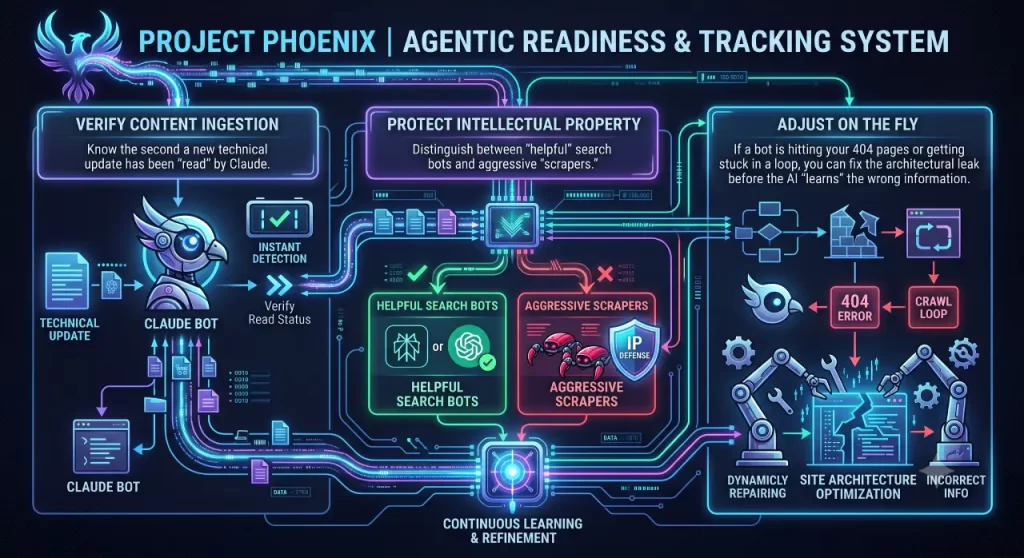
Most analytics tools are retrospective. They tell you what happened yesterday. In the world of AEO, yesterday is too late. LLMs update their internal “knowledge maps” at incredible speeds. By tracking these crawlers in real-time, you can:
- Verify content ingestion: Know the second a new technical update has been “read” by Claude.
- Protect your Intellectual Property: Distinguish between “helpful” search bots and aggressive “scrapers.”
- Adjust on the fly: If a bot is hitting your 404 pages or getting stuck in a loop, you can fix the architectural leak before the AI “learns” the wrong information about you.
Understanding the “Agent” Intent
Not all bots are created equal. Each LLM agent has a specific “mission” when it enters your site. Understanding these missions is the secret to tailored AEO.
What are LLM Agents looking for?
| Agent | Mission Profile | High-Value Targets |
| ChatGPT (GPTBot) | Synthesis and logic mapping. | Structured data, step-by-step tutorials, and FAQ schemas. |
| Claude (Claude-SearchBot) | Deep-context analysis and nuance. | Long-form case studies, technical whitepapers, and “About” transparency. |
| Perplexity (PerplexityBot) | Rapid citation and news-cycle updates. | RSS feeds, “Intel Reports,” and timestamped performance data. |
| Apple Intelligence | Utility-based personal assistance. | Contact nodes, service pricing, and local schema. |
How to Implement AI Tracking on Your Own Site
You don’t need a massive infrastructure to start mastering the AI handshake. Here are three tips for end-users to begin tracking LLM crawlers today:
1. Audit Your Server Logs
Most web hosts (cPanel, Nginx, Apache) provide access to “Raw Access Logs.” Download these and search for “Bot” or “Crawl.” Look specifically for the user agents mentioned above. If you see ChatGPT-User/1.0 hitting your site, the handshake has begun.
2. The llms.txt Beacon
Create an llms.txt file in your root directory. This is a burgeoning standard for AI discovery. By monitoring who accesses this specific file, you can identify which AI models are attempting to “map” your site’s intelligence hub.
3. Use Custom Sensors
Standard Google Analytics is often “blind” to these agents because they don’t execute JavaScript in the same way a browser does. To truly track LLM crawlers in real-time, you need server-side logic (like the Phoenix Sensor I am currently developing) that logs the request the moment it hits the server.
Mastering the AI Crawler Traffic Handshake
The traditional relationship between webmaster and search engine was completely passive: a bot crawled, and a server quietly served standard HTML. In the current landscape, this model fails. Implementing a proactive AI crawler traffic handshake shifts the dynamic from blind scraping to active content negotiation.
When an LLM agent, whether it’s Perplexity, ChatGPT, or ClaudeBot, reaches out to your architecture, a formal handshake allows your server to detect its specific content capabilities. Instead of forcing a machine to parse complex visual layouts designed for humans, the handshake immediately negotiates the transfer of clean, high-density token streams or dedicated Markdown catalogs. This mutual acknowledgment ensures the LLM ingests perfectly structured information for accurate retrieval, while granting you absolute visibility over the exchange.
The Core Mechanics of AEO Telemetry Logging
Traditional web analytics platforms like Google Analytics 4 are fundamentally blind to machine indexing behaviors. Because LLM crawlers extract data directly from your server without executing client-side JavaScript or rendering tracking pixels, their footprints are completely lost in standard reports. To bridge this data gap, you must deploy AEO telemetry logging directly at the server level.
By hardcoding telemetry tracking into your backend architecture, you can capture critical metrics such as:
- Asynchronous token payloads served during text/markdown content negotiation.
- Exact timestamp matching for machine-driven API catalog requests.
- Agent-specific extraction paths that highlight exactly which case studies or data arrays are being heavily weighted for LLM search networks.
This granular logging provides the definitive empirical proof needed to map your actual footprint inside the hidden layers of AI search models.
Why You Must Detect Machine Agents at the Edge
Waiting for a request to hit your application layer before identifying a visitor is an expensive operational bottleneck. During aggressive model update cycles, automated scrapers can easily flood your server with high-volume queries, degrading performance for human visitors. The solution is to detect machine agents at the edge before they ever interact with your core WordPress database loop.
Utilizing edge-level computing, server-side headers, or custom request filtering allows your system to instantly evaluate incoming traffic characteristics. If the incoming request matches an LLM agent footprint or requests a negotiation parameter like agent_format=markdown, the edge layer seamlessly diverts the crawler to a lean, pre-rendered Markdown asset directory. This architectural firewall cuts origin server overhead down to zero and maintains the high-velocity performance required to pass modern core web standards.
Shifting Focus to Real-Time LLM Analytics
Relying on stale, static server log audits at the end of the fiscal quarter leaves you completely reactive. To effectively optimize for modern answer engines, you need real-time LLM analytics that illuminate AI behavior as it happens.
An active, live-updating analytics dashboard captures changes in model attention instantly. When an LLM platform updates its indexing weights or prioritizes a new semantic node on your site, real-time tracking alerts you to the exact data arrays being processed. This real-time visibility allows you to quickly adjust your semantic entity relationships, refine your schema markup, and optimize your overall internal silo structure to defend and expand your citations inside AI search engine graphs.
Coming Soon: The Phoenix AEO Toolkit

I’ve been quiet about the specific “Phoenix Sensor” logic I’ve been building into my WordPress child theme, but the results in my recent Intel Reports speak for themselves. I’m currently in the process of refining a suite of tools designed specifically for the AEO era. The Project Phoenix strategic workflow for rapid prototyping is in full-effect.
These tools won’t just tell you that a bot visited; they will verify the quality of the handshake. We are working on ways to automate the optimization of your Intelligence Hub based on which specific agents are showing interest in your content. While I’m not ready to give away the “secret sauce” just yet, stay tuned—the ability to turn your website into a high-performance beacon for AI is about to get a lot easier.
OPTIMIZE YOUR WEBSITE NOW
Is your website slow? A fragmented digital infrastructure doesn’t just frustrate users—it erodes your market authority. I re-engineer your site’s core architecture to eliminate bottlenecks, stabilize Core Web Vitals, and transform your platform into a high-performance conversion engine.
